Resources
 Feature overview

 Alani
Alani 2026-06-03 11:19
In cross-border marketing, some accounts scale steadily, some get restricted after only a few days, and others trigger verification requests every time they log in. In many cases, the problem is not the product itself, but the "environment."
This is especially true when operating across multiple regions such as the United States, the United Kingdom, and Southeast Asia. Platforms are becoming increasingly strict in evaluating login environments, making IP addresses and browser environments critical factors affecting account security.
Today, we'll discuss how to leverage overseas proxy IPs for localized marketing strategies while avoiding common browser fingerprint detection risks.

1. Why Cross-Border Marketing Cannot Succeed Without Overseas Proxy IPs?
When running cross-border marketing campaigns, we often need to simulate user behavior in different countries or regions, such as the United States, the United Kingdom, and Southeast Asia. However, platforms use IP addresses to determine your actual location.
If you consistently use a domestic IP address to log in to overseas advertising accounts or social media accounts, you are likely to encounter frequent verification requests, advertising account restrictions, abnormal content distribution, or even account suspension.
This is where overseas proxy IPs become valuable. They help simulate a genuine local network environment, allowing the platform to perceive you as a legitimate local user.
2. Not All Overseas Proxy IPs Are Equal: Stability and Cleanliness Matter
One common mistake beginners make is purchasing cheap proxy IPs without considering quality, which often results in accounts getting restricted even faster.
1. IP Reputation and Cleanliness
Whenever possible, choose residential IPs or high-quality static IPs to avoid being flagged as a data-center IP.
2. Regional Consistency
For example, if you're targeting the U.S. market, consistently use a U.S.-based IP. Switching between New York today and Texas tomorrow can easily trigger suspicious activity alerts.
3. Long-Term Stability
Frequently changing IP addresses may be interpreted by platforms as abnormal login behavior, increasing account risk.
3. Common Cross-Border Marketing Risks and Solutions
| Common Issue | Symptoms | Possible Cause | Optimization Strategy |
|---|---|---|---|
| Frequent Account Verification | SMS or email verification required during login | Frequent IP changes or abnormal login activity | Use stable overseas proxy IPs and maintain a fixed region |
| Advertising Account Restrictions | Campaigns stop unexpectedly or fail review | Mismatch between browser environment and IP location | Align browser timezone, language, and IP region |
| Multi-Account Association | Multiple accounts identified as being operated by the same user | Identical browser fingerprints | Use isolated browser environments for each account |
| Traffic Decline | Significant reduction in content exposure | Flagged as abnormal traffic | Check browser fingerprints and IP quality |
| Store Approval Failure | E-commerce platform rejects the application | Inconsistent environment information or risky IP history | Replace with a clean proxy IP and reinitialize the environment |
4. Browser Environment Configuration Is More Often Overlooked Than IPs
Many people assume that having a proxy IP solves everything. In reality, another critical factor determines account security: the browser environment.
• Browser environment includes operating system details, screen resolution and fonts, timezone and language settings, cookies and cache status, and WebRTC information.
• If these parameters do not match the IP location—for example, a U.S. IP combined with a Chinese timezone and domestic font environment—the system can immediately identify the inconsistency.
Therefore, in cross-border marketing, IP location should match browser timezone, browser language should match the target country's language, and device information should appear natural while avoiding frequent environment resets.
5. Browser Fingerprinting: The Invisible Barrier Every Cross-Border Operator Must Face
Most platforms today use browser fingerprinting technologies, which are often more sophisticated than IP analysis. They can identify Canvas fingerprints, WebGL information, font lists, plugin environments, and hardware parameters.
In other words, even if you switch to a different overseas proxy IP, an abnormal or identical browser fingerprint can still reveal that the same person is operating multiple accounts.
In practical cross-border marketing scenarios, issues such as account association, bulk advertising account bans, store matrix detection, and traffic drops are common. As a result, more teams are adopting environment isolation strategies for account management.
6. The Practical Role of ToDetect in Environment Testing
Before managing accounts or launching campaigns, many teams use tools like ToDetect to assess browser environments. Its primary functions include:
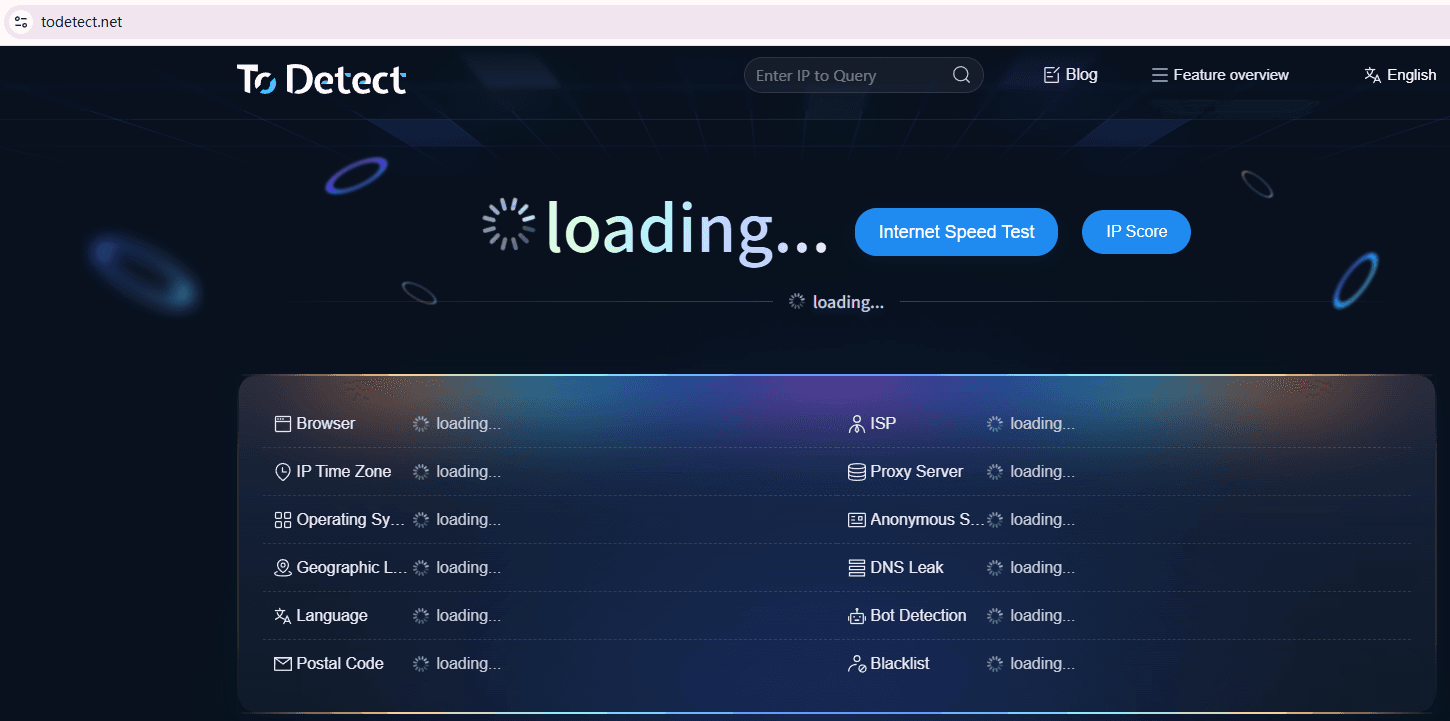
• Detecting browser fingerprint exposure
• Evaluating whether the IP matches the environment
• Simulating platform risk-control perspectives
• Identifying potential risks before they become problems
Rather than waiting until an account gets suspended, use tools to predict risks in advance. For teams operating multiple accounts, it's advisable to run an environment check before deploying each new setup.
7. Practical Strategy: A Complete Cross-Border Marketing Setup
If you plan to build a long-term overseas business, consider the following combination:
• Overseas proxy IPs + fixed-region strategy. Avoid constantly switching countries; assign one region per account.
• Independent browser environments (environment isolation). Give each account its own fingerprint profile to prevent contamination.
• Regularly use tools like ToDetect to monitor environmental risks before issues occur.
• Localized content operations. Not only should the IP be local, but your content should also reflect local language, holidays, and consumer behavior.
8. Frequently Asked Questions (FAQ)
1. Why do accounts still get suspended even when using overseas proxy IPs?
Because platforms do not rely solely on IP addresses. They also evaluate browser fingerprints and environmental consistency. IPs are only the foundation; consistency is the key.
2. Do I need a fixed IP for cross-border marketing?
If you operate long-term accounts such as advertising accounts or social media matrices, using a fixed-region proxy IP is highly recommended. Frequent IP changes can trigger risk-control systems due to apparent location hopping.
3. How sensitive is browser fingerprint detection? Does it really affect account security?
Extremely sensitive. Many platforms identify devices through Canvas fingerprints, WebGL data, fonts, and other browser attributes. Even with a different IP address, an identical browser fingerprint can still lead to account association or restrictions.
4. Is a tool like ToDetect really necessary?
If you manage multiple accounts or run advertising campaigns, the answer is yes. It helps identify browser-environment risks before accounts go live, effectively providing a preventive "health check" against platform risk controls.
Conclusion
The real challenge in cross-border marketing is not whether traffic exists, but whether you can obtain it consistently over the long term.
Many marketers focus only on overseas proxy IPs while overlooking browser environments, fingerprint detection, and platform risk-control logic. As a result, accounts become unstable, advertising costs increase, and access to marketing channels may eventually be lost.
If you're currently running a cross-border business or preparing to enter overseas markets, building a reliable underlying environment from the beginning may be the most important step toward long-term success.