Resources
 Feature overview

 browser
 2026-05-28 10:49
It's not as intuitive as cookies, nor as easy to understand as IP addresses, but it plays an increasingly central role in modern browser fingerprinting systems. It is called — Canvas Fingerprint.
Especially in scenarios like cross-border e-commerce and overseas social media operations, Canvas Fingerprint detection has almost become an "invisible standard" for platform risk control.
Today, let's break down: What exactly is Canvas Fingerprint detection, why do overseas platforms use it, and how can we leverage it for cross-border marketing.
1. What is Canvas Fingerprint?
Canvas Fingerprint is a type of browser fingerprint. Different devices, operating systems, graphics cards, and font environments produce slightly different details in rendered images.
These differences combined can form a relatively unique "device identifier," which is the Canvas Fingerprint. So even if you clear cookies or change IP addresses, as long as the Canvas Fingerprint remains the same, the system may still recognize it as "the same person."

2. How Canvas Fingerprint Detection Works
Canvas Fingerprint detection involves reading and analyzing the Canvas rendering features of a browser and generating a unique or highly unique identifier.
The main process: the browser executes a piece of Canvas drawing code → generates image content (e.g., text, shapes, gradients) → reads pixel data or hash value → compares it with the fingerprints in the database.
If you switch between different accounts but the Canvas Fingerprint is the same, it can easily be judged as "associated accounts." This is why it is especially important in risk control.
3. Why Cross-Border E-commerce and Overseas Platforms Use It
1. Core Problem in Cross-Border E-commerce: Multiple Accounts and Risk Evasion
Anyone in cross-border e-commerce is aware of a reality: many business models inherently involve "multi-account operations."
• For example: a single seller managing multiple stores (inventory matrix), testing different ad creatives via multiple accounts, operating in different regions (US, EU, SEA), or using backup accounts to prevent main account downtime.
• However, platforms do not want the same person controlling too many accounts. Risk control systems therefore check whether accounts are related. Canvas Fingerprint detection is an important tool for this.
2. Changing IP Alone Is No Longer Enough
Early on, people thought "change IP = change identity," but that's no longer the case.
• The risk control logic of overseas platforms has become multidimensional: IP address (basic layer), device info (system, resolution), browser fingerprint (core layer), Canvas fingerprint (high-weight signal), WebGL/fonts/timezone as supplementary information.
• Canvas Fingerprint is considered a "low-noise, high-stability signal," meaning that once matched, the confidence is very high. So even if you change IP or clear cache, if the Canvas Fingerprint hasn't changed, the system may still recognize you as the same person.
3. Overseas Platforms Rely More on “Invisible Identity Recognition”
• Platforms like Amazon, eBay, Walmart, TikTok Shop face bulk sellers, fraudulent accounts, bot registrations, fake orders, and arbitrage behaviors. Just using account credentials and IP addresses is not enough for risk control.
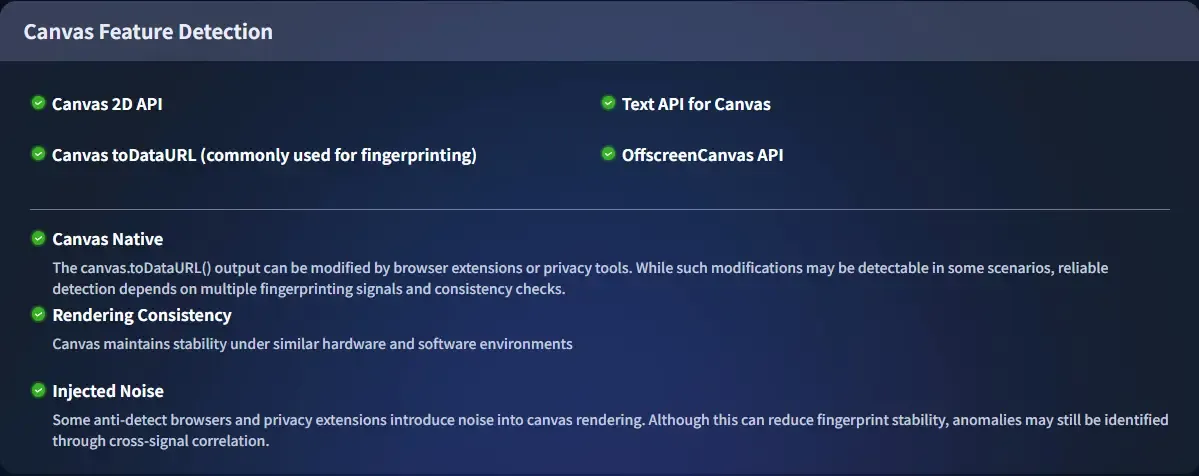
• Platforms prefer "invisible recognition technology," which is the browser fingerprint system, where Canvas Fingerprint is a key component.
It is imperceptible to users (collected silently), independent of login state, trackable across browsers, stable, and difficult to reset, making it highly useful in risk control systems.
4. Preventing Automated Attacks and Fraud
• Another important reason is the increasing automation and fraud attacks, such as bulk account registration, fake reviews, automated orders, bots logging in and nurturing accounts.
• These behaviors often use VPS, emulators, fingerprint browsers, or automation scripts. Canvas Fingerprint detection can identify whether the environment is consistent or belongs to the same batch of generated devices.
Many bulk tools can change IPs, but Canvas rendering details are hard to randomize naturally, creating a loophole for risk control detection.
5. Improving Risk Control Accuracy and Reducing False Positives
From a platform perspective, false positives are costly. Relying only on IP or login behavior can easily affect legitimate users.
• Adding Canvas Fingerprint detection improves account association accuracy, reduces false positives, and makes risk control more refined.
• Simply put: Canvas Fingerprint changes the process from "guessing who the user is" to "closer to knowing who the user is."
6. Cross-Border Industry Environment Is Naturally High-Risk
The reliance on Canvas Fingerprint detection is also related to the industry characteristics.
• Account value is high (a store may be a primary source of income), platform rules are strict (risk control frequently enforced), operations across multiple regions are complex (IP, timezone, language differences), competition is fierce (fake transactions and arbitrage are common). In such an environment, any identifiable dimension is heavily utilized.
• Thus, Canvas Fingerprint, browser fingerprint detection, and tools like ToDetect have naturally become basic infrastructure that operators monitor daily.
4. Comparing the Role of Canvas Fingerprint in Different Scenarios
| Application Scenario | Use of Canvas Fingerprint | Main Purpose | Risk Level |
|---|---|---|---|
| Cross-Border E-commerce Multi-Account Operations | High Frequency | Prevent account association, distinguish device environments | Medium-High |
| Advertising (Facebook / Google Ads) | High Frequency | Identify abnormal logins and fraudulent behavior | High |
| Payment and Financial Systems | Used | Prevent fraud and identity theft | High |
| General Website Analytics | Limited Use | User behavior analysis and statistics | Low |
| Privacy-Focused Browsers | Counteract / Avoid | Reduce tracking probability | Medium |
5. What Canvas Fingerprint Tools Can Do
Many Canvas Fingerprint tools on the market essentially detect whether your current browser's Canvas Fingerprint is unique and simulate or modify the Canvas rendering environment to make the fingerprint "clean."
These tools usually also include full browser fingerprint detection features, such as WebGL fingerprinting, font fingerprinting, resolution and system info analysis. Some tools even provide a comprehensive score to determine how easily your browser can be recognized.
6. The Role of ToDetect in Fingerprint Detection
Among many tools, ToDetect is a commonly used browser fingerprint detection platform.
Its main function is to help users quickly check whether the current Canvas Fingerprint is unique, whether the browser fingerprint has anomalies, and whether it can easily be recognized as the same device by platforms.
For cross-border e-commerce and ad operators, the value lies in "early warning," i.e., assessing whether the environment is safe before logging in officially.
Many users simply want to avoid their accounts being flagged by risk control as soon as they log in.
7. Risks and Controversies of Canvas Fingerprint Detection
Canvas Fingerprint is highly stable, so once used for long-term tracking, it is difficult for users to completely remove the device identifier through conventional means.
Because Canvas Fingerprint does not rely on cookies or local storage, in some cases it can identify devices without explicit user consent.
Browser fingerprinting collects multi-dimensional information, and overuse may result in cross-site user behavior correlation. In cross-border e-commerce or ad risk control, false positives may occur, misidentifying legitimate users as associated accounts.
Privacy advocacy groups consider Canvas Fingerprint as "hidden tracking technology," with low transparency and user awareness. Rendering differences across browsers and devices may also cause fingerprint fluctuations, affecting detection stability.
Summary: Canvas Fingerprint Has Become an “Invisible Barrier”
For ordinary users, it may just be a technical concept, but for cross-border e-commerce sellers and overseas social media teams, it can directly impact account survival, ad stability, and business costs.
Therefore, more people are paying attention to Canvas Fingerprint detection. The ToDetect platform essentially helps users identify environmental risks early, avoiding being flagged as abnormal before starting operations.
In the future internet environment, "identity recognition" will not stop at the account level but will extend to browsers, devices, and even rendering behaviors.