Resources
 Feature overview

 Charles
 2026-04-29 11:23
You may have enabled a proxy, switched nodes, or even carefully configured your proxy environment—but there might still be a detail quietly “giving you away” — that is DNS leaks.
Nowadays, many platforms have increasingly sophisticated risk control systems. They don’t just look at IP addresses, but also combine DNS resolution paths, browser fingerprint detection, and other multidimensional data for evaluation.
Next, let’s walk through what DNS leaks are, why DNS leak detection matters, and which stable and free online detection tools are available in 2026.

1. What Is a DNS Leak? Why It Matters
A DNS leak means that when you visit a website, your domain name resolution request does not go through your proxy tunnel, but instead goes directly through your local network.
DNS leaks can expose your real IP location, allow ISPs or network providers to log your browsing behavior, and may cause abnormal access issues on certain platforms (especially for cross-border operations).
Therefore, performing a DNS leak test before starting cross-border business is highly recommended.
2. DNS Leak Detection vs DNS Leak Testing: What’s the Difference?
Many people use “DNS leak detection” and “DNS leak testing” interchangeably, but they can be understood as:
• DNS Leak Detection: Focuses on the result (whether a leak exists)
• DNS Leak Testing: Focuses on the process (request paths, server info, etc.)
A complete DNS leak detection typically includes:
• DNS server location
• DNS request source
• Whether it matches your current proxy IP
• Whether there are abnormal resolution paths
If the results show your DNS server is still from your local ISP, it can generally be concluded that a DNS leak exists.
3. Stable DNS Leak Detection Tools in 2026 (DNS Leak Detection Tools)
1. ToDetect: All-in-One Detection Tool (Highly Recommended)
The advantage of ToDetect is that it not only performs DNS leak detection, but also integrates browser fingerprint detection, IP environment analysis, WebRTC testing, and more.
In other words, it not only tells you whether your DNS is leaking, but also evaluates whether your overall network environment looks like a “real user.”
Suitable for cross-border account operations (anti-linking), multi-account management, risk control testing, and privacy-focused users.
2. Other Common DNS Leak Testing Tools (Supplementary)
In addition to ToDetect, some platforms can also be used as supplements:
• DNS Leak Test platforms (basic checks)
• IP checking platforms (with DNS info)
However, note that most of these tools only provide single-dimensional DNS leak testing and lack comprehensive environment analysis. A combined tool like ToDetect is recommended.
4. Key Considerations for Cross-Border DNS Leak Testing (Common Pitfalls)
1. Don’t Test Only Once: Results May Be “False Safe”
Many users perform a single DNS leak test and assume everything is fine if the result looks normal.
In reality, DNS resolution paths can change over time, different platforms may use different DNS servers, and network fluctuations can affect results.
A safer approach is to test at least 2–3 times, switch nodes, and use multiple tools for cross-verification (such as ToDetect).
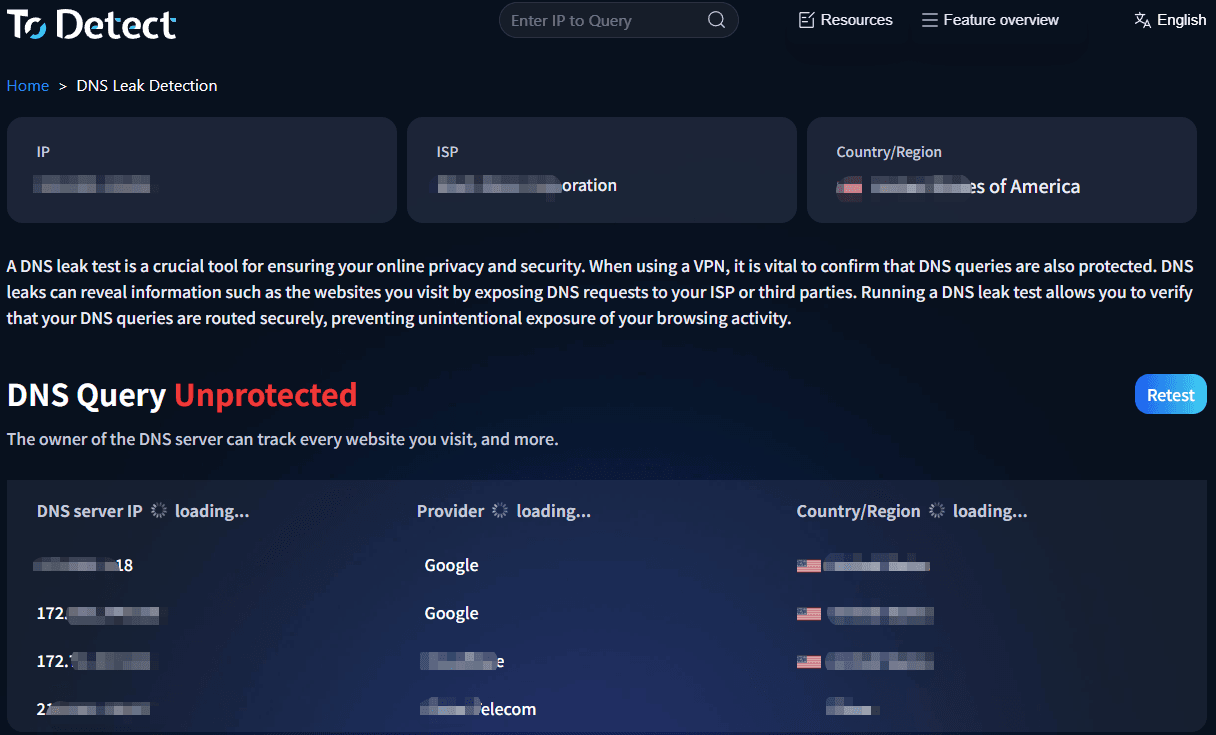
2. Check Whether DNS Location Matches IP Location
This is one of the key indicators of DNS leaks.
For example, if your IP shows the United States but your DNS server is in China, it is very likely a DNS leak.
When using ToDetect, focus on DNS server country, ASN information, and whether it belongs to a local ISP.
3. Clear Browser Cache Before Testing
Many people overlook this, leading to inaccurate results.
The reason is that browsers may cache DNS records, making results appear normal.
It is recommended to clear cache, use incognito mode, or switch browsers. Combine with browser fingerprint testing for better accuracy.
4. Don’t Ignore Browser Fingerprint Detection
DNS leak testing alone is not enough. Some users may have no DNS leaks but still expose identifiable browser fingerprints.
For example, an overseas IP with localized fonts/language or mismatched timezone can affect privacy and account safety.
It is recommended to use ToDetect for combined DNS + browser fingerprint analysis, focusing on overall environment consistency rather than a single metric.
5. Different Proxy Tools Handle DNS Differently
Not all proxies properly handle DNS requests—this is critical.
Common issues include: proxying traffic only (not DNS), using system default DNS (prone to leaks), or routing DNS through local gateways.
Therefore, test each proxy tool individually, test different nodes, and re-test after updates.
6. Mobile vs Broadband: Results May Differ
Many users only test on desktop and ignore device differences.
Mobile (4G/5G) DNS paths may differ, WiFi and wired networks behave differently, and ISPs use different resolution strategies.
It is recommended to test across multiple devices (desktop + mobile) and networks (WiFi / mobile data) to ensure accurate results.
5. How to Prevent Cross-Border DNS Leaks? Practical Tips
Detection is just the first step—the real goal is prevention.
1. Use Proxy Tools with DNS Protection
Not all proxies prevent DNS leaks. Make sure they support DNS encryption, custom DNS settings, and have leak protection features.
2. Manually Set Secure DNS
Consider using public encrypted DNS, such as DoH / DoT (DNS over HTTPS / TLS), to reduce ISP interception risks.
3. Disable WebRTC (Prevent Real IP Exposure)
Many browsers enable WebRTC by default, which may leak your real IP. Disable it via plugins or use privacy-focused browsers.
4. Perform Regular DNS Leak Testing
Network environments are dynamic. Test after changing proxies, regularly use ToDetect for full checks, and monitor DNS server changes.
Final Thoughts:
Today’s network environment is no longer just about IP addresses. From DNS resolution to browser fingerprinting, every detail can become a clue that exposes you.
Don’t rely on a single tool—use comprehensive platforms like ToDetect to regularly check DNS, IP, and browser fingerprint indicators.
If you are involved in cross-border operations or care about privacy, it’s recommended to perform a full DNS leak test now. Detecting issues early can significantly reduce costs.