Resources
 Feature overview

 Charles
 2026-07-11 11:42
Many people encounter a very easily overlooked issue when using overseas network proxies or setting up a proxy environment — DNS leakage.
When checking whether a proxy is secure, many only focus on IP detection results, but neglect the crucial step of DNS detection. As a result, many proxy environments appear normal on the surface but actually carry DNS leak risks.
Today, let’s walk through why overseas network proxies can cause DNS leaks, how to tell if your proxy environment has a DNS leak, and what methods you can use to fix it if a leak has already occurred.

1. What is DNS leakage and why does it happen even with a proxy?
If you are using an overseas network proxy, DNS requests should also be resolved through the DNS server provided by the proxy, so that your real network information stays hidden. However, if DNS requests bypass the proxy and are sent directly to your local ISP’s DNS server, a DNS leak occurs.
There are several causes of DNS leaks. Common situations include:
First, the system default DNS does not change with the proxy. Many proxy software only forward network traffic and do not automatically modify the system DNS configuration.
Second, browsers have their own independent DNS resolution mechanisms. For example, some browsers enable DoH (DNS over HTTPS), which bypasses the system DNS settings.
Third, incomplete proxy protocol configuration. Some HTTP proxies, SOCKS proxies, or self‑built proxy environments only proxy web traffic but do not handle DNS requests.
Fourth, network adapter priority issues in systems like Windows and macOS. This can cause DNS requests to be sent through other network interfaces. Therefore, even if the proxy IP has been successfully switched, it does not mean the network environment is completely safe.
2. How to determine if a proxy environment has a DNS leak?
The most direct way to confirm whether a proxy environment is secure is to perform a DNS leak test. Common DNS leak testing methods include:
Use a professional DNS leak test website
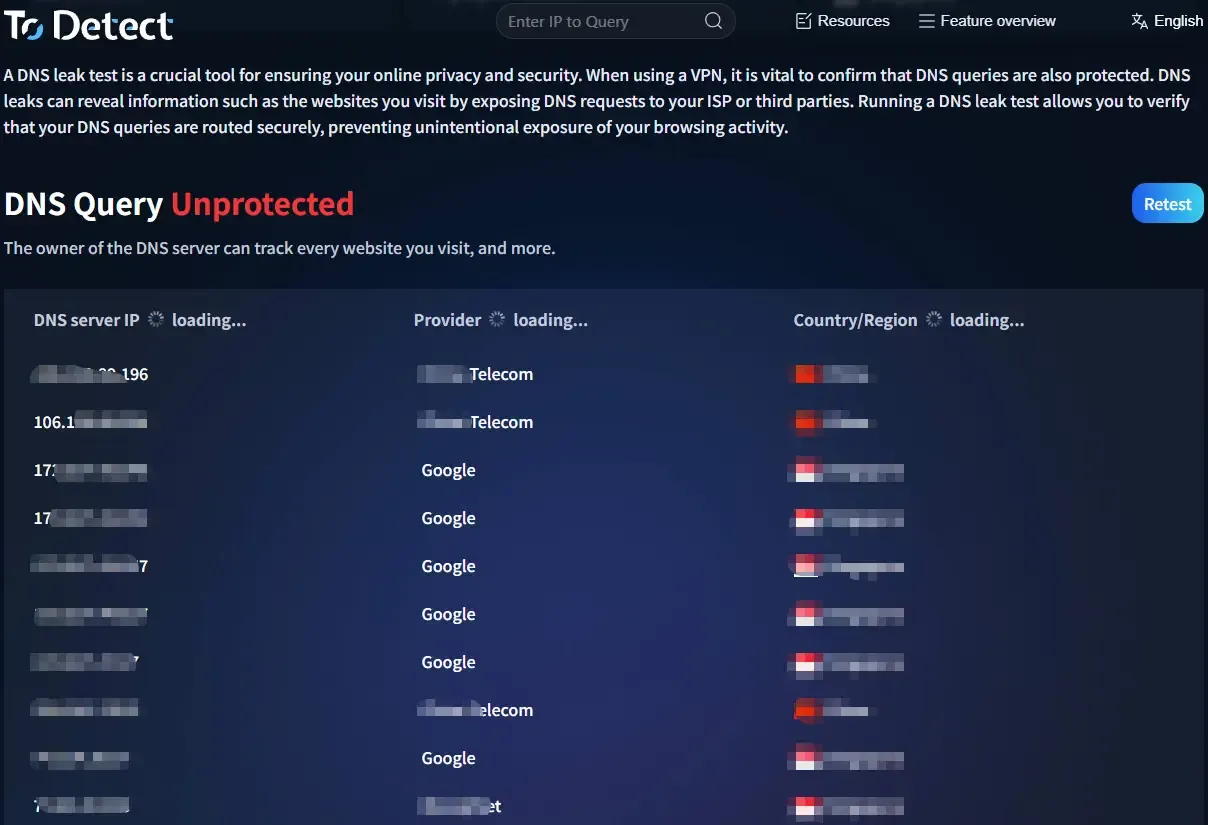
Open a DNS leak test tool and let it automatically query your current DNS server information. If the DNS server belongs to your local network provider rather than the proxy provider, it means a DNS leak still exists in your proxy environment.
Test with different network environments
Some DNS leaks only occur in specific network environments, such as home broadband, corporate networks, or mobile hotspots. Testing different network connections separately can help pinpoint the source of the problem.
Check your browser DNS settings
Some users only focus on proxy software settings but ignore the browser’s internal configuration. Go to your browser’s privacy and security settings and check whether Secure DNS is enabled.
Many users now use tools like ToDetect for DNS leak detection, which checks the DNS request path to identify anomalies in the proxy environment.