Resources
 Feature overview

 Ganesh
 2026-06-17 11:29
In 2026 risk control systems, an IP address is no longer just a “network address,” but a critical factor that directly affects whether an account can be used, an order can pass, or ads can run successfully.
However, the same IP can show completely different results across platforms—some label it safe, while others mark it as high risk. So what IP risk score is actually considered safe?
In this article, we will clearly explain the mainstream IP lookup logic in 2026, risk score standards, and practical evaluation methods, so you can confidently interpret any IP result.

1. What Is an IP Risk Score? Don’t Be Intimidated by the Number
An IP risk score is a “trustworthiness rating” calculated by risk control systems based on multiple factors, including IP lookup data, device environment, historical behavior, geographic location, and blacklist records. When using online IP lookup tools (such as ToDetect), you may see:
• Risk score: 0–100
• Risk level: Low / Medium / High
• Associated risk tags: proxy IP, data center IP, abnormal login, etc.
It is important to note that IP risk scores are not standardized globally. Different platforms use different algorithms, so a single number should not be used as an absolute judgment of safety.
2. Common IP Risk Score Ranges in 2026 (Industry Reference)
Although systems vary, mainstream risk control platforms (e-commerce, advertising, and payment industries) generally interpret scores as follows:
1. 0–20: Low Risk (Generally Safe)
Typical residential IPs with normal behavior and no abnormal history. Suitable for registration, login, browsing, and payments. This is considered the “trusted user” range.
2. 21–50: Low to Medium Risk (Monitor Required)
May involve mobile networks, dynamic IPs, or frequent network switching. Behavior may appear slightly abnormal but not blacklisted. Usable but unstable.
3. 51–75: Medium to High Risk (Use Cautiously)
May indicate proxy usage, multi-account behavior, or higher probability of data center IPs. Likely to be flagged in advertising or registration scenarios.
4. 76–100: High Risk (Strict Control)
Matches blacklist records, proxy/crawler patterns, or known fraudulent activity. Most platforms will restrict or block access.
3. IP Risk Score Requirements by Business Scenario (2026 Practical Guide)
| Business Scenario | Recommended IP Risk Range | Recommended IP Type | Risk Control Focus | Common Failure Reasons |
|---|---|---|---|---|
| Account Registration / Login | 0–30 | Residential IP / Mobile IP | Proxy detection, frequent registrations | Flagged IP, mass registrations in short time |
| Social Account Farming | 0–25 | Stable Residential IP | Behavior consistency, login stability | Frequent IP switching, device fingerprint changes |
| E-commerce Browsing / Cart | 0–40 | Residential IP preferred | Natural browsing behavior | Too fast actions, bulk abnormal behavior |
| Cross-border E-commerce Orders | 0–20 | High-quality Residential IP | Payment authenticity | Mismatch between IP and shipping location |
| Advertising / Account Operations | 0–30 | Dedicated Residential IP | Historical reputation, geo consistency | Bad IP history or shared contamination |
| API Calls / Data Scraping | 0–50 (dynamic) | Residential / Low-risk Proxy IP | Request rate, IP stability | High frequency requests leading to bans |
| Sensitive Operations (Password Change / Withdrawal) | 0–15 | Clean Residential IP | Security verification level | Abnormal IP or cross-region login |
4. Key Factors Affecting IP Risk (Often Ignored)
1. IP Type
Different IP types have different baseline trust levels. Residential IPs are usually the most stable and safest, while data center and proxy IPs are more likely to be flagged as high risk.
2. Historical Behavior
If an IP was previously used for spam, fake registrations, or abnormal activity, it will be recorded in risk control databases and will have a higher risk score later.
3. Geographic Anomalies
If the IP’s location differs significantly from the actual user environment, systems may consider it suspicious and increase the risk score.
4. Device & Behavioral Fingerprinting
Beyond IP itself, systems also analyze browser fingerprints, device info, and behavior patterns. Inconsistency or frequent changes increase risk.
5. Role of Tools like ToDetect in IP Detection
Many users rely on ToDetect for IP checking, mainly for:
• Checking whether an IP is blacklisted
• Detecting proxy usage
• Getting risk scores
• Identifying IP type (residential / data center / mobile)
These tools are valuable for quick risk assessment, especially before account registration, e-commerce operations, or cross-border business activities.
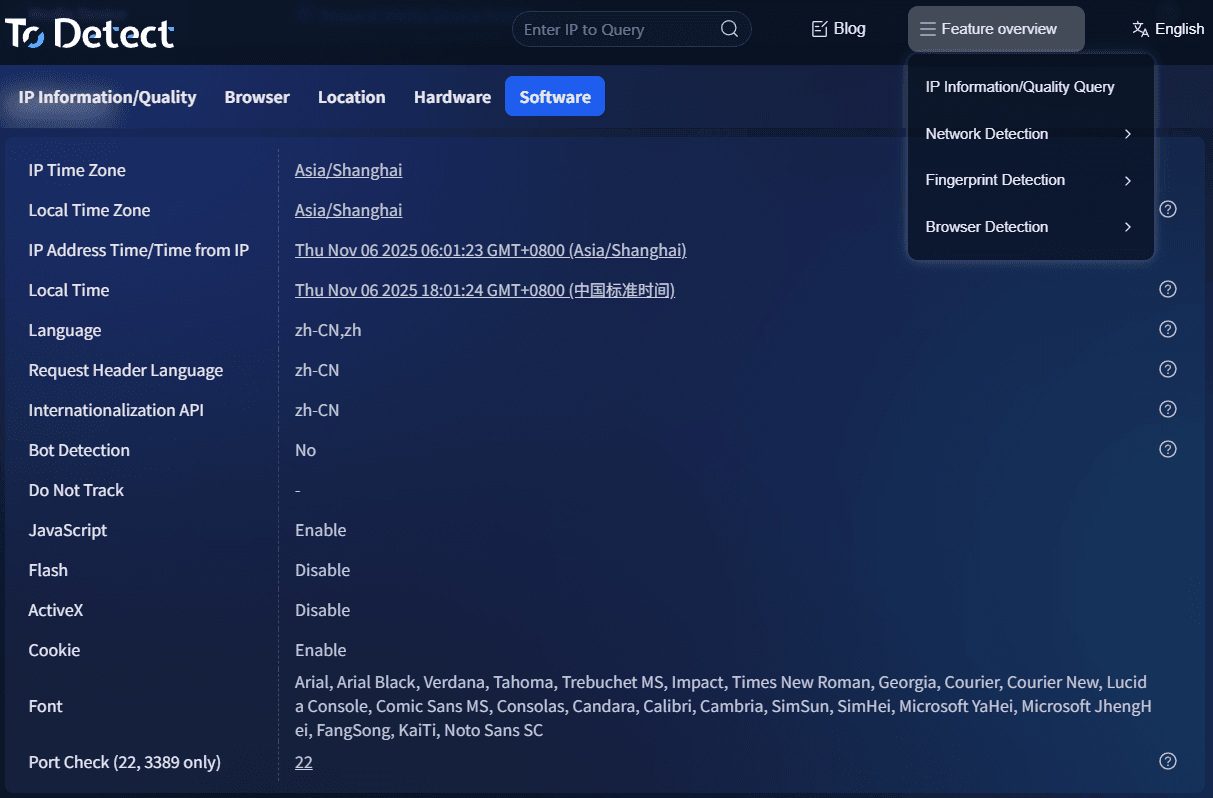
However, these tools provide probability-based risk estimates, not final decisions. A low score does not guarantee safety, and a high score does not always mean failure.
6. FAQ: Common Questions About Online IP Risk Checking in 2026
Q1: Can I still register an account if my IP risk score is around 50?
Usually it is “usable but unstable.” Some platforms may require SMS or additional verification. Below 30 is generally safer.
Q2: Why does my normal network still show high risk in IP checks?
The IP may have been used by many users before or belongs to a data center/proxy network. Historical records can affect the score even if current behavior is normal.
Q3: If ToDetect shows low risk, does that guarantee no risk control issues?
No. Low risk only indicates lower probability. Platforms still evaluate device fingerprints and behavior patterns.
Q4: Is residential IP always safer than proxy IP?
Generally yes, but a polluted or misused residential IP can still be considered high risk.
Conclusion
In 2026 risk control systems, whether using online IP lookup tools or platforms like ToDetect, evaluation has become highly comprehensive. Single metrics are less meaningful than before.
Many people focus only on the score, but the real determinants are IP type, historical behavior, device environment, and usage context.
There is no absolutely “safe” IP. The IP risk score is just a warning signal. What truly determines account stability is the overall usage strategy.