Resources
 Feature overview
2025 Year-End Review: In-Depth Analysis of Top Browser Fingerprint Detection
 bonnie
 2025-11-24 04:16


Browser fingerprint detection tools are used to identify the device characteristics exposed by browsers when accessing web pages and analyze the uniqueness and stability of these characteristics.
These tools utilize system configuration, hardware parameters, network features, and rendering results to help users understand whether their browsing environment is consistent and whether there are any unusual discrepancies.
Below, we introduce several practical browser fingerprint detection platforms in 2025 and their feature evaluations.
1. ToDetect
Overview
ToDetect is a browser fingerprint detection platform with a Chinese interface, supporting real-time detection and visual report display. It analyzes multiple parameters to let users understand the match between the current browser environment and the actual device configuration.

Main Detection Items
System parameters: operating system, browser version, language, time zone, etc.
Graphics and audio fingerprints: Canvas, WebGL, AudioContext
Fonts, plugins, network characteristics
Resolution, proxy identifiers, fingerprint stability analysis
Features
Fast detection, simple page structure, clear result presentation
Generates detailed parameter lists in reports and highlights key features with charts
Helps evaluate environment completeness and consistency
2. BrowserLeaks
Overview
BrowserLeaks is an early comprehensive detection website, providing multi-dimensional analysis from system to script layers.

Detection Modules
Browser information, plugins, network interfaces
Graphics rendering, time zone, and language
Features
Large number of output parameters, comprehensive information
Results displayed in sections, convenient for technical comparison
No automatic scoring provided; users must manually evaluate fingerprint differences
More suitable for technically skilled users, ideal for in-depth analysis or script verification
3. AmIUnique
Overview
AmIUnique, developed by the University of Toulouse in France, focuses on analyzing the uniqueness of browser fingerprints.

Detection Results
Parameter list
Comparison with sample database
Uniqueness ratio of the browser among global samples
Features
Helps users understand how rare their browser fingerprint is
Clear result structure and simple operation
Suitable for fingerprint research and educational purposes
4. Cover Your Tracks (formerly Panopticlick)
Overview
Launched by the Electronic Frontier Foundation (EFF), mainly for privacy protection detection.

Detection Items
Whether anti-fingerprinting features are enabled
Fingerprint uniqueness
Ad tracking protection test
Features
Results are presented as “trackable or not”
Suitable for privacy-conscious users to quickly evaluate browser performance
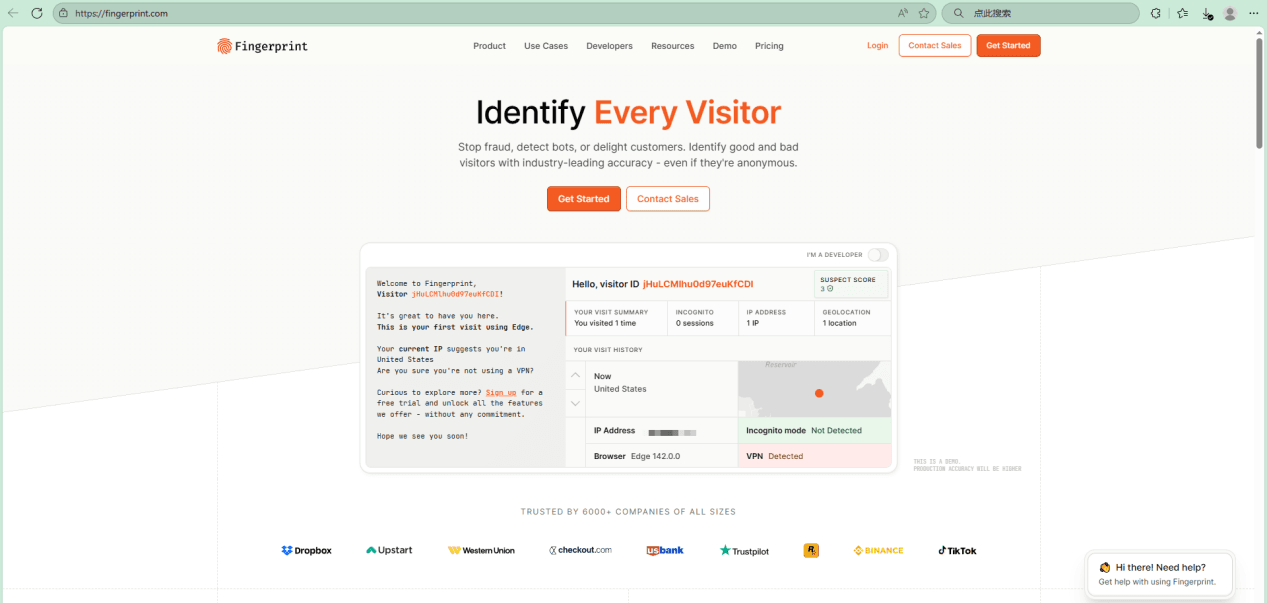
5. FingerprintJS
Overview
FingerprintJS is the official demo platform for the open-source fingerprint recognition library, primarily demonstrating the recognition algorithm's generation effect.
Detection Items
Browser and system parameters
Canvas and Audio fingerprints
Network configuration and language settings
Features
Geared towards developer testing
Results are structured hash data; does not provide privacy analysis
6. CreepJS
Overview
CreepJS is a community-maintained deep fingerprint detection project, offering very comprehensive detection.

Main Detection Scope
Canvas, WebGL, AudioContext fingerprints
GPU details and refresh rate
Mathematical precision errors and anti-aliasing performance
Font rendering differences
Features
Large output of information, suitable for low-level difference analysis
Detection process is relatively long and requires higher device performance
7. Browser Fingerprint Tool Feature Comparison
| Tool Name | Main Purpose | Detection Dimensions | Language | Suitable Users |
|---|---|---|---|---|
| ToDetect | Detection and visual reports | Extremely comprehensive | Multilingual | General users / developers / tech professionals |
| BrowserLeaks | Technical detection and parameter analysis | Comprehensive | English | Technical staff, researchers |
| AmIUnique | Uniqueness research | Medium | English / French | Researchers, general users |
| Cover Your Tracks | Privacy protection evaluation | Medium | English | Privacy-conscious users |
| FingerprintJS | Algorithm demo and developer testing | Medium | English | Developers |
| CreepJS | Deep research and detailed detection | Comprehensive | English | Security researchers |
Conclusion
Different browser fingerprint detection tools, based on their own recognition logic and data collection methods, display varying scopes and structures of information:
Some tools focus on detecting low-level parameter completeness
Some focus on fingerprint uniqueness statistics
Some specialize in visual reports or privacy protection performance
When analyzing detection results, users should consider the specific dimensions displayed by the tools, such as system configuration, rendering data, and network identifiers. This information reflects the match between the browser and system environment and provides reference for subsequent adjustments or verification.
 AD
AD