Resources
 Feature overview

 Ganesh
 2026-07-08 11:36
When conducting cross-border business and building overseas social media account matrices, many users are concerned about whether the IP they use is clean, whether it is a residential IP, and whether it has been identified by platforms as a data center IP.
A seemingly ordinary network IP may actually correspond to a residential broadband connection, a data center server, or even a high-risk proxy node that has already been used by many people.
Today, we will explain whether online IP lookup tools can identify data center IPs, what data should be checked during proxy IP detection, and what simple and effective methods can be used to answer the common question: "How can I identify a data center IP?"

1. What is Online IP Lookup? What information can it detect?
Simply put, online IP lookup is a tool that allows users to enter an IP address and check the network information associated with it. Common IP lookup tools can detect basic data such as the IP's country, region, ISP, ASN information, and network type.
For ordinary users, IP lookup is mainly used to confirm whether their network location is normal. However, for cross-border account operators, IP lookup has greater value because it helps determine whether the IP environment meets platform requirements.
However, it should be noted that not all online IP lookup tools can determine IP type with 100% accuracy. Different databases have different coverage, and detection results may vary. Therefore, multiple dimensions should be combined for analysis.
2. Can Online IP Lookup Detect Data Center IPs?
This is one of the most frequently asked questions among cross-border users: Can online IP lookup detect data center IPs? The answer is yes, but accuracy cannot be guaranteed completely. Online IP lookup can help determine whether an IP may be a data center IP through the following aspects:
First, check the IP organization. If the result shows that the IP belongs to cloud computing platforms or data center service providers, such as cloud server companies or IDC operators, it is highly likely to be a data center IP.
Second, check ASN information. ASN can be understood as an identifier for network operators. Residential broadband IPs usually belong to local ISPs, while data center IPs are generally associated with hosting networks.
Third, check IP type labels. Some professional IP detection tools directly indicate: Datacenter; Residential; Proxy; Hosting. If the result shows Datacenter, the IP can basically be identified as a data center IP.
3. Comparison of Different IP Types for Cross-Border Account Operations
| IP Type | Network Source | Common Use Cases | Account Operation Risks | Suitable for Cross-Border Account Management? |
|---|---|---|---|---|
| Data Center IP | IDC data centers, cloud server nodes | Server access, program testing, automated tasks | More likely to be identified by platforms as a non-real-user network, with stricter risk control on some platforms | Suitable for short-term testing, but not recommended for long-term operation of high-value accounts |
| Static Residential IP | Real home broadband networks | Store management, social media operations, advertising account management | Highly stable, but usually more expensive than regular proxy IPs | Suitable for long-term use with fixed accounts |
| Dynamic Residential IP | Rotating residential network pools | Data collection, market research, multi-region access | Frequent IP changes require proper control of switching frequency | Suitable for businesses requiring multiple regional network environments |
| Mobile Network IP | Mobile carrier base station networks | Mobile app testing, localized access | Highly authentic, but resources are more expensive and stability depends on the carrier | Suitable for scenarios requiring higher network authenticity |
| Shared VPN IP | Shared exits used by multiple users | General internet access, privacy protection | The same IP may be used by many people and can be affected by previous user activities | Not recommended for important commercial accounts |
4. How to Identify a Data Center IP? Several Simple Methods
Many beginners ask: "How can I identify a data center IP? Can it be determined just by looking at the IP address?" In reality, identifying a data center IP mainly depends on the following aspects:
1. Check the IP Ownership Organization
This is the most direct method. If the IP lookup result shows that the IP belongs to companies such as Amazon AWS, Google Cloud, Microsoft Azure, DigitalOcean, OVH, or other data center providers, the probability that it is a data center network is relatively high.
Residential IPs usually show local telecommunications providers, broadband operators, or cable network providers.
2. Use Proxy IP Detection Tools
Professional proxy IP detection tools do more than check basic IP information. They combine multiple databases to determine whether an IP is using a proxy, whether it is a VPN exit node, whether it belongs to a data center, whether it appears on blacklists, and whether it has a history of suspicious usage.
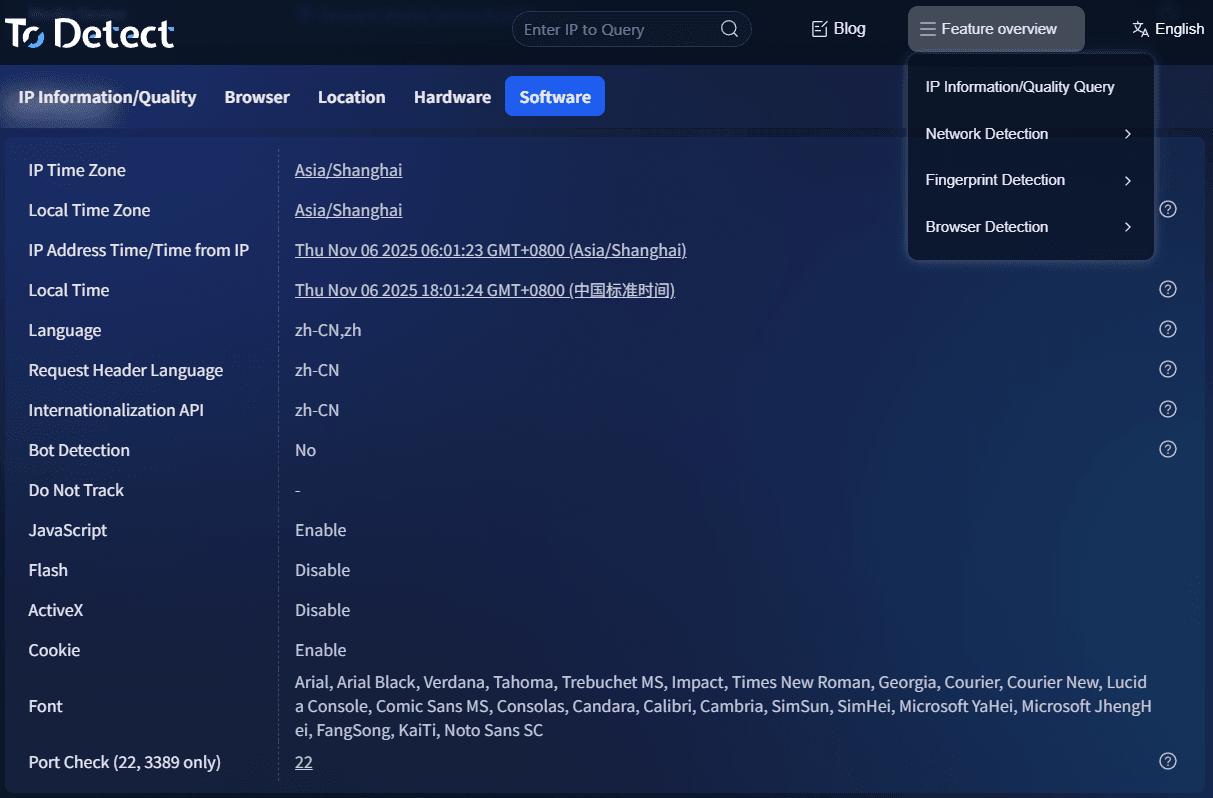
Services like ToDetect can help users evaluate IP quality from multiple dimensions. For users who need to operate overseas accounts for a long period, this type of detection is more comprehensive than ordinary IP lookup.
3. Check the IP Risk Score
If an IP has previously been used by a large number of accounts or has experienced abnormal access behavior, it may still have a low trust level even if it is not an obvious data center IP. Therefore, cross-border account operations should not only focus on whether an IP is a data center IP, but also whether the IP is clean and trustworthy.
5. Why Are Data Center IPs a Concern for Cross-Border Account Operations?
Many people believe that if an IP can successfully access overseas websites, there should be no problem. However, international platforms are becoming increasingly strict in evaluating account environments.
Taking overseas social media platforms as an example, they usually analyze multiple factors, including login IP, device fingerprint, browser environment, user behavior, and consistency between location information and account details.
If an account continuously uses a data center IP while its profile information indicates a normal residential user location, the platform may consider the environment abnormal.
This may result in new account registration failures, frequent verification requests during login, reduced account trust levels, difficulties during advertising account reviews, or account feature restrictions. Especially when operating multiple accounts, sharing the same data center IP among multiple accounts can make it easier to trigger platform risk controls.
6. Are Proxy IPs Always Safe? Do Not Ignore IP Quality
A proxy IP does not automatically mean it is a safe IP. There are many types of proxy IPs on the market, including data center proxy IPs, static residential IPs, dynamic residential IPs, and mobile network IPs.
Among them, data center proxy IPs are inexpensive and fast, but they are easier for platforms to identify. Residential proxy IPs are closer to real user network environments, which makes them more widely used in cross-border business operations.
When choosing proxy IP services, users should not only consider price but also pay attention to factors such as whether the IP is dedicated, whether its history is clean, whether it has been widely used by others, whether it supports the target country or region, and whether it can pass IP detection.
Before purchasing proxy services, users can first test sample IPs through online IP lookup or proxy IP detection tools to avoid purchasing high-risk resources.
7. How to Reduce IP Risks During Cross-Border Account Operations?
To reduce IP-related risks, you can start with the following aspects:
First, maintain a stable account environment. Avoid frequently changing IP countries and regions. For example, if a US-based account uses a US IP today and suddenly switches to a European IP tomorrow, it may trigger abnormal activity detection.
Second, avoid sharing the same IP among multiple users. Especially when operating multiple accounts, shared IPs may create associations between accounts.
Third, perform regular IP checks. During account operation, users can use IP lookup tools to monitor the current IP status and confirm whether the location, ISP, and risk level are normal.
Finally, choose reliable IP detection tools. Professional platforms such as ToDetect can help determine IP type and risk level, allowing users to understand the network environment before using proxy IPs.
Conclusion
The IP environment has become an important factor affecting account security. Online IP lookup can help users understand basic IP information and assist in determining whether an IP belongs to a data center. However, for more accurate results, additional methods such as proxy IP detection and IP reputation analysis are also required.
When answering the question "How can I identify a data center IP?", the key factors are IP ownership, ASN information, network type, and risk history. Do not assume that an IP is reliable simply because it can access overseas websites. A truly suitable IP for long-term account operation should have characteristics such as stability, authenticity, and low risk.
As cross-border operations become increasingly dependent on network environments, performing IP lookup and risk detection in advance can reduce account issues and make future operations more stable.