Resources
 Feature overview
Cross-Border Beginners: Must-Know IP Lookup and Detection Basics
 Ganesh
 2026-04-08 03:50


Why can some people run cross-border e-commerce accounts steadily for years, while others get banned frequently or trigger reviews at every turn?
Most account issues are not caused by “surface-level reasons,” but by problems with the environment. The core lies in IP address lookup, IP detection, and browser fingerprint detection—this entire risk control identification system.
Today, let’s talk about how crucial IP addresses are in cross-border e-commerce risk control, and what IP lookup and detection issues beginners must understand in advance.

1. Why has the IP address become the core of risk control?
Although platforms cannot “see who you are,” they can determine whether you behave like a normal user through data. Among these, the IP address is one of the most basic and direct identification dimensions.
Here’s a common scenario:
• The same account logs in from the United States today, Southeast Asia tomorrow, and Europe the day after — this kind of behavior appears highly abnormal to the platform.
• Or multiple accounts share the same IP, frequently switch IPs without a reasonable pattern, or use a previously flagged “blacklisted IP.”
These situations are easily detected by the system. So whether your IP is clean or not directly affects the survival of your account.
2. The role of IP address lookup in real-world risk control
Many sellers ask: What exactly can IP address lookup do for me?
1. Check whether the IP location is reasonable
Through online IP lookup tools, you can quickly find out:
• The country/city of the IP
• Whether it matches your account registration location
• Whether it aligns with normal usage behavior
For example, if you operate in the US market but your IP shows up in a “high-risk region,” you should be cautious.
2. Detect whether the IP is contaminated (blacklist issues)
Many people overlook this, but it’s actually critical. Professional IP detection can help determine:
• Whether it is a data center IP
• Whether it is flagged as a proxy/VPN
• Whether it has a history of abuse
Once an IP is contaminated, your account may still be penalized even if your operations are compliant.
3. Assist in identifying account association risks
• Platforms don’t just evaluate a single account—they also perform “association analysis.”
• If multiple accounts use the same IP or overlapping IP ranges, or frequently log in across each other, they are easily identified as being operated by the same person.
That’s why experienced sellers emphasize: one account per IP, with independent environments whenever possible.
3. IP detection ≠ everything, browser fingerprinting is equally important
If you think everything is fine as long as your IP is okay, that’s a bit naive.
Modern risk control systems have evolved from single IP checks to multi-dimensional identification. Browser fingerprints include a lot of information, such as:
• Operating system
• Browser version
• Screen resolution
• Font list
• WebGL information
• Timezone and language
These data points together form a “unique device identifier.”
In other words, even if you change your IP, the platform can still recognize you if your device fingerprint remains the same.
4. Why use ToDetect tools?
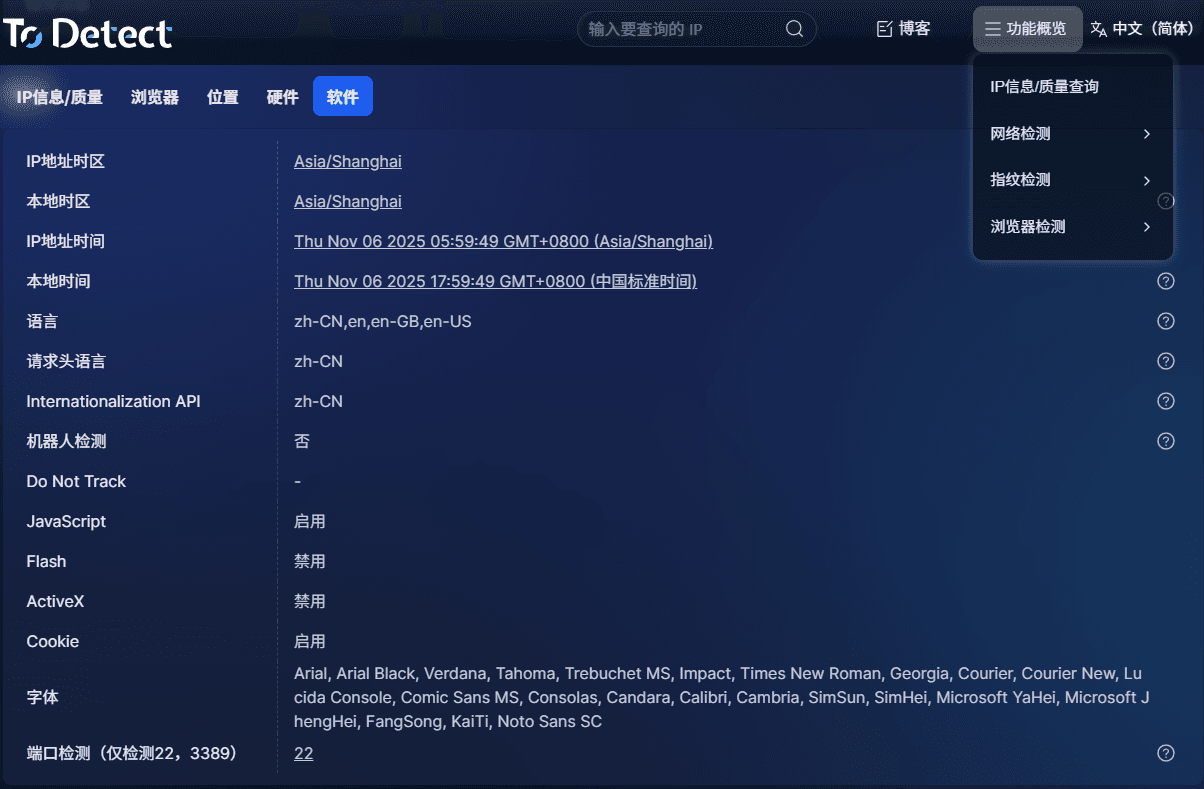
1. One-stop environment security detection
You can simultaneously check whether your IP is clean, whether there are proxy traces, and whether your browser fingerprint is abnormal—without switching between multiple tools.
2. Identify hidden risks in advance
In many cases, the problem isn’t your actions but the environment itself. For example:
• The IP appears normal but is identified as a data center IP
• Browser fingerprint leakage exists
• Inconsistent environment parameters
These can all be detected early through fingerprint analysis.
3. Suitable for multi-account management scenarios
If you manage multiple stores, operate account matrices, or run cross-platform businesses, ToDetect helps isolate environments and reduce association risks.
5. Online IP lookup common misconceptions
To be honest, many people only have a partial understanding here and often fall into common traps.
Misconception 1: Any IP tool will work
Many free or low-quality IP tools use shared IPs, are already flagged by platforms, and lack stability. Using such IPs can actually be more dangerous.
Misconception 2: Frequently switching IPs is safer
In fact, the opposite is true. Frequent IP switching is more likely to trigger abnormal behavior detection. Normal users typically have relatively stable IPs.
Misconception 3: Ignoring browser fingerprints
Only checking IP addresses without fingerprint detection is incomplete. Modern risk control systems rely on both “IP + fingerprint.”
6. Practical tips: How to reduce platform risk control?
1. Use stable and independent IPs
Choose residential IPs or high-quality proxies, avoid sharing, and keep usage in a fixed region.
2. Perform regular IP checks
Use online IP lookup and detection tools regularly to check for contamination, abnormal jumps, or proxy identification.
3. Combine with browser fingerprint isolation
Use independent browser environments, avoid sharing device configurations across accounts, and regularly test environment consistency with ToDetect.
4. Make behavior “look human”
This is crucial: avoid frequent logins/logouts in short periods, avoid frequent cross-region switching, and maintain natural usage patterns.
Platforms are getting smarter—“acting too fake” is easier to detect.
Summary in one sentence
Cross-border e-commerce risk control is essentially a game between you and the platform.
A truly safe account environment requires a clean and stable IP (verified through online IP lookup and detection) and a consistent device environment (optimized through browser fingerprint detection).
From basic online IP lookup to in-depth environment checks, and then to refined detection using ToDetect tools, every step helps reduce the probability of being flagged by risk control systems.
 AD
AD