Resources
 Feature overview

 Ganesh
 2026-07-09 11:28
IP addresses are like the “identity cards” of devices on the internet. Some businesses need a long-term stable fixed identity, while others require a more flexible and changing network environment. These needs correspond to what we commonly call static IPs and dynamic IPs.
When choosing an IP type, many people simply follow recommendations without truly understanding their own requirements. In fact, by using online IP lookup tools to check the current IP status and combining the results with business needs, it becomes easier to choose the right solution.
Next, we will explain the differences between static IPs and dynamic IPs, their applicable scenarios, and detection methods, helping you quickly determine which IP type better suits your needs and avoid business disruptions caused by choosing the wrong IP.

1. What is Static IP ? Why do many businesses need a fixed IP?
A static IP is a permanently fixed IP address. Once a device or server connects to the internet, it continues to use the same public IP address without changing after reconnecting or restarting.
For example, if a company builds its own server and needs employees to access it remotely for a long time, or if an international business team needs stable access to overseas platforms, a fixed IP is usually more suitable. The biggest advantage of a static IP is stability.
For websites, remote monitoring systems, email servers, and other services, IP address changes may interrupt normal operations. Using a static IP ensures that the access address remains valid for a long period and improves business continuity.
Before using a static IP, it is recommended to check IP quality through a static IP lookup tool, including IP location, ISP information, whether it belongs to a data center network, and whether it has risk labels.
2. What is a Dynamic IP? What are its advantages?
A dynamic IP refers to an IP address automatically assigned by the internet service provider whenever a device connects to the network. Most home broadband and mobile networks use dynamic IPs.
For example, after disconnecting and reconnecting home broadband, the public IP may change. When a mobile phone switches network environments, the corresponding IP may also be different. This automatic changing process is called a dynamic IP, and its biggest advantages are low cost and high flexibility.
For ordinary users, browsing websites, watching videos, and daily office work do not require a fixed IP. Dynamic IPs can fully meet these needs. In some situations, continuously changing IPs can also reduce restrictions caused by long-term use of a single IP.
If you want to know whether your current IP changes dynamically, you can use a dynamic IP detection tool to monitor whether the IP address changes over a period of time.
3. What are the key differences between Static IP and Dynamic IP?
Many people understand the basic concepts of both, but still find it difficult to choose the right one. Below are the main differences from several perspectives.
1. Whether the IP address is fixed
Static IPs remain unchanged for a long time and are suitable for scenarios requiring a fixed network identity, such as server access, enterprise systems, and remote connections.
Dynamic IPs change with network connections and are more suitable for normal internet usage, temporary access, and users who do not require high IP stability.
2. Differences in stability
Static IPs provide stronger stability. If you operate a website, manage servers, or need others to access your devices through an IP address, a fixed IP is more convenient.
Dynamic IPs work normally, but because the IP may change, some continuous connection services may experience interruptions.
3. Differences in security and privacy
Because static IPs remain unchanged for a long time, they create a clearer network history. If exposed, they may receive targeted access attempts over time.
Dynamic IPs change frequently, which can reduce certain tracking risks, but this does not mean complete anonymity. In real network environments, additional privacy protection measures are still required.
Many users check their public IP status through online IP lookup tools and combine proxy IP detection to determine whether the current IP has risks, such as being identified as a proxy IP or flagged as suspicious.
4. Differences in cost
Generally, static IP resources are more limited, so they are usually more expensive. Dynamic IPs are automatically assigned by providers and are normally free for home networks.
For personal users, dynamic IPs are usually sufficient. However, for enterprise operations, cross-border businesses, and server deployments, stable static IPs provide greater value.
4. How to use Online IP Lookup to determine which IP type you need?
Many users do not know what type of network they are currently using or whether their IP is suitable for their business requirements. Professional IP detection tools can help solve this problem.
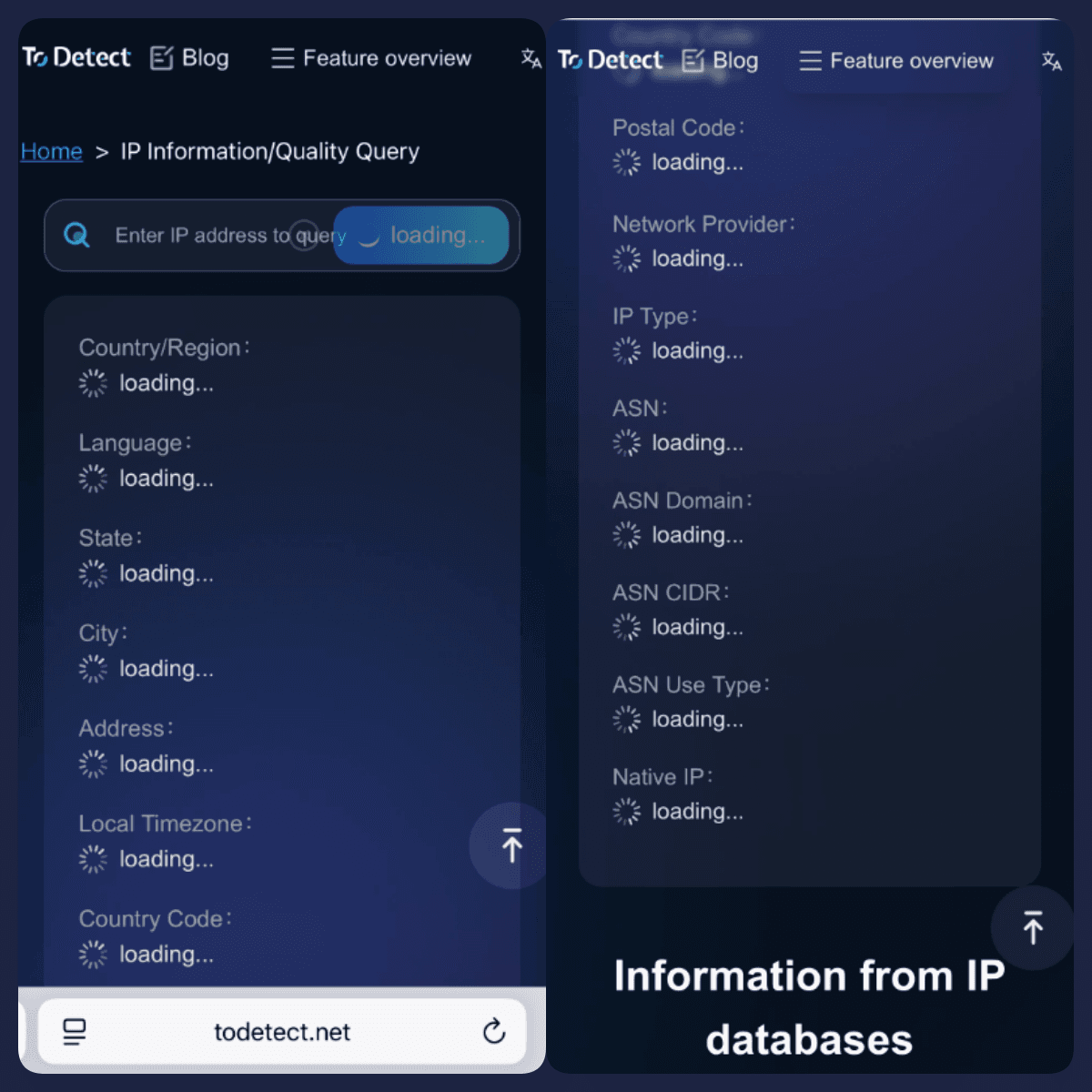
Through online IP lookup, users can check their current public IP address, IP location, ISP, and network type. For deeper IP quality analysis, ToDetect professional detection services can provide:
• Whether the current IP belongs to a proxy IP;
• Whether the IP has risk records;
• Whether the IP type is residential or data center;
• Whether the IP location matches business requirements.
For enterprise users, proxy IP detection before purchasing IP resources is extremely important. Many proxy IPs appear usable but may actually have issues such as heavy sharing or low IP reputation. Early detection can prevent future business problems.
If testing shows that an IP remains unchanged for a long time and the business requires remote server access, a static IP may be more suitable. If the IP frequently changes and is only used for browsing, office work, or general internet access, a dynamic IP is sufficient.
5. Application scenarios of Static IP and Dynamic IP
| Usage Scenario | Recommended IP Type | Main Reason |
|---|---|---|
| Enterprise remote work and internal system access | Static IP | Fixed IP address makes long-term remote connections more stable |
| Website servers and database deployment | Static IP | Provides a fixed access address and prevents service interruptions caused by IP changes |
| Remote monitoring and smart device management | Static IP | Makes long-term remote access and device management easier |
| Cross-border business and overseas platform operations | Static IP | Maintains a stable network environment and reduces frequent verification issues |
| Daily web browsing and video streaming | Dynamic IP | Lower cost and sufficient for regular internet usage |
| Home broadband and mobile network connections | Dynamic IP | Automatically assigned by the ISP without additional configuration |
| Temporary office work and regular network access | Dynamic IP | Flexible to use and does not require high IP stability |
| Network testing and businesses requiring IP switching | Dynamic IP | IP changes provide flexibility for adjusting network environments |
6. Why IP detection is important before choosing an IP
Many people focus only on price when choosing IPs but ignore IP quality. In reality, IP reputation, location matching, and network type all affect whether an IP can be used reliably.
Whether choosing a static IP or dynamic IP, it is recommended to first check basic information through online IP lookup and then use proxy IP detection to confirm the IP status.
Tools like ToDetect can help users better understand their current IP environment and reduce business failures caused by IP-related issues.
At the same time, regularly performing online IP lookup allows users to quickly detect network changes, such as IP changes, abnormal locations, or proxy status changes.
Summary:
Whether static IP or dynamic IP, both exist to satisfy different networking requirements. There is no absolutely “better” choice.
With ToDetect IP detection services, users can better understand their IP status and reduce access problems or business restrictions caused by choosing the wrong IP.
Simply put, understand your needs before choosing an IP, and test your IP before using it. Only by selecting the IP type that matches your business scenario can you achieve a more stable and efficient network connection while maximizing the value of IP resources.