Resources
 Feature overview

 Ganesh
 2026-07-14 16:58
In our daily use of the internet, or when engaging in cross-border e-commerce and social media operations, many people encounter a puzzling phenomenon:
The IP location displayed by the system does not match their actual physical location. For example, even when using a Hong Kong IP, the system might detect the location as Shenzhen; or someone physically in Africa might see their IP geolocation shown as Germany or somewhere even further away.
This "location discrepancy" is not a simple technical glitch. Rather, it is the cumulative result of complex network architectures, IP allocation mechanisms, and database update latencies working together.
From a professional standpoint, this article will analyze the true underlying reasons behind this mismatch.

How IP Geolocation Works and Its Limitations
First, it is important to clarify that IP geolocation is not, by design, a high-precision physical positioning technology. Unlike GPS, which offers meter-level accuracy, IP-based location is a "broad approximation" concept.
The Internet's "Virtual House Number": IP addresses (Internet Protocol Addresses) were originally designed to handle data routing and communication, not to pinpoint physical geographic coordinates.
Heavy Reliance on Third-Party Databases: Websites and apps typically identify a visitor's location by querying third-party IP intelligence databases (such as MaxMind, IP2Location, DB-IP, etc.).
These databases compile information from Regional Internet Registries (RIRs) registration records, BGP routing data, ISP records, network latency measurements, and commercial partnerships to map IP addresses to physical locations.
No Unified Industry Standard: There is no universally recognized, official authority for IP geolocation standards. Consequently, the exact same IP address can display completely different location results across different lookup platforms.
Core Reasons Behind Inaccurate IP Geolocation
1. Latency in IP Database Updates
This is the most common culprit. The ownership, assignment, and BGP routing of IP addresses change frequently, but geolocation databases often struggle to keep pace.
Because of the time lag between IP resource reallocation, ISP network adjustments, and database synchronization, an IP's location records may not update in real-time, causing search queries to return outdated allocation information.
2. ISP Resource Scheduling and Allocation Mechanisms
Dynamic IP Pool Allocation: Most residential broadband and mobile network users are assigned dynamic IPs.
ISPs dynamically allocate public IPs from their pools based on the user's local area, connection node, and current routing policies. These IP pools are often shared across different cities or even states.
Inter-Provincial / Inter-Regional Traffic Routing: To optimize network capacity and resource utilization, ISPs dynamically route network traffic across regions.
Particularly in mobile networks, a user's actual connection point may be physically distant from the carrier's public gateway node. As a result, the location returned by IP databases will point to the gateway node rather than the user's actual location.
Carrier-Grade NAT (CGNAT): To mitigate IPv4 address exhaustion, many ISPs implement CGNAT (Carrier-Grade Network Address Translation), allowing thousands of users to share a single public-facing IP address.
Under this setup, external websites can only see the location of the shared exit gateway, making it impossible to pin down the actual location of individual users.
3. The Impact of Network Proxies and Relays
Proxies, VPNs, or Accelerators: Utilizing these privacy or optimization tools hides your local public IP. The destination website only sees the exit IP of the proxy server, completely masking your actual physical location.
Datacenter and Hosting IPs: IP addresses originating from data centers (IDCs)—typically assigned to VPS or cloud servers—usually only resolve to the city level. Moreover, the actual physical server location often differs from where the IP block is registered.
Content Delivery Networks (CDNs): When a website uses CDNs or reverse proxy architectures, and fails to properly forward the real client IP (e.g., via the X-Forwarded-For header), the website's backend will log the location of the CDN edge server instead of the user's actual IP.
4. Physical Characteristics of Mobile Cell Towers
Mobile networks (4G/5G) rely on cellular base stations with overlapping coverage areas. As a mobile device moves or hands off between towers with similar signal strengths, the assigned IP subnet can change, causing the perceived IP location to "drift" rapidly.
The Impact of IP Discrepancies and How to Handle Them
Inaccurate IP geolocation does more than just disrupt user experience (such as showing you incorrect local services or ads); it can also trigger automated risk control systems.
For instance, global platforms like Amazon, eBay, and TikTok continuously evaluate security by assessing IP behavior, device fingerprints, and account activity.
Frequent or drastic shifts in login locations increase the likelihood of triggering security checkpoints, verification loops, or temporary account locks.
💡 Recommended Actions:
1. Cross-Reference Multiple Databases: If you notice conflicting geolocations, use multiple professional IP analysis tools to cross-verify the records and track database update cycles.
2. Clear Your Caches Regularly: Periodically clear your browser cookies, local cache, and flush your local DNS cache to prevent outdated location data from skewing your current lookup.
3. Deploy Professional Detection Tools: If your business relies on high-precision, clean, and consistent IP environments—such as for cross-border operations or social media account matrix management—you must use enterprise-grade tools to monitor IP health and consistency.
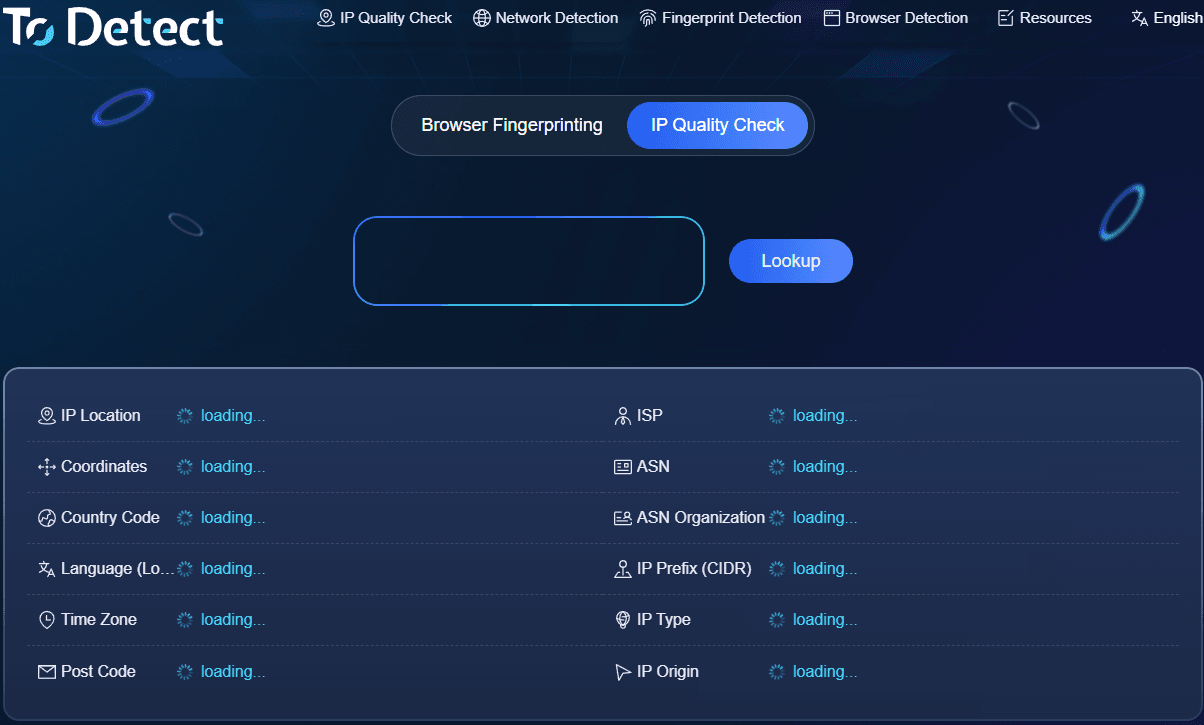
Looking to run a deep check on your IP properties, assess IP quality, and secure your network operations? Visit the ToDetect Official Website for comprehensive, professional-grade IP intelligence.
Frequently Asked Questions (FAQ)
Q1: Will an inaccurate IP geolocation compromise my personal privacy?
No. Geolocation data displayed publicly on websites and social media platforms typically only resolves to the state/province or country level.
It is technically impossible to pinpoint your exact street address or house number through standard IP lookups. It simply reflects the general region of your ISP's routing node, not your real-time physical coordinates.
Q2: Why does my IP address and location change after restarting my router?
Most home broadband connections utilize dynamic IP allocation. When your modem reconnects, your ISP assigns a new public IP from its current address block. Since different IP blocks may have slightly different geographical registration records in various databases, your displayed location may change.
Q3: Why do different IP lookup websites show different locations for the exact same IP?
This happens because different lookup tools pull from different IP intelligence databases. These databases vary in their data sources, update frequencies, and mapping algorithms, leading to minor location discrepancies.
Q4: If my IP location is wrong, is there any way to manually correct it?
If the mismatch is due to outdated database records, standard end-users have no direct way to edit public ISP registries.
However, if you are running cross-border operations that demand high-trust IPs mapped to a specific target country, you will need to rely on dedicated static residential proxies paired with a reliable anti-detect browser environment.
Q5: How do I verify if an IP is a "native residential IP"?
A native residential IP refers to an IP address assigned directly by an ISP within the targeted region, where its ASN, carrier type, and network attributes match those of a legitimate local resident.
You can visit the ToDetect Official Website and run a professional IP quality test. It will instantly identify the IP category (residential, datacenter, or mobile), verify its native status, and provide an accurate IP fraud score.