Resources
 Feature overview

 Alani
Alani 2026-06-04 11:39
As account risk-control systems become increasingly strict, one challenge that businesses involved in cross-border e-commerce and social media account matrices can hardly avoid is: how can multi-account anti-association be implemented more reliably?
WebRTC fingerprinting is often an overlooked yet critical factor. Many accounts are "mysteriously linked together" because of issues originating from WebRTC.
In this article, we'll explain why WebRTC fingerprints can lead to account association and how to effectively prevent WebRTC fingerprint leakage in real-world operations.

1. What Is WebRTC Fingerprint Detection and Why Does It Expose Information?
WebRTC is originally a browser technology designed for real-time audio and video communication, such as web-based video calls and peer-to-peer connections. During operation, it may expose certain device and network information.
For example, it may reveal your real IP address (including local IP and public IP), network environment characteristics, and device connection routes. This is what is commonly referred to as WebRTC fingerprint detection.
Many platforms use WebRTC information as an important factor in browser fingerprint analysis, combining it with Canvas fingerprints, font fingerprints, time zones, screen resolutions, and other signals to determine whether multiple accounts belong to the same device or operator.
2. Why Is Multi-Account Anti-Association Becoming More Difficult?
Modern risk-control systems no longer rely solely on IP addresses. Instead, they perform cross-validation across multiple dimensions. Common association signals include:
• IP Address + WebRTC Information
• Browser Fingerprints (Canvas / WebGL / Audio)
• Cookies and Local Storage
• Time Zone, Language, and System Fonts
• Behavioral Patterns (Clicks, Session Duration, Operating Rhythm)
Therefore, simply changing your IP address is no longer sufficient. This is why multi-account anti-association has evolved into a comprehensive system-level challenge rather than a simple technical adjustment.
3. Core Principles of WebRTC Fingerprint Protection (Critical)
The goal is not to completely eliminate WebRTC, but to prevent it from exposing real network information.
1. Limit WebRTC Information Leakage
Many browsers allow users to control the amount of network information WebRTC can expose, such as restricting access to the real IP address.
2. Use Isolated Browser Environments
Many operators managing multiple accounts use fingerprint browser solutions that isolate each account into its own environment. This allows each profile to have different WebRTC parameters, reducing the likelihood of association.
3. Verify with Fingerprint Detection Tools
In practice, many users rely on tools such as ToDetect to verify whether WebRTC is leaking real IP information, whether browser fingerprints are duplicated, and whether the environment contains suspicious association signals.
4. Key Considerations for Multi-Account Anti-Association in Practice
1. Browser Fingerprints Must Be Different Yet Natural
During browser fingerprint detection, platforms are not merely checking whether you modified parameters—they are evaluating whether the environment resembles that of a normal user.
For example, identical WebGL or Canvas fingerprints across accounts, mismatched User-Agent and operating system versions, or overly clean and identical font lists can all trigger suspicion.
Each environment should be unique while remaining consistent with realistic device behavior rather than being randomly assembled.
2. WebRTC Should Be Properly Isolated Rather Than Uniformly Hidden
Many users simply disable or uniformly configure WebRTC across all accounts, but this can create additional risks.
If multiple accounts share exactly the same WebRTC configuration, such as all being disabled or exposing identical network characteristics, they may appear as part of a batch operation.
A safer approach is to ensure different network exits for each environment, maintain internally consistent WebRTC information without revealing the real IP address, and avoid sharing identical network fingerprints across accounts.
3. Network Environments Should Not Be "Too Clean"
A common mistake among beginners is pursuing "perfectly clean IPs" and completely fresh environments. From a risk-control perspective, this can actually appear abnormal.
Real users typically experience network fluctuations, varying latency, and slightly different connection paths, even within the same region.
If all accounts share the same IP ranges, identical latency patterns, and the same access routes, platforms can easily identify them as a batch-operated environment.
4. Behavioral Patterns Are the Core of Advanced Risk Control
Modern platforms do not rely solely on technical fingerprints. They also analyze behavioral patterns to build user profiles.
Common signals include login schedules, page dwell times, click paths, and whether operating rhythms resemble automated scripts.
For example, if multiple accounts log in at the same time every day, visit identical pages, remain for similar durations, and perform actions in the same sequence, this becomes a highly recognizable abnormal pattern.
In practice, each account should appear to be operated by a different person. Even if technical isolation is perfect, highly consistent behavior can still result in association.
5. The Role of ToDetect in Real Operations
Many users focus heavily on configuration but neglect verification. This is where ToDetect can be valuable as a pre-deployment inspection tool.
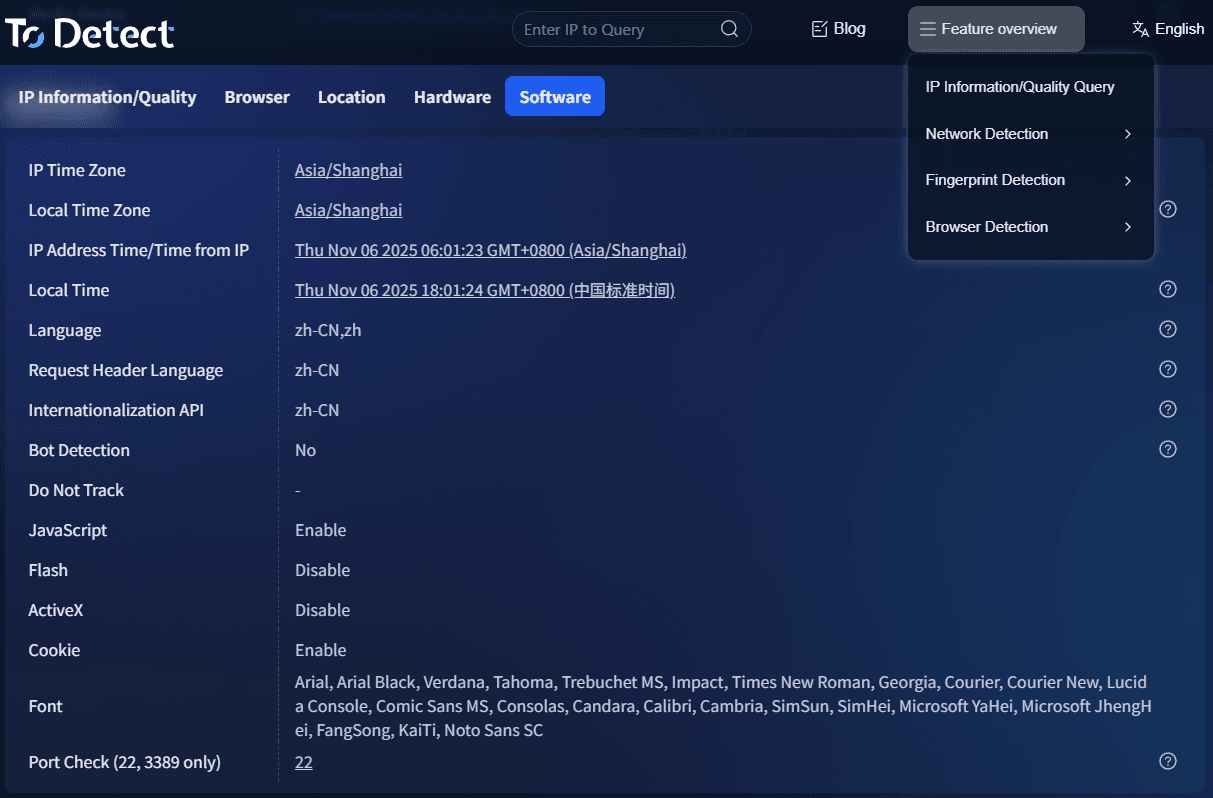
• Detect whether WebRTC is leaking real IP addresses
• Analyze browser fingerprint consistency
• Determine whether environments are overly standardized
• Provide fingerprint risk-scoring references
For operators managing account matrices or cross-border business operations, this verification step is extremely important because many issues remain invisible without testing.
6. Frequently Asked Questions About Multi-Account Anti-Association
1. Why Are My Accounts Still Being Associated After Blocking WebRTC?
Many users assume that once WebRTC is protected, the problem is solved. In reality, platforms evaluate multiple factors simultaneously.
Besides WebRTC, platforms also analyze browser fingerprints (Canvas, WebGL, Fonts), IP environments, and behavioral patterns. Therefore, addressing only WebRTC reduces only part of the overall risk.
2. Why Does ToDetect Still Report Abnormalities Even When Using a Fingerprint Browser?
This usually occurs because WebRTC still leaks some IP information, browser parameters are overly standardized, or multiple environments remain too similar.
It is recommended to use ToDetect to inspect each fingerprint element individually, especially WebRTC, time zones, and Canvas fingerprints.
3. What Is the Difference Between Disabling WebRTC and Limiting IP Leakage?
These are not the same thing. Disabling WebRTC completely removes its functionality, which may affect websites that depend on real-time communication features.
Limiting information leakage preserves WebRTC functionality while preventing exposure of the real IP address. For multi-account operations, restricting leakage is generally the preferred approach.
4. Do Multi-Account Operations Require Complete Environment Isolation?
Not necessarily complete isolation, but sufficient differentiation is essential.
The goal is to prevent platforms from confidently identifying multiple accounts as belonging to the same user through browser fingerprints, network characteristics, and behavioral models. If environments are too similar, accounts can still be linked even when using different IP addresses.
Conclusion
Today's risk-control systems are highly sophisticated. They no longer focus solely on IP addresses but instead combine browser fingerprints, WebRTC information, device characteristics, and behavioral data into a unified analysis model. Once highly consistent patterns emerge, account association becomes increasingly likely.
If you are currently operating multiple accounts—whether for social media matrices, cross-border e-commerce, or advertising campaigns—it may be time to reassess your environment setup.
By placing each account in a separate browser environment, creating distinct fingerprint profiles, and validating configurations with ToDetect before deployment, you can identify and address potential risks proactively rather than dealing with account bans and association issues afterward.