Resources
 Feature overview

 Charles
 2026-05-08 10:29
People managing Instagram accounts today fear not “low traffic,” but sudden account abnormalities, frequent verification requests, or even direct account bans.
One of the most overlooked yet critical issues is DNS leaks. Once the Instagram platform detects abnormal environmental signals, it can easily trigger risk control mechanisms.
Next, let’s talk about how to detect DNS leaks when managing Instagram accounts, as well as the complete process of maintaining and testing a stable account environment.

1. What Is a DNS Leak?
When you open Instagram, the system first uses a DNS server to resolve the website address before establishing the connection.
Under normal circumstances, if you are using a U.S. proxy IP, your IP address should appear in the United States, and the DNS server should also be located in the U.S., keeping the network environment consistent.
However, many people encounter situations where the proxy IP has already switched overseas, but DNS requests are still being sent through the local network. This is a classic DNS leak.
For Instagram, this type of network environment appears unnatural. A real U.S. user would not be using a U.S. IP while simultaneously accessing the platform through a Chinese DNS server.
2. Why Instagram Account Farming Must Pay Attention to DNS Leak Detection?
Many beginners managing Instagram accounts only focus on whether the IP has successfully switched, while ignoring the DNS environment.
For example, you may log into Instagram using a U.S. residential IP, but your browser language is Chinese, the DNS shows a Chinese ISP, and the timezone is still Beijing time.
From the platform’s perspective, this environment clearly does not resemble a real overseas user. As a result, many accounts may encounter:
• Frequent login verification
• Abnormal login alerts
• Instant bans after new account registration
• Sudden account logouts
• Ad account association abnormalities
Therefore, for people running accounts long-term, performing regular DNS leak tests has become an essential operation.
3. Why Is Instagram Risk Control Paying More Attention to Environment Detection?
In the past, simply switching IPs was enough for Instagram operations. Now, Instagram focuses more on the “overall authenticity” of the environment.
IP and DNS Region Mismatch
This is the most common issue. For example, if the IP shows the United States but the DNS comes from China, the environment is considered high-risk.
Browser Fingerprint Abnormalities
Many platforms now perform browser fingerprint detection. If browser parameters do not match the IP region, the account can easily be flagged.
Timezone and Language Conflicts
Some users successfully switch proxies, but their timezone remains set to China, the browser language stays Chinese, and the system region is unchanged, making the environment appear suspicious.
4. Common Instagram Environment Issues Reference Table
The following table summarizes common environment risks during Instagram account management and provides optimization suggestions for quick troubleshooting.
| Issue Type | Common Symptoms | Risk Level | Solution |
|---|---|---|---|
| DNS Leak | IP shows overseas, but DNS shows local ISP | High | Use residential proxies that support DNS routing and perform regular DNS leak tests |
| Browser Fingerprint Abnormality | Multiple accounts share highly similar fingerprints | High | Use isolated browser environments and regularly test browser fingerprints |
| WebRTC Leak | Real local IP gets exposed | High | Disable WebRTC or use anti-leak browsers |
| Timezone Mismatch | U.S. IP but Chinese timezone displayed | Medium | Set the system timezone to match the proxy country |
| Language Conflict | Overseas IP but browser language is Chinese | Medium | Keep browser and system language consistent with the IP country |
| Frequent IP Switching | Different IP every login | High | Use stable residential IPs for long-term consistency |
| Multiple Accounts Sharing the Same Environment | Several accounts use the same browser environment | High | Isolate environments for each account |
| Cookie Abnormalities | Login sessions frequently expire | Medium | Avoid frequently clearing cookies and maintain normal user behavior |
| Device Parameter Conflict | Windows environment pretending to be a Mac device | Medium | Keep device information logically consistent |
| Low-Quality Proxy | Large number of verifications and login issues | High | Choose high-purity residential proxy IPs |
In many cases, it is not user behavior that triggers risk control, but rather the system detecting that your network and device environment do not match normal user characteristics.
5. How to Perform DNS Leak Detection?
To confirm whether your environment is secure, you can use professional tools to perform DNS leak detection or DNS leak testing.
DNS Server Location
Check whether the DNS server location matches the proxy IP country. If you are using a U.S. IP, the DNS should ideally also be located in the United States.
Presence of Local ISP DNS
If the test results show China Telecom, China Unicom, or local broadband DNS servers, it usually indicates a DNS leak problem.
Multiple Abnormal Nodes
Some low-quality proxies can hide the IP address, but DNS requests still pass through multiple random regions. Such environments are also likely to trigger risk control.
6. Why Do Many Proxy IPs Still Expose the Environment?
Many users wonder why Instagram can still detect abnormalities even after using proxies. The reasons are actually simple:
• DNS requests still use the local network
• WebRTC is not disabled
• UDP traffic is not proxied
• System DNS settings are not synchronized
The result is that although the IP appears switched successfully, the real network information is still exposed—especially when using free proxies.
Therefore, a truly stable Instagram account environment is not just about clean IPs, but overall environmental consistency.
7. Why Is ToDetect Suitable for Environment Detection?
Many cross-border operation teams now use ToDetect for environment checks because it does more than just test IPs—it also identifies multiple critical risk factors.
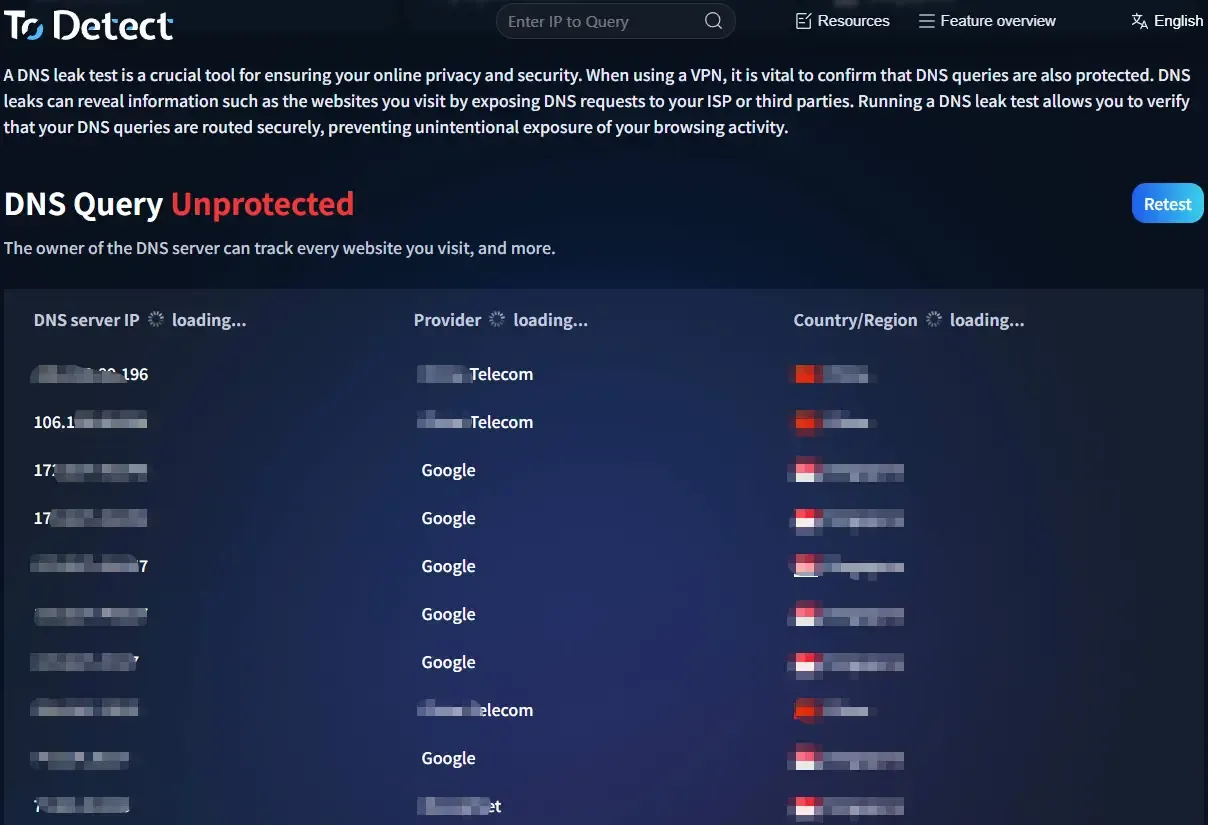
• For example: DNS leak detection, browser fingerprint testing, WebRTC testing, timezone consistency, system language, proxy environment abnormalities, and IP purity analysis.
• For teams managing multiple accounts, this type of comprehensive testing is far more efficient.
• In many cases, account issues are not caused by a single problem, but by multiple conflicting environment parameters.
Preventive testing is often more important than fixing issues after accounts get flagged.
8. How to Reduce the Risk of Instagram Account Suspension?
Use High-Quality Residential IPs
Prioritize native residential IPs, dedicated residential IPs, and fixed ISP proxies.
Avoid using datacenter IPs for long periods, as they have become a major target of Instagram’s detection systems.
Maintain a Stable Login Environment
Avoid frequently changing IPs, devices, browsers, or system languages.
Many accounts are not banned because the environment is imperfect, but because it changes too often.
Perform Regular Browser Fingerprint Testing
In addition to DNS, also check WebRTC, Canvas, timezone, language, and font environments.
Keeping the entire environment consistent can significantly improve account stability.
Conclusion
Today, issues such as DNS leaks, browser fingerprint abnormalities, and WebRTC exposure often have a greater impact on Instagram account survival than the actual content you post.
It is recommended to treat DNS leak detection and ToDetect browser fingerprint testing as part of your daily workflow. Truly stable operations rely on detecting and avoiding risks in advance.
Especially by using ToDetect to proactively identify environment problems, you can effectively reduce account abnormalities and suspension risks, making your Instagram account environment more stable and secure.