Resources
 Feature overview

 Alani
Alani 2026-06-24 12:01
You've already configured a proxy IP for your fingerprint browser, and the detection results even show an overseas location. Yet your accounts still get linked, flagged by risk-control systems, or even receive suspicious login alerts shortly after registration?
If you've experienced this situation, the problem may not be the proxy IP itself. Instead, there could be vulnerabilities in your browser environment configuration that are exposing your real IP address without you realizing it.
Why does a fingerprint browser still leak IP addresses? And how can you quickly identify configuration mistakes? In this guide, we'll help you complete a comprehensive fingerprint browser check in just 5 minutes and uncover hidden configuration issues.

1. Why Does a Fingerprint Browser Still Leak Your IP Address?
A fingerprint browser is responsible for simulating and isolating browser environments. However, whether network traffic actually passes through the proxy server depends on multiple factors, including browser settings, DNS resolution, WebRTC configuration, and the system's network environment.
If any of these components are configured incorrectly, websites may still obtain your real IP address even when the proxy IP appears to be working properly.
This is especially important when registering accounts, logging into advertising platforms, or managing multiple social media accounts. Once an IP leak occurs, platforms can easily identify relationships between accounts through network characteristics.
Therefore, regular fingerprint browser testing has become an essential step in multi-account operations.
Check #1: Verify That Your Proxy IP Is Actually Working
Many users assume their setup is complete once they see an overseas IP address displayed in the browser. In reality, some proxy nodes may only route HTTP traffic while failing to fully cover HTTPS, UDP, and other protocols.
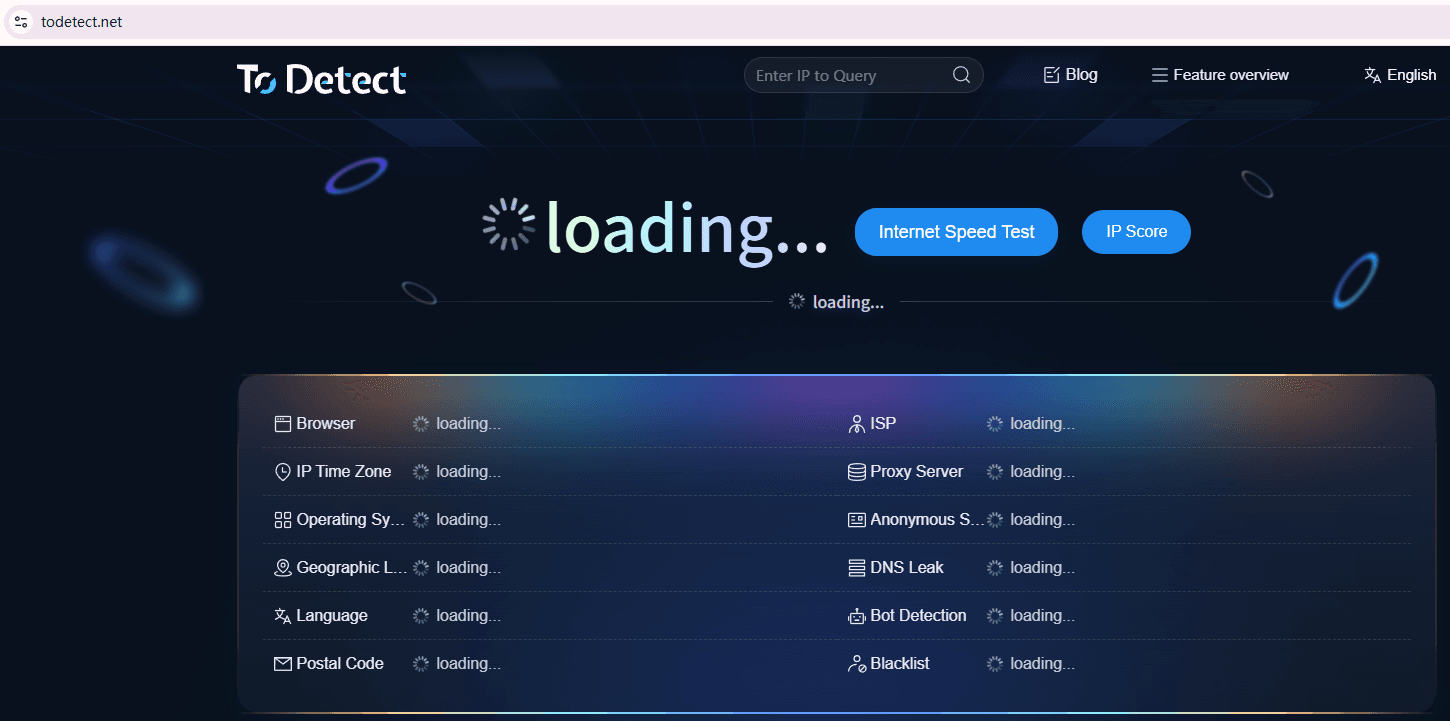
It's recommended to verify your setup using a professional detection platform such as ToDetect. Check your public IP address, IP location, ISP information, timezone settings, and browser language settings.
If the detected information does not match the proxy location, it indicates that the proxy is not functioning correctly. For example, if you're using a U.S. residential IP but the detection result still shows a Chinese ISP, this can easily trigger platform risk controls.
For this reason, every newly created browser profile should undergo a complete fingerprint browser check before use.
Check #2: Investigate WebRTC Leaks
WebRTC is one of the most common causes of IP leakage. Even when connected to a proxy server, WebRTC may bypass the proxy and expose your local network address directly.
Many websites use WebRTC to obtain information such as local LAN IP addresses, real public IP addresses, and network interface details. If this information does not match the proxy IP, it creates obvious environmental inconsistencies.
Therefore, when configuring a browser environment, make sure WebRTC protection is enabled.
Most mainstream fingerprint browsers provide options such as disabling WebRTC, replacing the WebRTC IP, or forcing WebRTC traffic through the proxy. It is generally recommended to choose either "Proxy Mode" or "Replace Mode" to maintain functionality while preventing IP leaks.
Check #3: Look for DNS Leaks
Many users focus only on IP addresses and overlook DNS resolution. When configuring your browser environment, verify whether DNS requests follow the proxy, whether remote DNS is enabled, and whether local DNS caching is present.
Tools such as ToDetect can quickly identify the location of your DNS servers. If the DNS location differs from the proxy region, you should adjust your proxy configuration accordingly.
Check #4: Ensure Timezone and Geolocation Match
Many account-linking issues are not caused by IP exposure but by inconsistent environment parameters.
For example, if your IP address is located in New York, your timezone is set to Beijing, your browser language is Chinese, and your geolocation is empty, risk-control systems may view this as suspicious behavior. The correct approach is to ensure that all browser environment settings match the proxy location.
For example, when using a U.S. proxy, synchronize the timezone, geolocation, browser language, and system time with the United States. This creates a complete and natural browser fingerprint environment.
Check #5: Use Professional Tools for Fingerprint Browser Detection
Many users start logging into accounts immediately after completing their configuration. A safer approach is to perform a comprehensive environment check first.
Common detection items include Browser Fingerprint, Canvas Fingerprint, WebGL Fingerprint, Audio Fingerprint, DNS Detection, WebRTC Detection, and IP Consistency Checks. Platforms such as ToDetect can quickly reveal any abnormal environment indicators.
If the results contain red warnings or high-risk indicators, it is advisable to resolve the issues before performing account operations. Detecting problems beforehand can save significant time and costs compared to investigating account bans afterward.
7. Best Practices for Preventing IP Leaks in Fingerprint Browsers
For users who manage multiple accounts over the long term, the following habits are recommended:
First, assign a dedicated proxy IP to each browser profile and avoid sharing the same proxy node across multiple accounts.
Second, perform a complete fingerprint browser check every time you switch proxies.
Third, regularly update your browser kernel version to prevent outdated environment parameters.
Fourth, verify that WebRTC, DNS, and geolocation settings remain synchronized.
Finally, avoid frequently switching between countries and regions, as this can create suspicious behavioral patterns.
Only when your IP address, timezone, language, geolocation, and browser fingerprint data are fully aligned can a fingerprint browser effectively provide environment isolation.
Conclusion
Many users believe their proxy configuration is complete, while details such as WebRTC, DNS resolution, and timezone settings may already be exposing their real information.
Whether you're operating a cross-border e-commerce store or managing multiple social media accounts with a fingerprint browser, it's important to regularly review your browser environment configuration.
By using professional tools such as ToDetect to perform a fingerprint browser check and ensuring consistency across IP, DNS, timezone, and geolocation settings, you can significantly reduce operational risks.