Resources
 Feature overview

 Alani
Alani 2026-07-06 11:40
In cross-border e-commerce or multi-account operations, if the browser environment is not properly set up, you may face frequent verifications at best, or account bans at worst—and often you cannot even figure out what went wrong.
Today’s platform fingerprint browser detection mechanisms are becoming increasingly sophisticated. They no longer rely only on IP addresses, but instead evaluate multiple dimensions such as device environment, browser characteristics, and behavioral patterns to determine whether you are the “same person.”
In this article, we will discuss how to choose a fingerprint browser, where browser environment setup most often goes wrong, and what modern risk control systems are actually detecting.

1. What problem does a fingerprint browser actually solve?
Browser fingerprinting is essentially a combination of information used by websites to identify a user’s device, such as:
Operating system version, browser type and version, font list, screen resolution and GPU information, timezone, language settings, and Canvas/WebGL rendering characteristics.
Combined together, these form a “digital identity card.” Even if you clear cookies or change IP addresses, websites may still recognize you through these signals.
Therefore, the core purpose of fingerprint browsers is not simply multi-login, but “environment isolation,” making each browser instance appear like a completely different device.
2. Why choosing the wrong fingerprint browser can be “dangerous”
A common mistake beginners make is focusing only on price or feature count, while ignoring “environment quality.” If a fingerprint browser is not realistic enough, several issues may occur:
First, the environment may be “too clean,” which itself becomes suspicious. Real devices are complex, but some tools generate overly uniform environments that are easily detected.
Second, high duplication rates. If multiple accounts share similar browser parameters (such as identical WebGL or Canvas fingerprints), they may be flagged as linked.
Third, mismatch between IP and environment. For example, a US IP combined with Chinese language and Asian timezone is highly sensitive in risk control systems.
When combined, these issues can lead to frequent verification or even account bans. The real risk is not the tool itself, but improper selection and configuration.
3. Common browser environment risk checklist
| Risk Type | Typical Behavior | Possible Trigger | Optimization Approach |
|---|---|---|---|
| Over-consistent fingerprints | Multiple environments share highly similar Canvas/WebGL parameters | Account linking, mass bans | Add natural randomness; avoid cloning environments in bulk |
| IP-device mismatch | US IP but system language is Chinese | Elevated risk control checks | Keep region, language, and timezone consistent |
| Overly “clean” environment | Minimal and uniform fonts/plugins | Detected as virtual environment | Simulate real user traces |
| Abnormal behavior patterns | Bulk actions immediately after login | Behavioral risk triggers | Simulate natural usage rhythm |
| Frequent environment changes | Frequent fingerprint parameter modifications | Reduced account trust | Keep environment stable after setup |
4. Core logic of browser environment setup
Many people mistakenly think browser environment setup is just “filling in parameters,” but the real key is logical consistency. A stable environment must meet three principles:
1. Consistent device information
System language, timezone, and IP region must be aligned. For example, a Japan IP should ideally match Japanese system language and timezone, otherwise it may trigger inconsistencies.
2. Natural fingerprint characteristics
Canvas and WebGL fingerprints should not be overly uniform or idealized; instead they should include natural variation closer to real-world device behavior.
3. Long-term stability
Once the environment is set, avoid frequent changes to core fingerprint parameters, as this may reduce trust scores and increase risk.
5. What does fingerprint browser detection actually check?
Many people feel nervous when hearing “detection,” but in essence it is just device identification by risk control systems.
Typical detection signals include: virtualization or automation environments, inconsistent Canvas/WebGL results, standardized font lists, conflicts between plugins and User-Agent, and IP-device mismatch.
Some systems also include behavioral signals such as click speed and page dwell time. This is why simply changing IP is no longer enough.
6. The role of ToDetect in the industry
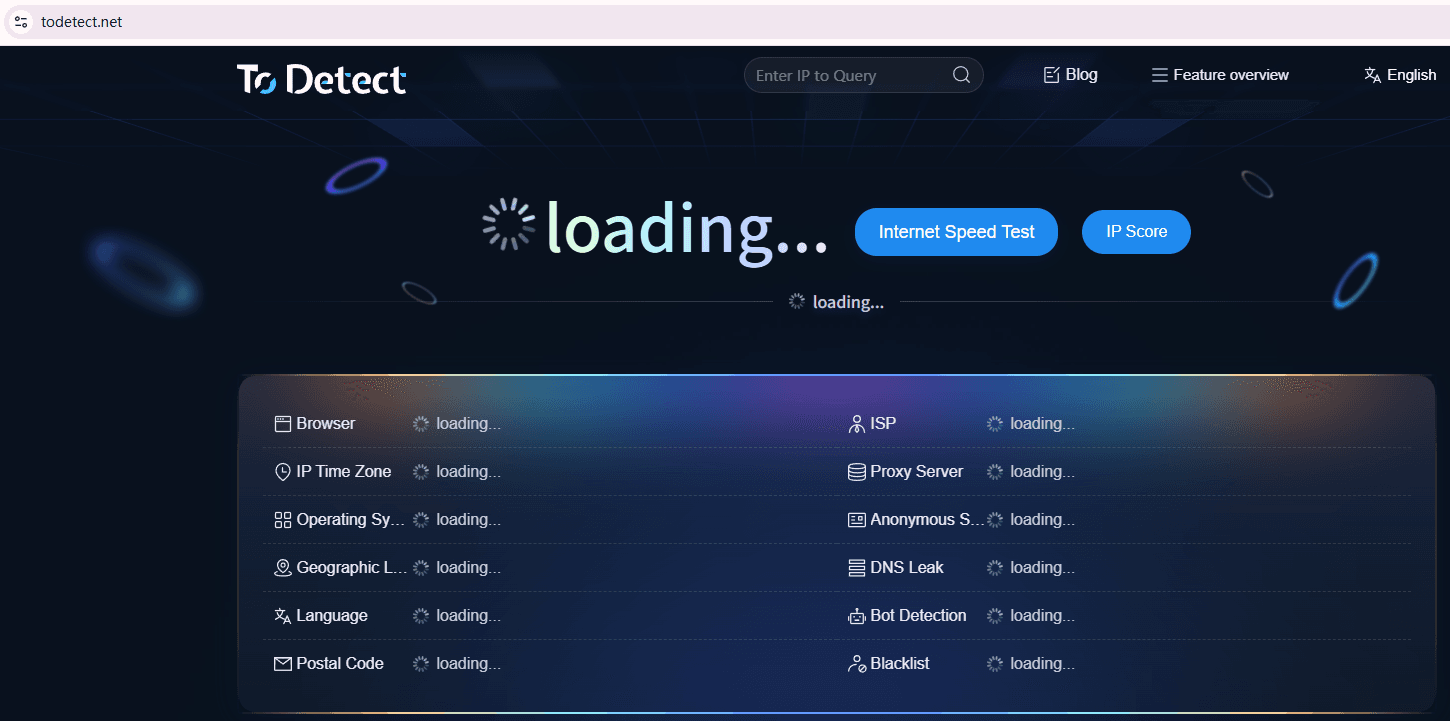
In practice, many users rely on tools like ToDetect for environment validation. It does not “hide” you; instead it helps you verify:
• Whether the browser environment looks abnormal
• Whether fingerprint parameters are duplicated
• Whether IP and device information match
• Whether the setup may trigger risk control systems
In simple terms, after setting up an environment, you use such tools for a “health check” to see whether it resembles a real user device from a risk-control perspective.
7. Key details beginners often overlook
Many people think using a fingerprint browser alone is enough, but it is not. Common overlooked issues include:
1. Do not clone environments in bulk
Bulk cloning leads to highly similar fingerprints, which can be flagged as multi-account behavior.
2. Do not ignore network environment
Even with good fingerprint setup, mismatched datacenter IPs can significantly reduce trust.
3. Do not frequently change device fingerprints
Frequent changes to User-Agent or screen resolution may make accounts appear unstable.
4. Browser plugins can leak information
Some plugins may expose language, timezone, or system traits. Keep extensions minimal and consistent.
8. How to correctly understand “anti-detection techniques”
The correct interpretation is: reduce abnormal signals + improve consistency + simulate real user behavior.
It is not about “beating the system,” but about making your environment look like a real user. Mature teams focus on long-term stability rather than short-term tricks.
Conclusion: tools are only the first step
Ultimately, a fingerprint browser is just a tool—it does not determine success or failure. The real difference lies in how you use it.
For multi-account operations or cross-border business, environment quality determines the upper limit of account longevity. Tools like ToDetect help identify issues early and make environments closer to real devices.
In reality, the most stable approach always follows one principle: make the system believe you are a real, natural, and long-term stable user.