



 Resources
 Feature overview
 Ganesh
 2026-07-29 12:15
IP is an important identity identifier in the network environment, and its quality directly affects the stability of many online businesses. Especially in scenarios such as cross-border operations and multi-account management, whether an IP is clean often determines whether subsequent usage goes smoothly.
Through professional detection methods, users can understand whether the current IP has been marked as risky, check IP reputation, and avoid potential problems caused by network environment issues.
Today, we will show you how to quickly determine whether your IP is secure, where to perform reliable online IP queries, and how to understand the various data indicators in IP purity test results.

1. What is IP Purity Check ? Why Check IP Risk?
IP purity checking is a professional process that analyzes an IP address based on its usage status, risk history, reputation, and other factors. It is not simply checking the IP location. Instead, it evaluates whether the IP has been identified as a proxy IP, data center IP, malicious IP, or has abnormal access history.
Especially in cross-border business, overseas account management, SEO optimization, market research, and data collection scenarios, having a stable and clean IP environment is extremely important. A high-quality IP can reduce abnormal risks and improve business stability, while a low-quality IP may increase the probability of platform risk control.
2. Online IP Query : Quickly Understand Your Current IP Status
For ordinary users, the easiest method is to use an online IP query tool. Compared with traditional methods, online IP queries require no software installation. Users only need to open the detection page to quickly view their public IP address and related information.
Generally, a complete online IP query result includes the following aspects:
First: Basic IP Information
Includes IP location, ISP information, network type, and other details, helping users confirm whether the current network environment matches their expectations.
Second: IP Risk Information
Professional detection tools determine whether an IP has blacklist records, malicious activity history, or abnormal usage patterns.
Third: IP Type Analysis
For example, determining whether an IP belongs to a residential broadband network, data center IP, proxy IP, or another type of network resource.
Fourth: IP Quality Score
Some platforms provide a comprehensive evaluation based on multiple factors, allowing users to understand IP quality more intuitively.
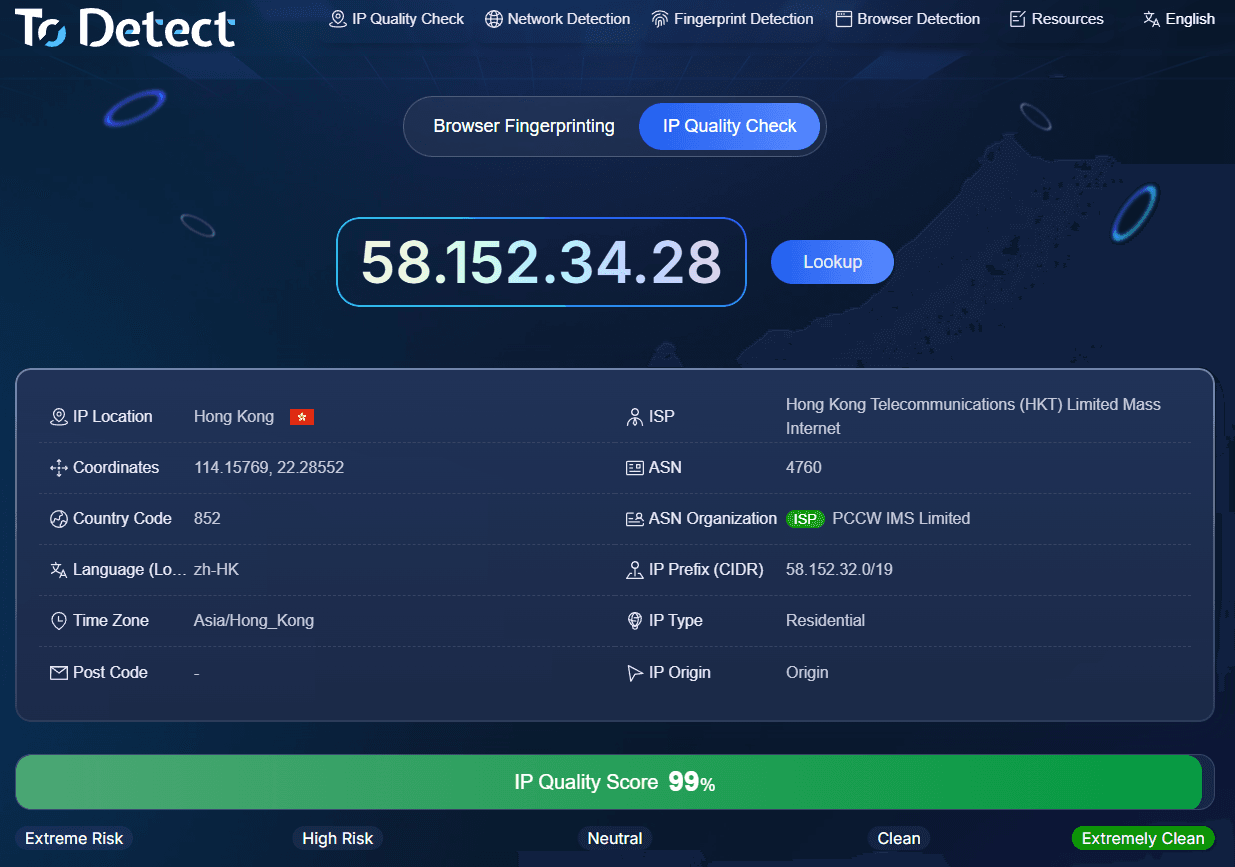
If you only need to check your public IP address, a basic query website is usually enough. However, for business purposes, it is recommended to choose a more comprehensive IP detection tool, because simply displaying an IP address cannot reflect its actual quality.
3. How to Choose a Reliable IP Detection Tool?
There are many IP detection tools available today, and their detection results and functions vary. When choosing a tool, users should not only consider query speed but also pay attention to the following aspects:
First, the detection coverage should be comprehensive. A good tool should not only display IP location information but also analyze IP risk level, proxy attributes, blacklist status, and other details.
Second, detection results should be clear and easy to understand. For ordinary users, complicated data is less meaningful. It is more important to directly know whether an IP is risky and whether its quality is acceptable.
In addition, database update frequency is also important. Since IP risk databases change frequently, outdated detection data may have limited reference value.
Currently, many users use professional platforms such as ToDetect for IP queries and risk analysis. Through professional detection services, users can quickly evaluate IP quality and identify potential issues.
4. IP Purity Check : What Indicators Should You Focus On?
When performing IP quality checks, many users only focus on one question: whether the IP has risks. In reality, determining whether an IP is high quality requires comprehensive analysis from multiple perspectives.
1. Whether the IP Appears on Risk Lists
This is one of the most important indicators. If an IP has previously been used for spam sending, malicious crawling, attacks, or other abnormal activities, it may have been recorded by security systems. Even without current abnormal activity, it may still affect future usage.
2. Whether the IP Type Is Stable
Residential broadband IPs and data center IPs may perform differently in practical usage. Some platforms apply stricter reviews to data center IPs and proxy IPs, so choosing the right IP type according to actual needs is important.
3. Historical IP Usage
An IP that has been heavily shared by many users may accumulate more risk records. In comparison, stable, independent, and reputable IPs usually provide a better experience.
4. Whether the Location Matches
Some businesses have specific location requirements for IP addresses, such as overseas market operations and regional advertising tests. If the displayed IP location does not match the target region, it may affect business results.
5. Common Fields in IP Purity Detection Reports
| Detection Field | Meaning | How Ordinary Users Understand It | Impact Level |
|---|---|---|---|
| ASN Information | Autonomous System Number of the network where the IP belongs, used to identify the network source | Determines which ISP or network organization the IP belongs to | High |
| ISP Provider | Information about the organization providing network services for this IP | Helps determine whether the IP source is legitimate and avoids abnormal network environments | Medium-High |
| IP Active Time | The usage period and activity history of this IP within the network environment | Newly appearing or frequently changing IPs require additional attention | Medium |
| Reverse DNS Record | Domain name resolution information associated with the IP address | Helps determine whether the IP belongs to a normal business environment | Medium |
| Data Center Identification | Determines whether the IP belongs to a cloud server or data center node | Some platforms apply stricter verification to data center IPs | High |
| Risk Tag Count | Total number of abnormal labels recorded by security systems | More tags usually indicate higher historical risk | High |
| Proxy Detection Result | Determines whether the current IP is forwarded through a proxy | May affect account operations, access, and verification scenarios | High |
| Blacklist Status | Whether the IP exists in security database records | Directly reflects whether the IP may face usage restrictions | High |
| IP Sharing Status | Determines whether the IP is shared by multiple users | Excessive sharing may reduce IP stability | Medium-High |
6. What Should You Pay Attention to When Using an IP Detection Tool ?
Although IP detection provides useful references, the results are not permanently fixed. IP status may change over time due to usage patterns and network environment changes. During actual use, users should pay attention to the following points:
Avoid frequently changing large numbers of IP addresses. Abnormal IP switching within a short period may trigger platform risk control systems.
Choose network resources from reliable sources. Even if an IP appears normal during short-term testing, unstable sources may cause problems later.
Perform IP purity checks regularly. For websites, accounts, or business environments that operate for long periods, regular inspections can help identify risks in advance.
At the same time, do not rely on only one detection result. For businesses with higher requirements, multiple factors should be considered, including IP reputation, network type, and historical risks.
Summary
By performing regular IP purity checks, potential risks can be discovered earlier and network environments can be adjusted in time. The purpose is not simply to determine whether an IP can be used, but to understand the network attributes, historical performance, and potential risks behind the IP.
Professional IP detection services such as ToDetect can help users understand IP status from multiple perspectives and make IP risk evaluation more intuitive. Proper IP detection and management can reduce unnecessary network problems and make future business operations more stable and efficient.
Paying attention to IP purity means protecting your online identity and business foundation. Developing the habit of regularly checking IP quality will become an increasingly important way for internet users to improve stability and reliability.
Browser Fingerprint Detection Tool
Efficiently solve multi-account management, environment isolation, and account security