



 Resources
 Feature overview
 Ganesh
 2026-07-20 15:21
In 2026, with risk control algorithms becoming increasingly precise, the independence and purity of your network environment directly impact business operations—whether you're managing Amazon stores, running a TikTok matrix, or placing Facebook ads.
Many sellers still face account bans or traffic restrictions due to association risks, even when using antidetect browsers and proxy IPs.
The underlying causes are often a combination of factors, among which IP reputation, network environment consistency, and account behavior patterns are key metrics evaluated by platform risk control systems.
This article breaks down the risk control logic behind proxy IPs and demonstrates how to assess IP quality using an IP checker tool.

Why Standard IP Lookup Tools Fall Short for Cross-Border Risk Control
Basic IP lookup tools typically only offer fundamental details, such as:
- Current IP address
- Country or city
- Internet Service Provider (ISP)
However, for cross-border e-commerce and social media management, simply knowing the IP address isn't enough. Platform risk control systems evaluate multi-dimensional data, including:
IP Type and Network Origin: Platforms can detect whether an IP originates from a real residential broadband network (native residential IP) or a cheap rented data center (data center IP).
Historical IP Reputation: Whether the IP has a past record of being used for bulk registrations, spamming, or fraudulent activities.
Network Environment Consistency: If an IP shows New York, but the browser's time zone, language, or DNS resolution node points to Asia, it immediately triggers risk flags due to inconsistency.
3 Core Metrics for Evaluating Proxy IP Quality
Before binding a new IP to core store accounts or social profiles, make sure to inspect these three metrics:
1. IP Reputation and Quality Score
Risk control databases assign security scores to global IPs. A low score indicates the IP has been heavily shared or flagged on public blacklists, which easily causes immediate bans during registration or triggers re-verification on existing accounts.
2. Native Residential IP vs. Data Center IP
Data Center IP: Low cost and high speed, but low risk-control pass rates—easily flagged as proxies or bots.
Native Residential IP: Assigned by real ISPs in target countries (e.g., Comcast, AT&T), offering the highest risk control trust score. It is the top choice for account nurturing and high-value operations.
3. Environment Consistency and Leak Risks
Even if the proxy connects successfully, WebRTC enabled in the browser might still leak the real IP via UDP packets.
Additionally, if DNS queries do not route through the proxy tunnel, it creates a discrepancy where "the IP is in the US, but the DNS is local," instantly exposing environment spoofing.
Professional-Grade IP Detection in 2026: Practical Application of ToDetect
For cross-border business scenarios, traditional lookup sites cannot provide deep risk warnings.
Designed for cross-border operations, proxy verification, and network environment assessment, the professional tool ToDetect helps sellers inspect network environment risks before executing account operations.
Practical Value of ToDetect:
Multi-Database Cross-Verification: Cross-checks real-time data from major databases like MaxMind and IP2Location to anticipate account registration or login risks.
Deep Proxy/Node Attribute Detection: Instantly verifies if the IP is a genuine residential IP and accurately identifies data center, or Tor flags.
Quantified Risk Assessment: Provides an intuitive quality score to help teams standardize node selection and reduce account loss rates.
Environment Leak Warnings: Automatically scans for potential leak risks within the browser environment, including:
- WebRTC
- DNS
- Time Zone
- Browser Parameter Consistency
Helps users complete a comprehensive network environment check before operating accounts.
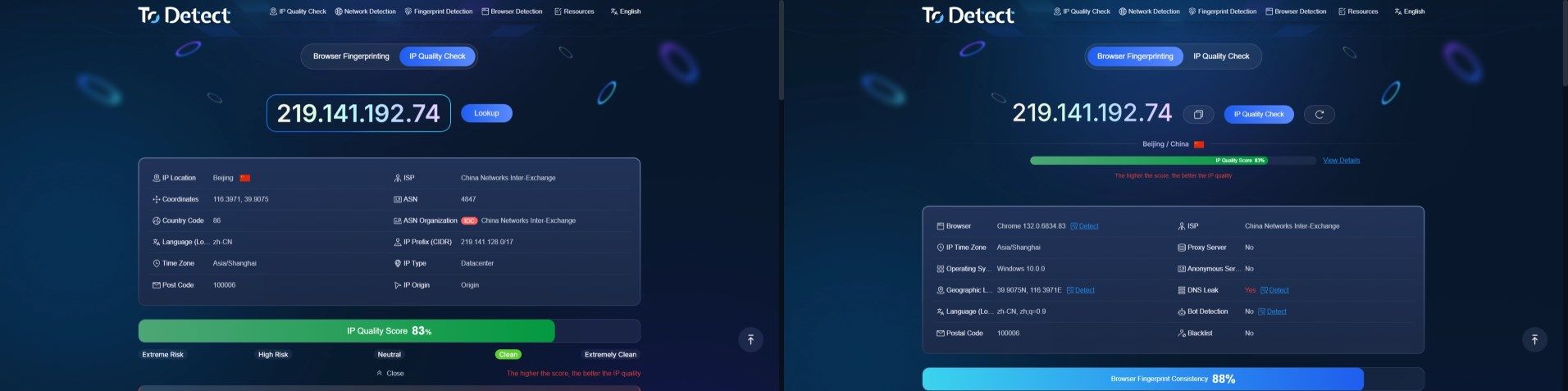
💡 Recommended Workflow: Before assigning proxy nodes in bulk, registering new accounts, or logging into critical business profiles, run a quick network check using ToDetect.
FAQ
Q1: Why does my account still get banned frequently when using "Dynamic Residential IPs"?
Some proxy providers repackage recycled, abused IPs from black-hat activities as residential IPs.
Furthermore, if a dynamic IP constantly shifts locations (e.g., jumping from California to New York within 5 minutes), platforms flag it as suspicious login behavior. It is recommended to use static residential IPs for managing core accounts.
Q2: Do I still need to check the IP if I'm already using an antidetect browser with a proxy?
Yes, absolutely. Antidetect browsers handle client-side parameters (like Canvas fingerprints and User-Agent consistency), whereas IP tools address the purity of the network connection itself (network identity). Combining both creates a robust anti-association setup.
Q3: What should I do if the IP shows a high risk score?
IPs with high risk scores (high fraud scores or active abuse records) should not be used for core stores or ad accounts. Contact your proxy provider immediately to replace them with clean IP pools to prevent irreversible damage to your account assets.