Resources
 Feature overview

A clean IP address not only minimizes the risk of account suspension but also significantly boosts the success rate of your business operations.
This article will break down the technical principles, evaluation standards, and practical methods of IP lookup and detection from a professional standpoint, helping you build a more stable online environment.
What Is IP Purity?
At its core, IP purity serves as a "behavioral record" and trust rating for an IP address within the global internet ecosystem.
It measures the extent to which the address has been abused, flagged as high-risk, or associated with malicious activity over a recent period.
High-purity IPs typically originate from genuine residential networks or highly reputable ISP resources, meaning they have no history of policy violations such as spamming, automated script abuse, or cyberattacks.
Why Should You Test IP Purity?
Preventing Account Linking Bans: In cross-border e-commerce (such as Amazon, eBay) or social media management (such as Facebook, TikTok), using a "blacklisted IP" that was previously penalized can easily trigger automated systems to link and ban both new and established accounts.
Minimizing Risk Triggers: High-risk IPs often trigger frequent CAPTCHAs, 403 access restrictions, or page loading failures.
Boosting Operational Success Rates: When registering accounts, running ad campaigns, or scraping data, a high-purity IP ensures your operational environment looks exactly like a real user, significantly increasing your pass rate.
Core Technical Metrics of IP Detection
Accurately evaluating an IP's quality goes beyond just checking its geographic location; it requires comprehensive verification across three technical layers:
1. Basic Information & Type Identification
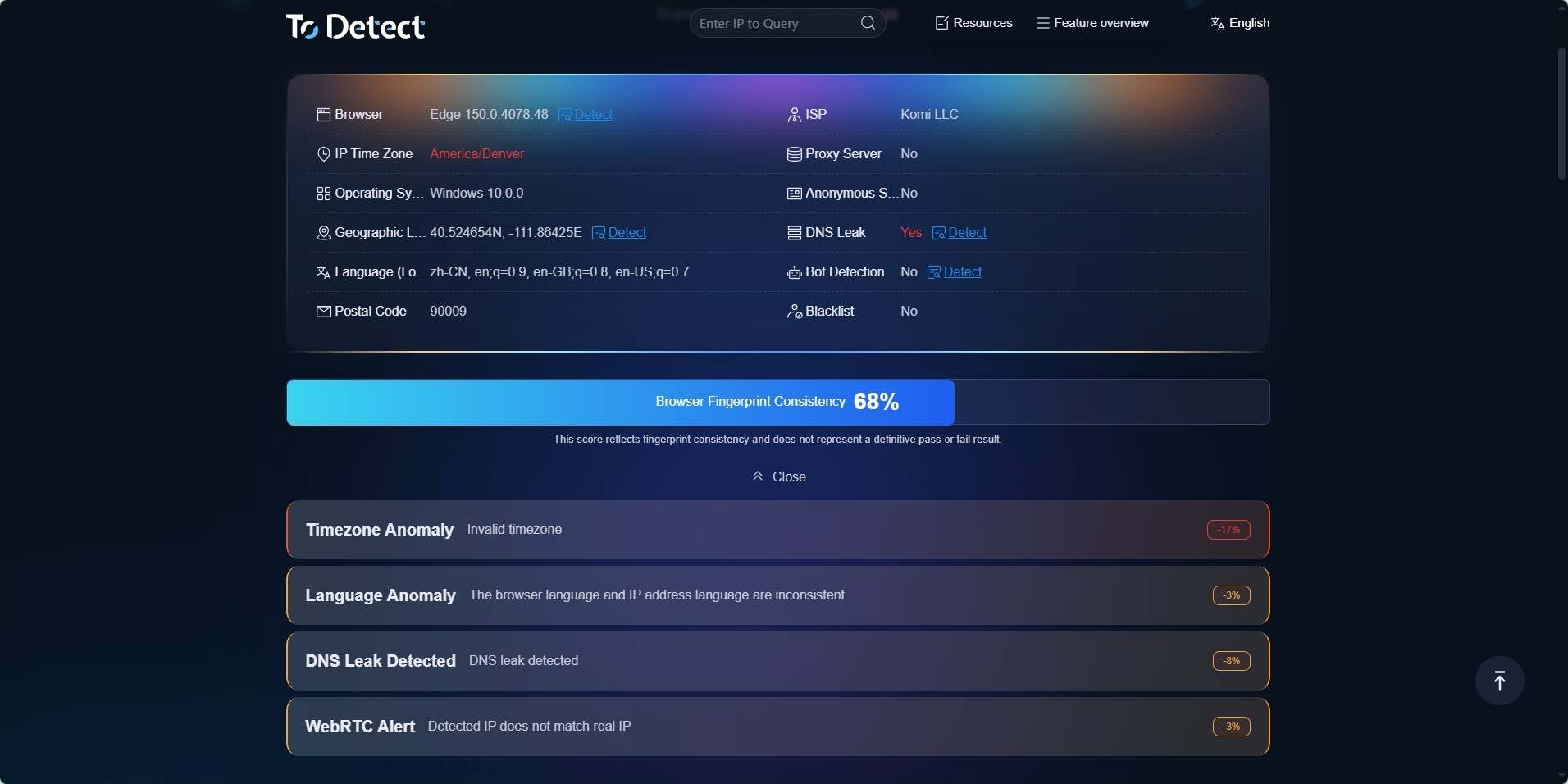
By utilizing IP detection tools, you can quickly identify the IP's Internet Service Provider (ISP), ASN organization, and network type.
Generally, Residential IPs carry a far higher trust rating than Datacenter IPs.
2. Risk Scoring & Blacklist Status
Fraud Score: A value calculated based on multiple malicious behavior data sources used to assess whether the IP is currently flagged for fraudulent activities.
Blacklist Monitoring: Verifying whether the IP appears in authoritative blacklist databases such as Spamhaus or AbuseIPDB. If an IP is flagged as high-risk by more than three platforms, it is highly recommended to abandon it immediately.
3. Environment Consistency Check
DNS & WebRTC Leaks: If the proxy IP's geographic location does not match its DNS resolution records, or if your local, real IP is exposed via WebRTC, anti-fraud systems will instantly flag the environment as anomalous.
Geographic Logic: Checking whether the time zone and language attributes of the IP perfectly match your browser's profile configuration.
Best Practices for Improving IP Security
Ensure Proxies Are Fully Effective Globally: Before starting your business operations, always run a check to confirm your public exit IP has successfully switched to the target overseas IP. This prevents proxy misconfigurations or leaks from exposing your real local network.
Regularly Retest Dynamic IPs: Since dynamic residential IPs rotate or change addresses upon reconnection, you should perform an IP purity check every time the IP changes to ensure the new address is just as secure.
Pair with Anti-Detect Browsers: Use anti-detect browsers to isolate your browser fingerprints, and bind a dedicated, clean IP to each account to achieve deep environmental decoupling.
Avoid the Pitfalls of Free Tools: Many free detection tools rely on outdated databases and fail to catch the latest blacklist records. It is best to use professional platforms like ToDetect that feature real-time data updates for your verifications.
Frequently Asked Questions (FAQ)
Q1: What is considered a safe Fraud Score during an IP check?
Generally speaking, the lower the Fraud Score, the better.
0 - 20 points: Highly secure, ideal for operations with strict risk controls.
21 - 50 points: Moderate risk; acceptable for general browsing or account nurturing, though you should monitor your account activity closely.
60+ points: High risk; we strongly advise caution or completely avoiding these IPs for high-risk cross-border projects.
Q2: What should I do if I find out my IP is not clean?
The most straightforward solution is to swap the IP. If you are using a dynamic residential proxy, you can rotate the proxy pool or switch ports via your provider's dashboard to fetch a new address. If you are on a fixed static line, you will need to contact your proxy provider to request a clean IP block.
Q3: How can I quickly check if my IP is Native?
You can visit the ToDetect Online IP Detection Tool to check the IP's attribution tags.
A native IP means its registered Whois location perfectly matches the geographic location identified by target platforms (like Netflix or TikTok), which offers a massive advantage for unlocking streaming content or managing local e-commerce stores.