Resources
 Feature overview

 Ganesh
 2026-06-30 11:43
For many people just starting with overseas social media matrix, the most easily overlooked aspect is not account registration process, nor content operations, but IP environment checking.
You painstakingly prepare dozens of accounts, only to have them restricted, demoted, or even banned shortly after registration. After much troubleshooting, you finally discover it's due to an abnormal IP environment.
Now let the editor introduce the IP testing process and practical tips that must be completed before account warming, and how to better reduce account risks through online IP queries and IP quality checks.

1. Why must you check IP before warming up accounts?
Overseas platforms' risk control systems comprehensively judge whether an account is trustworthy, and IP is one of the most important criteria.
If your proxy IP has been used by a large number of accounts in the past, is flagged by the platform as a proxy or data center IP, has many blacklist records, has inconsistent IP location with the proxy information, or has abnormal DNS, timezone, WebRTC, etc., then even if your account details are complete, it may still trigger risk control upon login.
Many people think that purchasing a proxy IP is enough, but that's not the case. Before officially logging into accounts, performing an IP quality check can often avoid a lot of unnecessary losses later.
2. What exactly does an online IP query check?
First, IP geolocation accuracy.
Confirm that the country, city, and ISP match the provider's information, to avoid anomalies like a US IP showing an Asian region.
Second, proxy type detection.
Many platforms detect whether the IP is a data center, residential, mobile, or VPN proxy – which is why proxy IP testing is crucial.
Third, IP reputation score.
Some IPs have been heavily used historically and have been flagged by multiple platforms, significantly lowering their reputation. Such IPs, even if they can access web pages normally, are unsuitable for account warming.
Fourth, blacklist status.
If an IP is already in spam databases or on multiple security blacklists, account risk naturally increases.
Fifth, network environment consistency.
This includes checking for obvious anomalies in DNS, ASN, timezone, browser fingerprint, etc., all of which affect the platform's judgment of account authenticity.
3. Key IP testing priorities at different stages of overseas social media account warming
| Warming Stage | Suggested Checks | Purpose | Recommended Frequency |
|---|---|---|---|
| Before account registration | Online IP query, IP geolocation, ASN info | Confirm proxy node matches target region, avoid risk due to region mismatch. | Test once before using each new IP |
| First login | Proxy IP detection, proxy type identification | Determine if flagged as proxy, VPN, or data center IP; increase initial trust. | Before every first login |
| Daily warming phase | IP quality check, blacklist status | Check if IP reputation has dropped; replace risky nodes promptly. | 1-2 times per week |
| Before publishing content | Network environment consistency, DNS, timezone | Ensure browser environment matches IP info, reduce abnormal login risk. | Spot-check before publishing |
| After changing proxy node | Online IP query, risk score, ISP info | Verify new node meets warming requirements; avoid low-quality IPs. | After every node change |
| Batch matrix account operation | Multi-node IP quality comparison, proxy stability test | Assign independent, stable IP resources to different accounts; reduce关联 risk. | Before each batch goes live |
4. Why do many teams first perform proxy IP detection?
Matrix accounts are typically numerous; one account having issues can affect the entire batch. If a risky IP logs into multiple accounts consecutively, those accounts may become关联.
Many teams follow this workflow: test IP first, then log in, and only after confirming IP quality is fine do they start registering, warming, and publishing content.
Although it adds just one step, it significantly reduces the chance of platform risk control. Especially during batch warming, the benefit far outweighs the few minutes spent.
5. How to quickly perform an IP quality check?
There are already many professional tools online that can help with testing. ToDetect is a commonly used testing platform.
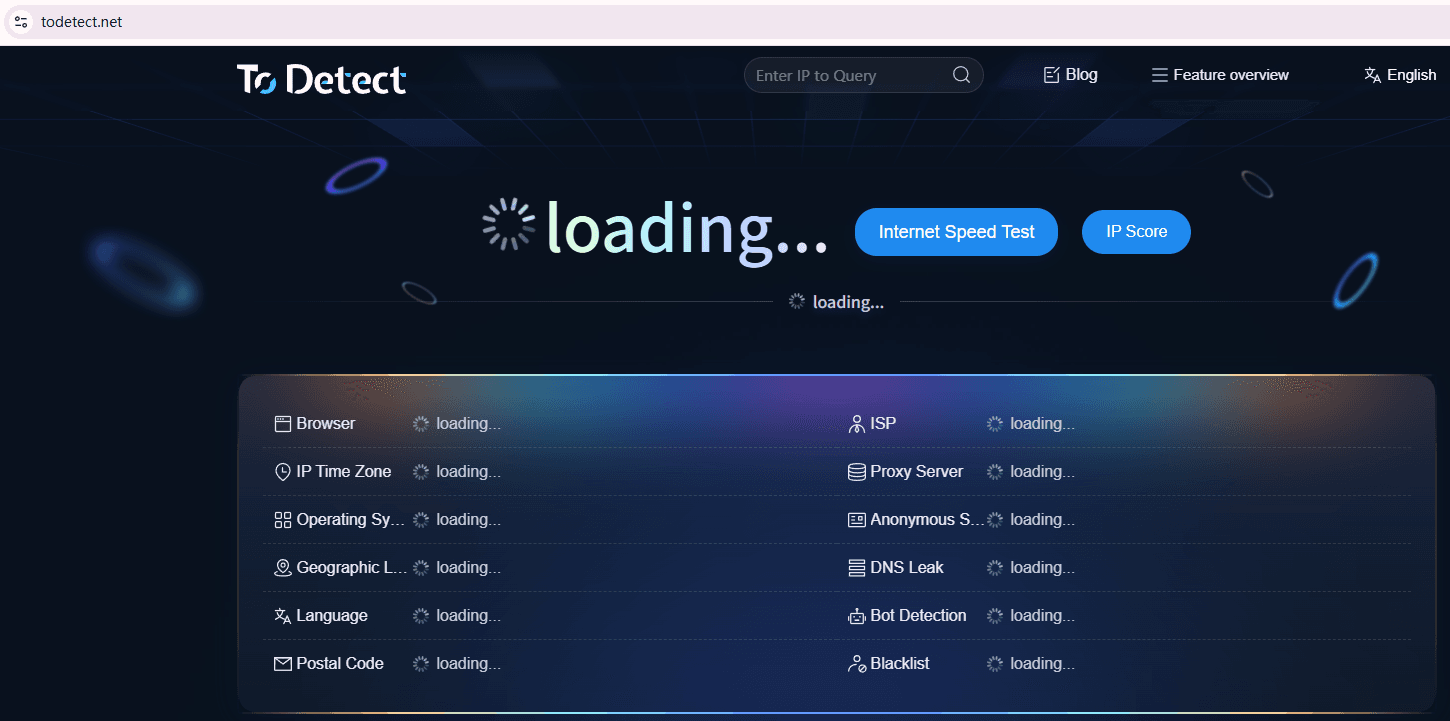
Through ToDetect online IP query, you can check: current IP address info; country and region location; ASN and ISP info; whether it's a proxy IP; IP risk level; blacklist records; browser environment detection; DNS and network consistency analysis.
Compared to sites that only show IP geolocation, such tools provide more comprehensive data, making them better suited for pre-warming risk assessment.
It is advisable not to test just once. If managing multiple accounts, every time you change a proxy node, you should re-run an online IP query to ensure each IP meets the requirements.
6. Practical tips for overseas social media matrix account warming
First, do not switch IPs frequently. Today USA, tomorrow UK, the day after Canada – such login patterns easily trigger platform anomaly detection.
Second, try to assign a stable IP to a fixed account. Don't let dozens of accounts share one proxy node just to save costs – this can lead to关联.
Also, keep browser environment consistent. Many teams use fingerprint browsers together with isolated Cookies, local cache, browser fingerprints, etc., between accounts, combined with stable proxy IPs, which greatly improves overall security.
One more easily overlooked point: proxy IPs need periodic re-inspection. Good quality yesterday does not mean it's still safe today. Some IPs may have their reputation scores decline as many users use them, so it's recommended to regularly perform proxy IP detection and replace risky nodes in time.
Final words
In overseas social media matrix operations, what truly determines account stability is often not operational skills – many account anomalies occur because the platform already judged the environment as high-risk at login.
Therefore, developing the habit of doing an online IP query before warming not only helps discover problems with proxy nodes in time, but also eliminates potential risks through IP quality checks and proxy IP detection, making account operations more stable.
For teams that operate overseas social media matrices long-term, spending a few minutes to complete a test in advance often saves a lot of time and costs later. And professional testing tools like ToDetect are becoming an indispensable part of more and more operations teams' pre-warming routines.