



 Resources
 Feature overview
 Ganesh
 2026-06-11 11:23
Static IPs for cross-border e-commerce are considered a “standard tool.” Whether it’s Amazon, eBay, or TikTok Shop, account environments must be stable, and IPs must be clean. However, few people truly manage this properly in detail.
Many people only know how to buy static IPs, but overlook that IPs are not something you buy and finish with—they are resources that require continuous monitoring and verification. This is why more and more sellers are paying attention to “IP stability monitoring” and “online IP lookup.”
Today we will explain why cross-border e-commerce using static IPs must implement stability monitoring and online IP lookup, and how to actually put this workflow into practice.

1. Why must cross-border e-commerce pay attention to static IP stability?
Cross-border platforms are increasingly strict with account environment risk control, especially login behavior. If your IP shows the following issues, it can easily trigger risk flags:
• IP frequently changes (even static IPs may drift)
• Region display anomalies (e.g., US IP suddenly appears in another state)
• IP reused or polluted by multiple users
• Unstable proxy routes causing environment changes during login
These issues may seem minor, but in platform risk control systems, they are often signals of “abnormal login.” That is why many sellers now use IP stability monitoring tools to verify whether an IP consistently maintains the same location, ISP, and network fingerprint.
2. Online IP Lookup: The most basic but often overlooked step
Many people think they can use an IP immediately after purchasing it, but the first step should always be an online IP lookup.
Online IP lookup essentially checks the basic information of an IP, including country and city, ISP provider, whether it is a data center or residential IP, and whether there are proxy traces.
In daily operations, a simple IP lookup can help avoid many problems. For example, if your newly purchased static IP shows:
• Data Center IP
• Location inconsistent with the seller’s claim
• Marked as a proxy-risk IP
Then it is likely not suitable for long-term account operations. Some advanced teams even perform daily online IP lookups to monitor environmental changes.
3. Static IP Lookup: Not just “static,” but truly stable
Many people mistakenly believe “static IP = never changes,” but in reality, that is not always true. Static IP lookup is not about confirming whether it is static, but whether it remains truly stable over time.
Key points include: whether the IP remains unchanged for 7–30 days, ASN stability, geographic consistency, and whether it is flagged as a proxy IP.
For multi-account operations (such as account farms or matrix accounts), static IP lookup is often a daily routine.
Many teams also compare static IP lookup with proxy IP checks to avoid situations where “static IPs” are actually shared or dynamic pool resources.
4. Cross-border IP tools & use cases comparison table (practical version)
| Tool / Action Type | Main Purpose | Stage of Use | Output | Practical Value |
|---|---|---|---|---|
| Online IP Lookup | Quickly confirm IP basic info (country, ISP, type) | New IP setup / before login | IP location + ISP info | Prevent wrong IP purchase/use and initial environment issues |
| Static IP Lookup | Verify whether IP remains consistent and stable | Account maintenance / long-term operations | IP stability record + geographic consistency | Confirm true “static IP” and avoid pseudo-static IPs |
| IP Stability Monitoring | Continuously track IP changes or contamination | Full lifecycle operations | IP change logs + risk alerts | Detect risks early and avoid sudden account issues |
| Proxy IP Lookup | Determine if IP is proxy/datacenter/residential | When purchasing or switching IPs | IP type identification result | Avoid high-risk proxy IPs affecting account authority |
| ToDetect-type tools | Comprehensive IP environment risk evaluation | Before account registration / ads | Risk score + network fingerprint analysis | Quickly determine if IP is suitable for cross-border business |
5. Why proxy IP lookup is also necessary
In cross-border e-commerce, many people mix static IPs and proxy IPs, but the issue is: what you think is a static IP may actually be a high-anonymity proxy.
Proxy IP lookup helps determine whether it is a data center proxy, residential proxy, shared usage, or blacklisted IP.
Especially for TikTok e-commerce, using unclean proxy IPs can easily lead to ad account restrictions, frequent login verification, and reduced account authority.
Therefore, it is recommended to combine “proxy IP lookup + online IP lookup” instead of relying on a single tool.
6. The role of tools like ToDetect in real operations
There are tools on the market such as ToDetect, mainly used for IP environment detection and risk assessment.
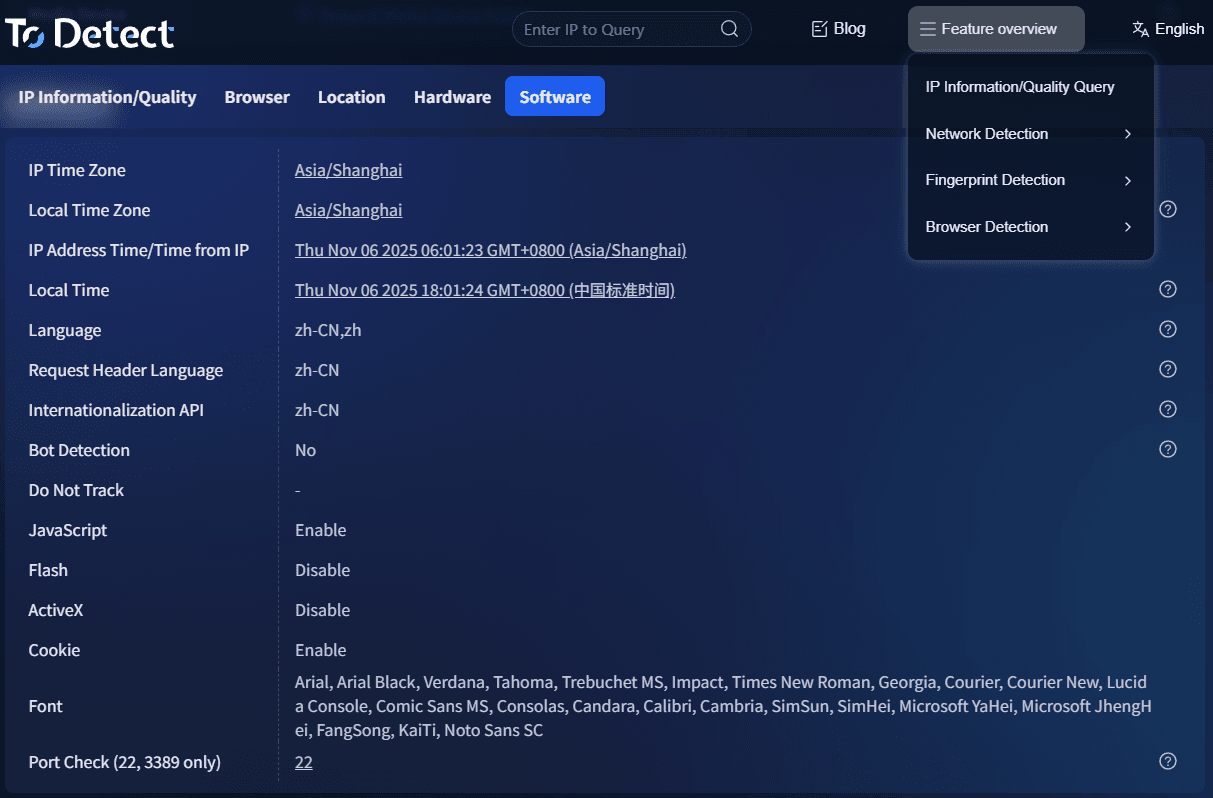
• IP purity detection, IP type identification (residential/datacenter/proxy), risk scoring, and network fingerprint analysis
• The biggest value is not “checking IP,” but quickly determining whether it can be used for accounts
• Especially in new account warming stages, full detection helps avoid large-scale account losses
7. Practical IP stability monitoring methods (often ignored)
Professional teams do not just check IP once—they continuously monitor it:
◇ Verify IP consistency with purchase info via online IP lookup
◇ Record ASN, city, and network type as baseline data
◇ Perform scheduled IP stability checks daily
◇ Detect hidden changes in ISP or routing
◇ Run proxy IP lookup when anomalies occur
◇ Maintain per-account IP logs for multi-account operations
◇ Use ToDetect for periodic risk and blacklist checks
8. Static IP online lookup FAQ
1. Why does a static IP still change or cause login issues?
Some static IPs are actually shared or semi-static resources. Network routing or provider changes may still cause variation. Use regular monitoring to ensure stability.
2. Are frequent account verifications caused by dirty IPs?
Not always, but IP is a major factor. Proxy-risk or datacenter IPs can trigger platform security systems.
3. Do multi-account operations require separate IP monitoring?
Yes. Each account should have independent IP tracking to avoid cross-account association risks.
Summary
Many “sudden bans” or unstable accounts in cross-border e-commerce are not caused by operations, but by environment issues—especially IP.
Static IP is only the foundation. The real difference comes from whether you regularly perform IP lookups, verify stability, and proactively monitor anomalies.
If you still just “buy an IP and use it directly,” you are already one step behind. In cross-border operations, the competition is increasingly about attention to detail rather than the number of tools.