



 Resources
 Feature overview
 Ganesh
 2026-07-22 11:55
For beginners who are just entering the cross-border business field, account warming is often an unavoidable step. Before starting account management on overseas platforms such as TikTok, Facebook, and Instagram, conducting proxy IP detection is extremely important.
Nowadays, social media platforms are becoming increasingly strict when evaluating account environments. Whether an IP is suitable for long-term use requires comprehensive analysis from multiple aspects, including IP location, network type, risk history, and stability.
Today, let's discuss how cross-border beginners can determine whether an IP can be used for social media account warming, what indicators should be checked during proxy IP detection, and whether ordinary online IP lookup tools can meet actual needs.

1. Why Is IP Detection Necessary Before Social Media Account Warming?
Many people think that as long as a proxy IP can open websites normally, it can be used directly. However, an IP being able to access the internet only means it is "usable", not that it is "suitable for account warming".
Generally speaking, an IP suitable for social media account warming should meet the following requirements: the IP's country matches the target market; the IP type is authentic and stable; there are no obvious blacklist records; it is not a low-quality IP shared by many users; and the network environment remains stable over time.
Simply put, the purpose of IP detection is to determine whether the IP resembles a real user's network environment.
2. What IP Indicators Should Cross-Border Account Operators Check?
1. Check Whether the IP Location Is Accurate
IP geographic location is one of the important factors used by social media platforms to judge user authenticity. Through online IP lookup tools, users can check: IP country; specific city; ASN information; internet service provider; and time zone information. If these details do not match the account positioning, it is recommended to replace the IP.
2. Check IP Type: Residential IP or Datacenter IP
• Residential IP. Residential IPs come from real home network environments. They usually provide higher authenticity and are closer to normal user browsing behavior, making them more suitable for long-term social media account operations.
• Datacenter IP. These IPs come from server data centers. They offer fast speeds and lower costs, but because many accounts may share similar network environments, some platforms may apply stricter risk controls.
• Mobile IP. Mobile network IPs usually come from carrier cellular networks and may provide higher authenticity in certain scenarios.
For cross-border social media account warming, different platforms have different requirements. Regardless of the proxy type used, it is recommended to perform proxy IP detection first instead of using IPs in bulk immediately.
3. Check IP Historical Risk Records
Whether an IP is "clean" is a key factor affecting account stability. Some proxy IPs may have previously been used for bulk account registration, automated operations, spam marketing, or abnormal logins. Even after the IP is assigned to a new user, previous risk records may still remain.
Therefore, when performing IP quality checks, focus on: IP reputation score; blacklist status; abnormal activity records; and whether it has been flagged by security databases. If the detection result shows high risk, such IPs are not recommended for important account operations.
3. Key IP Detection Points for Different Cross-Border Business Scenarios
| Application Scenario | Main Objective | Key IP Detection Points | Common Issues |
|---|---|---|---|
| TikTok, Instagram, Facebook Account Warming | Maintain account stability and reduce risk control probability | IP stability, location matching, historical usage, proxy environment security | Frequent IP changes, multiple users sharing the same IP causing account verification |
| Overseas Advertising Campaigns | Ensure advertising accounts operate normally | IP country, ISP information, login environment consistency | IP location mismatch with advertising market, triggering account review |
| Amazon and Shopify Store Operations | Maintain store login security | IP consistency, network environment independence, stable login history | Multiple accounts sharing the same IP causing association risks |
| Overseas Customer Service Account Management | Ensure smooth daily login access | IP speed, connection stability, network quality | High network latency affecting customer service efficiency |
| Overseas Market Research | Obtain authentic regional content | IP location accuracy, access success rate, geographic authenticity | IP location mismatch with target market causing inaccurate data |
4. How to Use IP Detection Tools to Evaluate Proxy Quality?
There are many IP detection tools available on the market that can help users quickly evaluate whether a proxy environment is reliable. Taking professional detection platforms such as ToDetect as an example, users can check IP information to understand the overall condition of their current proxy network:
1. IP Risk Score
A lower risk score usually indicates a cleaner IP environment. If the detection result shows high risk, blacklist records, suspicious proxy status, or bulk datacenter IP characteristics, users should use the IP with caution.
2. Proxy Detection Results
Some platforms can determine whether the current IP belongs to a proxy server. For social media accounts requiring long-term operation, it is better to choose IPs with lower proxy detection risks and higher authenticity.
3. DNS and Browser Leak Detection
Many people overlook an important issue when using proxies: the IP has changed, but real network information may still be exposed.
For example: DNS still shows the local ISP; WebRTC exposes the real IP; browser language and time zone do not match. These details may increase account risks. Therefore, complete proxy IP detection is not only about checking the IP address itself, but also about examining the entire network environment.
5. The Correct IP Detection Process for Cross-Border Beginners
If you are doing social media account warming for the first time, you can follow the process below.
Step 1: Obtain a Proxy IP
Choose a proxy from the target country or region based on your market. For example: for US market accounts, prioritize US IPs; for UK market accounts, choose local UK IPs. Avoid frequently changing countries, as this may cause abnormal account environments.
Step 2: Perform Online IP Lookup
Check basic IP information: country, city, ISP, and ASN to confirm whether it meets business requirements.
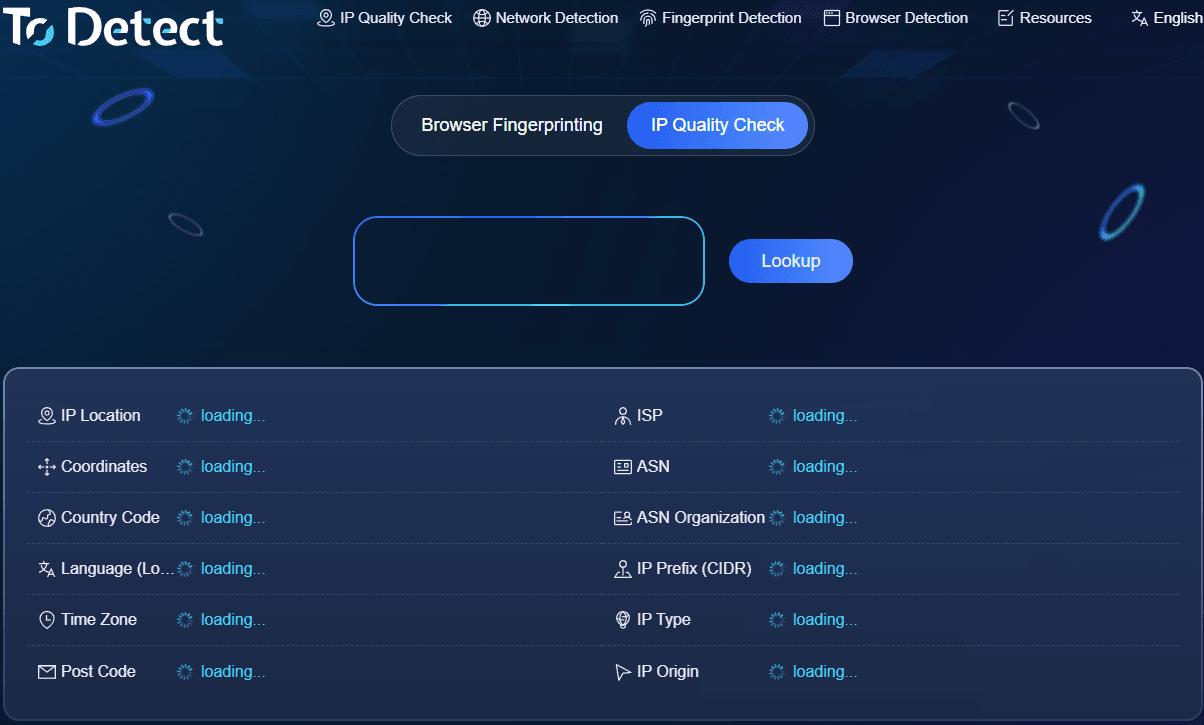
Step 3: Use Professional Tools for Proxy IP Detection
Further check IP risk level, whether it is a proxy IP, whether it appears on blacklists, and whether there are network leaks. This step helps filter out a large number of low-quality IPs.
Step 4: Simulate a Real User Environment for Testing
After passing detection, do not immediately register accounts in bulk. First test stability by logging into regular websites, maintain a fixed device environment, monitor connection speed, and avoid performing large numbers of operations within a short period. Social media platforms evaluate not only IPs but also device fingerprints and user behavior patterns.
6. What Should You Pay Attention to When Choosing Proxy IPs for Social Media Account Warming?
In addition to checking IP quality, several practical issues should also be considered.
First, avoid purchasing large numbers of extremely cheap proxies simply because of the price. Many low-cost proxies are shared resources. Although they are inexpensive, they may create higher account risks.
Second, avoid frequently switching IPs. If an account constantly logs in from multiple countries or cities, platforms may consider the account abnormal.
In addition, different accounts should ideally maintain independent network environments. Especially when managing multiple brand accounts, avoid operating multiple accounts under the same IP environment. Stability is more important than quantity.
Summary:
Social media account warming is not simply about registering accounts and publishing content. It requires long-term maintenance of a stable and trustworthy account environment. Among these factors, IP quality is one of the important elements affecting account security.
Performing detection in advance can reduce account abnormalities and lower the probability of account suspension. Choosing suitable detection tools, such as professional detection services like ToDetect, and understanding IP status beforehand can help cross-border businesses operate more steadily and sustainably.
Whether you are starting TikTok operations, Facebook marketing, or building a cross-border e-commerce business, establishing proper IP detection habits is an important step for long-term growth.