Resources
 Feature overview

 Ganesh
 2026-08-06 12:08
Even after purchasing high-quality proxy IPs, why do you still face frequent verification checks when accessing platforms? Why can some IPs be used stably while others get restricted shortly after connecting? In fact, most of these issues are related to IP purity.
The so-called IP purity refers to factors such as an IP address's past usage history, risk level, blacklist status, and whether it has been heavily reused by multiple users.
Today, we have compiled a list of common free IP purity testing websites in 2026 and how to judge whether an IP is worth long-term use, helping you quickly find a suitable IP detection solution.

1. What is Proxy IP Purity? Why Test It?
Proxy IP purity mainly refers to the "health status" of an IP address. Although an IP appears to be just a simple string of numbers on the surface, it may have left behind extensive historical records in the internet environment.
Therefore, before purchasing or using a proxy IP, checking the IP status via an IP detection tool is very necessary. Common scenarios that require testing proxy IP purity include:
• Cross-border e-commerce account operation;
• Overseas social media operation;
• Ad placement testing;
• Data collection and web scraping;
• Multi-account management;
For overseas business operations, especially enterprise users, using low-quality proxy IPs in bulk may affect business stability. Performing proxy IP lookups and risk detections in advance can prevent many subsequent issues.
2. 2026 IP Purity Testing Websites Comprehensive Overview
| Website Name | Website Type | Main Test Content | Supports Proxy IP Testing | Target Audience |
|---|---|---|---|---|
| ToDetect | Comprehensive IP Testing Tool | IP address, Region, ISP, Proxy Identification, Risk Info | Supported | Proxy IP Users, Cross-Border Business Users |
| IPinfo | Online IP Lookup Platform | IP Location, ASN, ISP, Network Type, Organization Info | Supported | Overseas Proxy IP Testing Users |
| WhatIsMyIPAddress | IP Lookup Tool | Public IP, Geolocation, Network Info, Basic Risk Detection | Supported | General Users, Personal Testing |
| AbuseIPDB | IP Reputation Testing Platform | Blacklist Records, Malicious Behavior Reports, Risk Score | Supported | Security Audit, Batch Screening |
| IP138 | Domestic IP Lookup Website | IP Location, ISP, Basic Network Info | Partially Supported | Domestic Users for Quick Lookup |
| IPLocation | IP Location Detection Tool | Country, City, ISP, Coordinates Info | Supported | Overseas IP Location Verification |
| BrowserLeaks | Browser Environment Testing Tool | IP, DNS Leak, WebRTC Leak Detection | Supported | Privacy-Conscious Users |
| DNSLeakTest | DNS Testing Tool | DNS Servers, Proxy Leak Detection | Supported | Check Proxy Anonymity Effect |
| Scamalytics | IP Risk Testing Platform | Fraud Risk, Proxy Detection, IP Reputation Score | Supported | E-commerce, Payment Business Testing |
| MaxMind GeoIP | IP Database Lookup Tool | IP Location, Network Type, Risk Analysis | Supported | Enterprise-Grade IP Analysis |
3. Detailed Guide to 2026 Free IP Purity Testing Websites
Below is a curated list of commonly used free IP detection platforms so you can choose according to your specific needs.
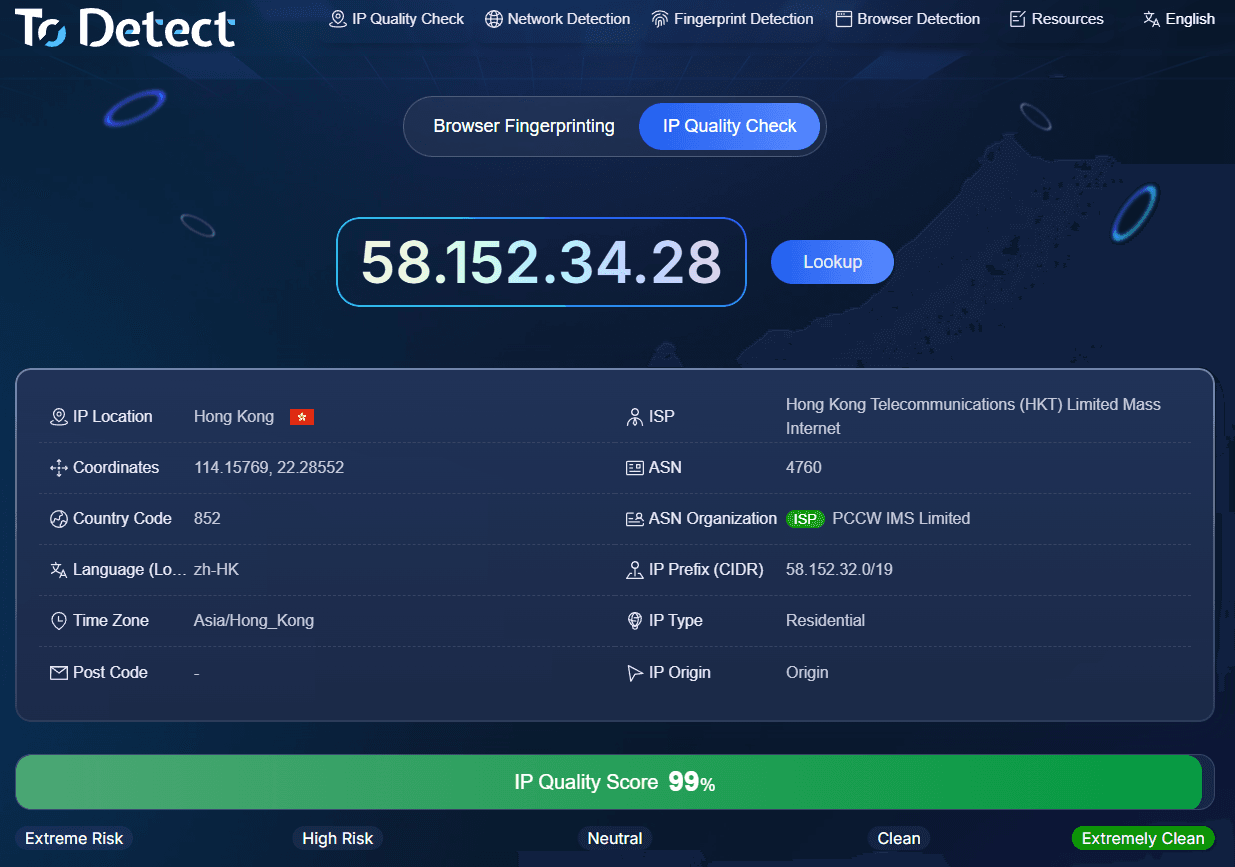
1. ToDetect IP Testing Platform
ToDetect is one of the popular platforms used by many users to test proxy IPs.
It helps users view current IP details, including: IP address; Country/Region; Network Operator; Proxy Usage Status; IP Risk Information.
For beginners using proxy IPs, ToDetect is easy to operate—simply open the website to view your current network environment.
If you want to test whether a purchased proxy IP is authentic and valid, connect to the proxy first, then perform a test via ToDetect to verify if the results match your purchase details.
2. IP138 Online IP Lookup
IP138 is a widely used IP lookup service in China. It is primarily used to check basic details such as IP address location and ISP, making it suitable for quick online IP lookups.
Note that basic location queries can only determine fundamental information. For deeper data like IP risks and blacklists, it is recommended to use it alongside other detection tools.
3. IPinfo IP Detection Tool
IPinfo is a well-known international IP information lookup platform.
It provides detailed IP data, including: ASN info; ISP operator; Geolocation; IP type classification. If you use overseas proxy IPs, IPinfo usually offers a comprehensive reference.
4. WhatIsMyIPAddress
WhatIsMyIPAddress is another popular online IP lookup website.
It allows you to view your current public IP while providing basic location and network details. It is very convenient for testing whether a proxy is active.
5. AbuseIPDB IP Risk Detection
AbuseIPDB focuses more on security risk detection.
It is mainly used to check whether an IP has abuse report records, such as spamming or malicious attacks. If you want to judge if a proxy IP is blacklisted, this platform provides valuable reference.
4. How to Test Proxy IP Purity? Step-by-Step Guide
Many people know they need to test IPs, but do not know how to operate step-by-step. In fact, the testing workflow is straightforward.
• Step 1: Obtain a Proxy IP. You can purchase a proxy service or use a test proxy IP.
• Step 2: Connect to the Proxy. Configure the proxy IP in your browser, software, or system network settings.
• Step 3: Open Multiple IP Detection Websites. Do not rely on a single platform, as data sources vary across websites.
• Step 4: Compare Detection Results. Pay close attention to: whether the IP location is consistent; whether the ISP matches expectations; whether proxy status is detected; whether risk records exist. If results across multiple platforms are consistent, the proxy IP quality is generally stable.
5. How to Judge Whether a Proxy IP is "Pure" Enough?
When selecting a proxy IP, do not focus solely on price. To evaluate IP quality, consider the following points:
• Long-term Stability: IPs that disconnect frequently or fail quickly generally offer a poor user experience.
• Shared Usage: Shared proxy IPs are easily affected by other users' actions, causing purity to drop rapidly.
• Historical Risk Records: If an IP was heavily abused in the past, potential risks remain even if it works currently.
• Business Scenario Alignment: Different tasks have distinct IP requirements. For instance, basic web browsing has lower IP demands, whereas account operations and ad verifications demand higher IP quality.
6. What to Keep in Mind When Using IP Purity Testing Websites?
First, do not rely on a single test result. Different platforms use distinct data sources—some prioritize geographic location, while others focus on security risks. A comprehensive evaluation provides greater accuracy.
Second, simulate real usage conditions during testing. For example: test via browser access; inspect the cookie environment; test connection speeds; check for frequent CAPTCHA prompts.
Finally, do not blindly chase a "100% pure IP". The internet environment changes constantly; an IP that is clean today is not guaranteed to remain risk-free forever. Choosing stable, authentic, and task-appropriate proxy IPs remains the core standard.
Conclusion
No IP can guarantee 100% purity forever. Therefore, evaluating your proxy IP through IP purity testing websites prior to use is a simple and effective approach.
By utilizing the free testing platforms compiled in this article, users can analyze proxy IPs from multiple dimensions, including IP geolocation, ISP data, proxy detection status, blacklist records, and risk scores.
Properly utilizing IP purity testing websites and mastering correct evaluation methods will help you secure safer, more reliable, and high-quality proxy IP resources in complex network environments.