



 Resources
 Feature overview
 Ganesh
 2026-07-27 12:23
Many people become confused when they see messages like "High Risk" or "Risk Score 60+": Does it mean the IP has been blocked? Is the network environment unsafe? Why does the same IP receive different results on different platforms?
In fact, an IP risk score is not simply used to determine whether an IP can access the internet. Instead, it evaluates multiple dimensions, including the IP's historical usage, network characteristics, and potential risks.
Today, let's take a look at what to do when an IP detection tool shows a risk score above 60, how to quickly handle high-risk IPs, and how to reduce IP risk scores.

1. IP Detection Tool : What Does a Risk Score Above 60 Mean?
Generally, IP detection tools use algorithms to analyze an IP address comprehensively and determine whether it has abnormal activity. Different platforms may use different scoring standards. When an IP risk score exceeds 60, common reasons include:
First, the IP may have been used by many users. For example, public proxy IPs and shared exit IPs are used by multiple people, and the actions of one user may affect the reputation of the entire IP.
Second, the IP may belong to a special network type. For example, data center IPs, cloud server IPs, and IDC hosting IPs are often monitored more strictly in certain business scenarios.
Third, the IP may have abnormal historical behavior. If the IP was previously involved in large-scale account registration, bulk access, frequent API requests, or similar activities, risk databases may retain records of these behaviors.
Fourth, the IP location may not match the access behavior. For example, if an account shows a US location but the IP frequently changes or accesses from multiple countries within a short period, the risk score may increase.
2. How to Use Online IP Lookup to Determine Whether an IP Really Has Problems?
Many people only check the IP location when using online IP lookup tools, while ignoring more important detection factors. A complete IP quality check usually includes:
1. Check Basic IP Information
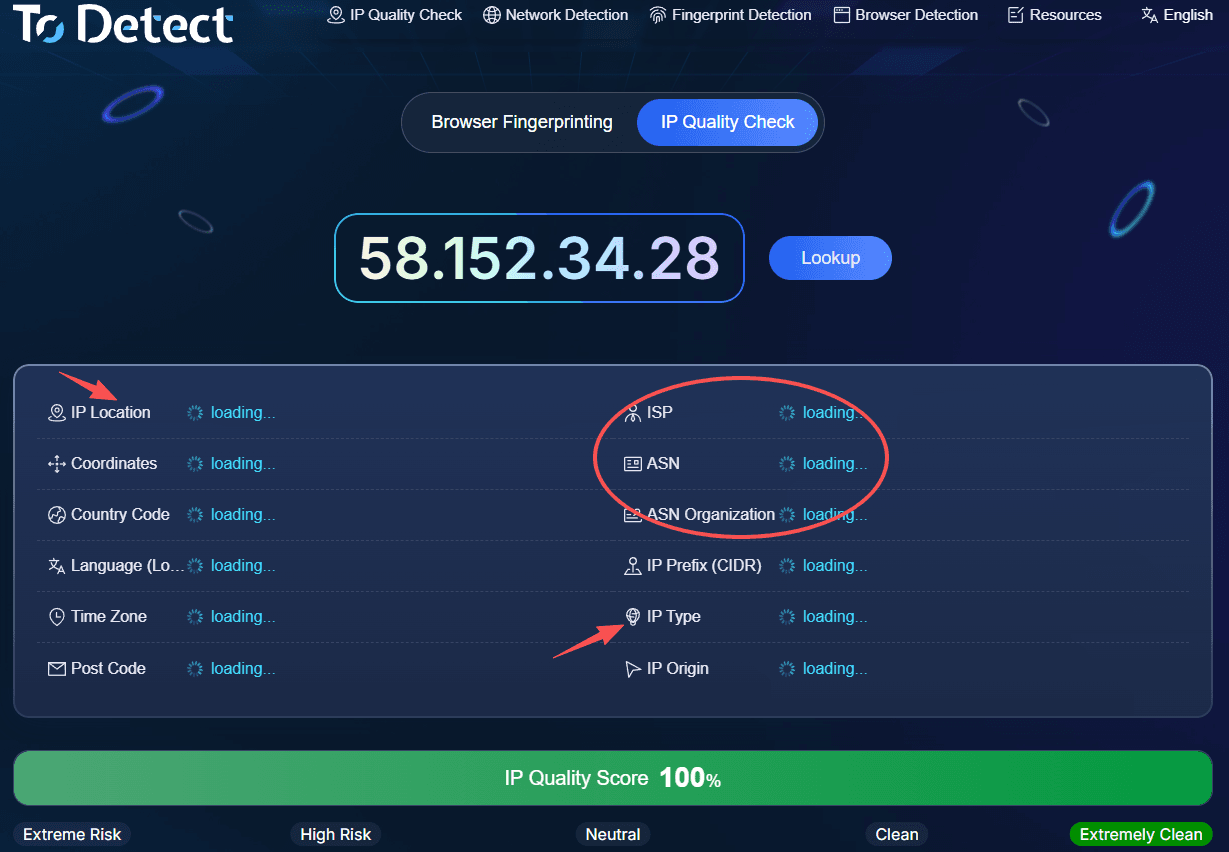
This includes IP location, country and city information, network provider, ASN information, and IP type. For example, a normal residential broadband IP and a cloud server IP may have completely different risk scores. Residential IPs are usually closer to real user environments, while data center IPs are more likely to be restricted by some platforms.
2. Check Proxy Attributes
Proxy detection is an important part of evaluating IP quality. If the detection result shows:
• Proxy: Yes;
• Tor: Yes;
• Hosting: Yes;
It means the IP may belong to a proxy server exit node or a data center IP. For scenarios such as account operations, e-commerce platforms, and advertising businesses, these types of IPs usually carry higher risks.
3. Check Blacklist Records
Some IP detection tools check whether an IP has appeared in spam blacklists, cyber attack databases, malicious access lists, or automated behavior databases. Even if the IP currently has no abnormal activity, previous blacklist records may still affect future business operations.
3. Reference Standards for IP Risk Scores in Different Business Scenarios
| Usage Scenario | Recommended Risk Score Range | Key Detection Items | Potential Issues Caused by High Risk |
|---|---|---|---|
| Daily Web Browsing | Within 0-70 | IP Location, Basic Reputation, Access Stability | More access verification steps, restricted access to some websites |
| Enterprise Business Access | Within 0-40 | IP Reputation, Network Type, Historical Records | Abnormal enterprise system login, frequent security verification |
| Overseas Business Operations | Within 0-30 | Location Matching, IP Quality, Proxy Detection | Incorrect region identification, affecting user data analysis |
| Account Registration & Maintenance | Within 0-30 | IP History Behavior, Risk Score, Device Environment | Registration failure, account security review triggered |
| Data Collection Tasks | Within 0-20 | IP Stability, Request Quality, Abnormal Records | Higher request failure rate, reduced data collection efficiency |
| Advertising Campaign Testing | Within 0-30 | IP Authenticity, Region Matching, Traffic Source | Lower traffic quality, inaccurate testing data |
4. What Are the Common Impacts of High-Risk IPs?
Many users think that a high IP risk score is only a detection result. In reality, high-risk IPs can affect multiple business scenarios.
1. Account Registration May Fail Easily
For example, when registering overseas email accounts, social platforms, or e-commerce accounts, if the system detects a high-risk IP, it may trigger: frequent verification codes, interrupted registration processes, additional account verification, or restrictions after registration.
2. Advertising Performance May Decline
Advertising platforms usually evaluate the quality of traffic sources. If a large amount of traffic comes from high-risk IPs, it may result in slower ad reviews, abnormal conversion data, and reduced traffic quality.
3. Website Access Restrictions
Some websites use IP risk detection systems to determine whether visitors are legitimate. High-risk IPs may trigger Cloudflare verification, slider verification, access restrictions, or temporary bans.
4. Reduced Data Collection Efficiency
For data scraping, market analysis, and similar businesses, low-quality IPs may cause request failures, CAPTCHA challenges, and incomplete data collection. Therefore, maintaining good IP quality is important for long-term stable operations.
5. IP Risk Detection : How to Quickly Fix a Risk Score Above 60?
If an IP detection tool shows a risk score above 60, you can try the following solutions.
Method 1: Replace with a Higher-Quality IP
If the current IP belongs to a public proxy, shared node, or high-risk data center IP, it is recommended to replace it with a new IP resource. When selecting an IP, do not only consider price. Pay more attention to IP history, whether it is shared by multiple users, whether it supports long-term stable use, and whether it passes proxy detection.
Method 2: Avoid Frequently Switching IPs
Some users believe that more IPs mean better security and frequently change IP addresses. However, rapidly switching between many IPs within a short period may create new risk signals. For normal business operations, it is recommended to maintain a stable IP environment, keep access patterns consistent, and avoid frequent changes.
Method 3: Check the Proxy Environment
If you are using a proxy network, proxy detection should be performed. Key factors include whether the proxy IP is genuine, whether it is shared by many users, whether it has been heavily used by other businesses, and whether it is an open proxy. High-quality proxies usually provide better stability and lower risk.
Method 4: Reduce Abnormal Access Behavior
IP risk is not only related to the IP itself but also to how it is used. For example, high-frequency website requests, registering multiple accounts in a short period, obvious automation behavior, and repeatedly accessing the same pages can all affect IP reputation.
Improvements include controlling access frequency, simulating normal user behavior, increasing access intervals, and avoiding repeated abnormal operations.
6. How to Choose a Reliable IP Detection Tool?
There are many IP lookup services available today, but the quality of detection results varies. A professional IP detection tool should provide:
• Support for Multiple Detection Dimensions
It should not only display the IP address but also provide IP risk scores, proxy detection, data center identification, blacklist checks, and IP quality analysis.
• Timely Data Updates
IP reputation can change quickly. If the database is not updated regularly, the detection results may lose practical reference value.
• Transparent Detection Criteria
A good tool should explain why an IP is considered high risk. For example: proxy detected, blacklist match, data center IP, or historical risk records.
Currently, many users rely on professional platforms such as ToDetect for IP risk analysis and use online IP lookup tools to quickly understand their current network environment quality.
7. Frequently Asked Questions About IP Risk Detection
1. Why does my IP detection tool show a risk score above 60? Can I still use it normally?
Answer: An IP risk score above 60 usually indicates that the IP has certain risk factors, such as abnormal historical usage, low IP quality, or being shared by multiple users. It is recommended to use a professional IP risk detection tool to further analyze the specific cause. If it is only a general risk warning, you can replace the IP environment or optimize your usage behavior.
2. Online IP lookup shows that my IP is high risk. How can I quickly reduce the risk?
Answer: First, use online IP lookup tools to check the detailed risk reasons. Focus on the IP type, proxy status, and historical reputation. If the IP quality is poor, consider replacing it with a more stable IP resource and avoid frequent network changes or large-scale access activities within a short period.
3. Why does the same IP receive different risk scores from different IP detection tools?
Answer: Different IP detection tools use different data sources, detection models, and risk evaluation standards, so scores may vary. It is recommended to evaluate multiple indicators together, including IP quality analysis, proxy detection results, and risk scores. Professional platforms such as ToDetect can help users understand their IP status more comprehensively.
Summary:
An IP risk score above 60 does not necessarily mean that the IP cannot be used. However, it indicates that the current network environment may have potential risks that require analysis and adjustment.
If the problem is caused by shared proxies, replace them with higher-quality IPs. If the issue comes from abnormal access behavior, adjust the usage pattern. If it is related to historical reputation problems, consider selecting a cleaner network environment.
Choosing a reliable IP detection tool, such as professional services like ToDetect, can help users quickly evaluate IP status, reduce issues caused by high-risk IPs, and create a more stable and secure network environment.