



 Resources
 Feature overview
 Ganesh
 2026-07-28 17:18
Many users mistakenly assume that "being able to connect" means an IP is usable, overlooking the strict reputation assessments executed in the background by platform risk control systems.
An IP with a low reputation score or abnormal historical records can increase the probability of access restrictions, verification requirements, or triggered security checks.
This article provides a professional perspective on how to scientifically evaluate proxy IP quality and its risk score.

What is IP Quality and Cleanliness?
IP cleanliness generally describes an IP's overall performance across multiple dimensions, including network origin, historical reputation, fraud risk score, and behavioral consistency.
In internet security systems, different risk control models evaluate factors such as IP history, network type, and blacklist records. IPs frequently used for abnormal activities are flagged as "high risk" in security databases.
Six Core Dimensions for Evaluating Proxy IP Quality
To perform a comprehensive check on a proxy IP, focus on the following metrics:
1. IP Type: Residential IP vs. Datacenter IP
Residential IP: Broadband networks assigned to home users by Internet Service Providers (ISPs). These typically resemble ordinary user environments and hold higher credibility in scenarios requiring genuine user verification.
Datacenter IP: Sourced from cloud providers (such as AWS and Google Cloud). Some platforms use datacenter IPs as a risk factor because automated services and server traffic originate heavily from these networks.
2. Blacklist Status
This is an essential indicator for assessing historical IP risk.
Global blacklist databases like Spamhaus and AbuseIPDB track known spam sources and malicious activity origins.
If an IP appears on multiple blacklists, it faces a higher probability of verification challenges or restrictions on security-strict platforms.
3. Fraud Score and Risk Level
Mainstream risk assessment tools (such as IPQualityScore) provide fraud scores.
Higher scores typically indicate more risk factors, though exact thresholds depend on business scenarios, target platform rules, and other environmental elements.
4. Anonymity Level
Based on how proxies handle client information, they are categorized into three types:
Transparent Proxy: Exposes the real IP, offering the lowest cleanliness.
Anonymous Proxy: Hides the real IP but exposes proxy characteristics.
High Anonymity Proxy: Does not directly expose the real client IP, though detection still depends on the IP source, network environment, and target platform mechanisms.
5. Geographic and Environmental Consistency
Platforms verify whether the IP location matches account settings such as time zone, language, User-Agent, WebRTC, DNS, and browser fingerprints.
For example, using a US IP while the system time registers as Beijing time easily triggers risk controls.
6. Online Stability and History
High-quality IPs should show stable online patterns. Additionally, you should review past usage history, prioritizing IPs with minimal risk records and good blacklist status.
Risk Mitigation Strategies in Business Operations
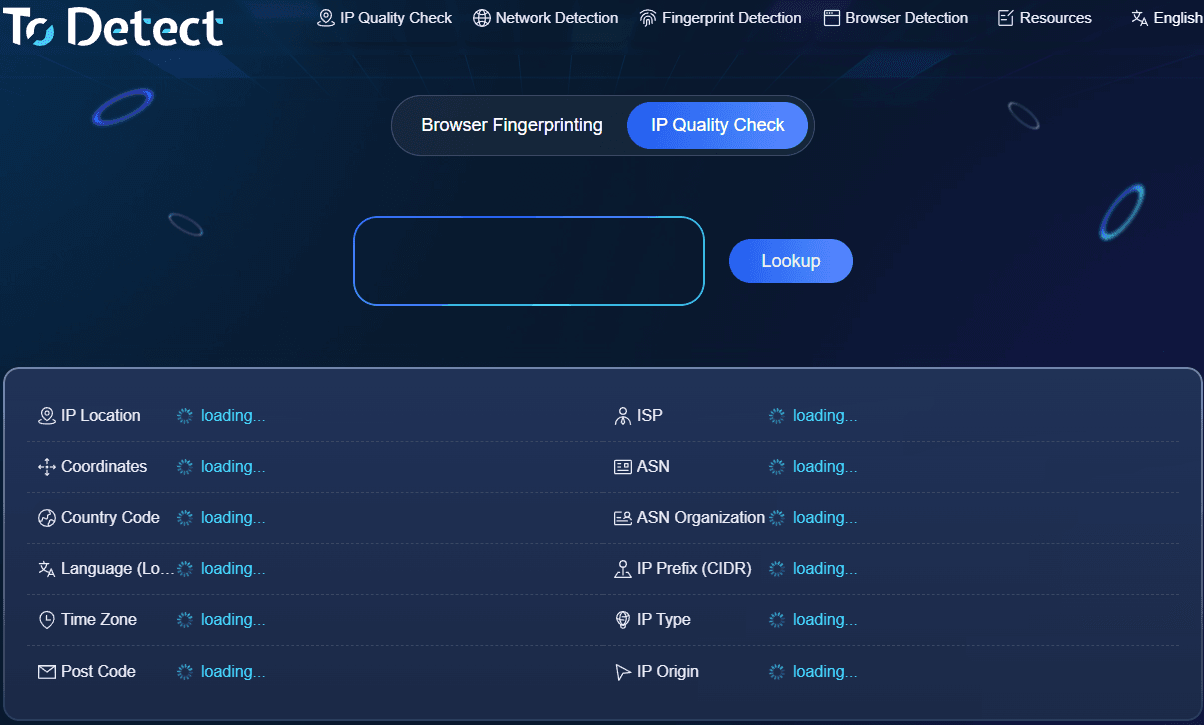
Pre-Operation Checks: Before logging into core accounts or executing critical tasks, evaluate IP quality using tools like ToDetect to ensure risk metrics remain within safe ranges.
Avoid Shared Contamination: Opt for exclusive residential IPs when possible. Shared IP pools are like co-living spaces; other users' rule violations can negatively impact overall IP reputation.
Multi-Dimensional Consistency Checks: Ensure parameters like IP location, browser fingerprint, operating system, and time zone align closely to lower the chance of bot detection.
FAQ
Q1: Does connectivity mean an IP is completely fine?
Not necessarily. Connectivity only proves normal network routing. If the IP has a low reputation score or is flagged by the target platform, it can still cause business failure.
Q2: What is a "Native IP"?
A native IP generally refers to an IP whose assigned ISP matches the target country or region and is distributed by a local network operator.
Q3: Why can't my IP stealth reach 100%?
This usually results from a leak point, such as WebRTC exposing the real IP or a system time zone mismatch with the IP location.
Q4: Are residential IPs always better than datacenter IPs?
For scenarios requiring simulated standard user environments, residential IPs typically align better with platform expectations than datacenter IPs.
Q5: How can I get a more detailed report on my current IP environment?
Visit the ToDetect IP Testing Tool to get comprehensive network characterization and environmental security assessments, helping you build a trusted digital identity for cross-border operations.
Browser Fingerprint Detection Tool
Efficiently solve multi-account management, environment isolation, and account security