



 Resources
 Feature overview
 Ganesh
 2026-07-28 11:55
Nowadays, there are more and more proxy IP resources available, with significant differences in price, type, and stability. Some IPs may appear to connect normally, but in reality they may have already been marked as high-risk, with issues such as insufficient anonymity, inaccurate geographic location, and complicated historical usage records.
In fact, determining whether a proxy IP is reliable is not complicated. Before officially using a proxy IP, performing a proxy IP check can help you understand the general quality of the IP within just a few seconds.
Today, we will show you how to quickly determine whether a proxy IP is trustworthy. Is there a simple way to check IP authenticity, anonymity level, and risk rating within seconds?

1. Why Must You Check a Proxy IP Before Using It?
Many users believe that if a proxy IP can connect successfully, it means the IP is normal. However, "usable" and "high-quality" are completely different concepts. Ordinary proxy IPs may have the following issues:
First, the IP address may have already been used by a large number of users, resulting in a lower reputation score. For example, some e-commerce platforms, social media platforms, and search engines may restrict IPs with frequent abnormal access.
Second, the actual location of the proxy IP may not match the advertised location. Some proxy providers claim to offer US IPs or Japan IPs, but actual testing may show that they come from other regions, which can affect business performance.
Third, the proxy IP type may not meet your requirements. Data scraping may require high-anonymity proxies, while advertising verification may require residential proxies. If the IP type does not match your needs, even a successful connection may still fail.
Therefore, performing a proxy IP check before officially using a proxy IP is extremely important. Through simple testing, low-quality IPs can be filtered out in advance, improving the success rate of future operations.
2. What Metrics Are Important in Proxy IP Detection ?
When performing proxy IP detection, you should not only look at the IP address itself but also pay attention to multiple dimensions.
1. IP Location Detection
Through online IP lookup tools, you can check information such as the proxy IP's country, city, and network provider. If the IP location does not match the expected information, it may indicate that there is a problem with the proxy. For overseas marketing, cross-border e-commerce, and advertising campaigns, accurate IP geolocation is extremely important.
2. Anonymity Level Detection
Proxy IPs are usually divided into transparent proxies, anonymous proxies, and high-anonymity proxies. To check the anonymity level of a proxy IP, you can examine whether the HTTP request headers expose the real IP, such as: X-Forwarded-For; Via; Proxy-Connection. If the real IP is exposed, the proxy's hiding capability is insufficient.
3. IP Risk Level Detection
Many websites now evaluate whether an access IP has risks, such as whether it belongs to a data center IP, whether it has been identified as a proxy server, whether it has malicious activity records, or whether it appears on blacklists. Therefore, when performing IP quality checks, IP reputation scores should be carefully considered.
4. Connection Speed and Stability Detection
Proxy IP speed directly affects user experience. During testing, you can evaluate response time, download speed, connection success rate, and continuous access stability. If a proxy IP connects quickly at first but frequently times out after repeated tests, its actual value is limited.
3. How to Determine Whether a Proxy IP Is Reliable in 3 Seconds?
| Detection Item | 3-Second Checking Method | Normal Result | Explanation of Abnormal Situation |
|---|---|---|---|
| IP Location | Use an online IP lookup tool to check location information | Country and city match the purchased information | Location mismatch, possibly a fake IP or shared IP |
| IP Type | Check the identification result from an IP detection tool | Shows residential IP, mobile IP, or another required type | Shows a high-risk data center IP, easily triggering restrictions |
| Anonymity Level | Check proxy detection results | No real IP leakage, high-anonymity status | Real IP exposed, lower security level |
| Risk Score | Perform an IP quality check | Low risk level with no blacklist records | Abuse records exist, making it easier to be blocked by target websites |
| Network Speed | Test proxy connection response time | Stable webpage loading speed with no obvious delays | Frequent timeouts or slow loading affect business efficiency |
| Website Recognition Status | Test access using the target website | Normal access without increased CAPTCHA verification | Frequent verification or access denial indicates poor IP quality |
4. Complete Guide to Common Proxy IP Detection Methods
Method 1: Use an Online IP Lookup Website
This is the simplest method and is suitable for ordinary users who need to quickly evaluate proxy IP conditions.
Open an online IP lookup page to view current IP information, including: IP address; country and region; network provider; ASN information; and whether it is a proxy IP. This method is simple to use and requires no software installation, making it ideal for beginners who are new to proxy IPs.
However, it should be noted that ordinary online IP lookup tools can only display basic information. If you want to understand IP reputation and risk level, you need to use more professional IP detection tools.
Method 2: Use Professional IP Detection Tools
Professional IP detection tools can provide more detailed data analysis. Common detection items include: IP type detection; proxy identification; blacklist detection; DNS leak detection; WebRTC leak detection; and IP reputation checks.
For example, professional detection platforms like ToDetect can help users quickly analyze proxy IP quality and determine whether the current IP is suitable for use from multiple perspectives.
Method 3: Use Command-Line Tools for Detection
For technical users, proxy IPs can also be tested through command-line tools. For example, ping can be used to test network latency, while curl can be used to check returned access information. Although this method is flexible, it requires technical knowledge and cannot fully evaluate IP reputation, so it is usually used as a supplementary testing method.
5. How to Use ToDetect for Proxy IP Detection?
ToDetect is a convenient IP detection solution suitable for users who need to quickly evaluate proxy IP quality. The usage process is usually very simple:
Step 1: Prepare the proxy IP that needs to be tested.
Step 2: Configure the proxy IP in the testing environment.
Step 3: View the detection results through ToDetect.
The detection report usually contains multiple important details, such as: IP location; IP provider; whether it belongs to a proxy network; anonymity level; risk score; DNS/WebRTC leak status. Through these results, users can quickly determine whether a proxy IP meets their business requirements.
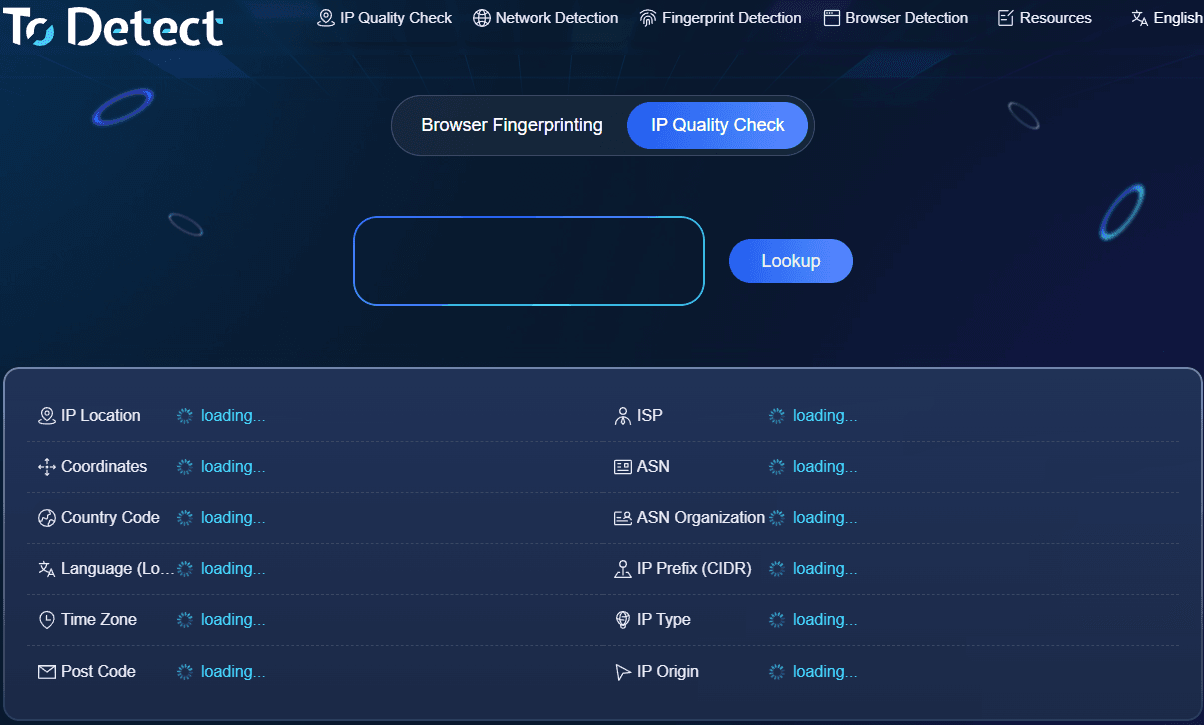
For example, if you need to manage overseas social media accounts, you should focus on IP stability and risk level. If the IP is used for web data collection, you should pay more attention to anonymity level and access success rate.
6. Common Issues Often Ignored During IP Quality Check
Many people only focus on whether an IP is a proxy IP when performing an IP quality check. However, this alone is not enough. A truly high-quality proxy IP should also meet the following conditions:
Clean IP history. Some proxy IPs have been used by a large number of users for a long time and may already be monitored by target websites. Even if these IPs can currently access websites normally, they may trigger restrictions at any time.
The IP type matches the business purpose. Residential IPs, data center IPs, and mobile IPs each have different applications. For example: account registration usually requires a more realistic user environment; data collection focuses more on stability and speed; advertising verification focuses more on geographic authenticity. Choosing the wrong IP type can greatly reduce effectiveness.
IP pool update frequency. Proxy IPs are not fixed resources. High-quality proxy providers usually continue updating their IP pools to reduce repeated usage and accumulated risks.
7. Frequently Asked Questions About Proxy IP Detection
Q1: Why can a proxy IP connect normally but still get restricted by websites after some time?
A: Successful connection does not mean the IP quality is good. Many proxy IPs may have historical risks, high reuse rates, or have already been flagged by platforms. It is recommended to use IP quality check tools to evaluate IP reputation, anonymity level, and risk records in advance to filter high-quality IPs.
Q2: Why is the proxy IP location correct according to online IP lookup, but actual access is still abnormal?
A: Online IP lookup tools mainly display basic information and cannot completely evaluate IP quality. Some proxy IPs may have DNS leaks, proxy detection risks, or real IP exposure issues. A professional IP detection tool is required for comprehensive testing.
Q3: How can I quickly determine whether a proxy IP is reliable?
A: You can evaluate several key indicators through proxy IP detection: whether the IP location is accurate, whether the anonymity level meets requirements, whether the risk score is normal, and whether the access speed is stable. Using detection tools such as ToDetect, basic evaluation can usually be completed within seconds.
Conclusion
The quality of a proxy IP cannot be judged simply by whether it connects successfully. A proxy IP suitable for long-term use requires comprehensive verification, including accurate IP location, sufficient anonymity, stable access speed, and the absence of risk records.
Before officially using a proxy IP, spending a few seconds on proxy IP detection is highly necessary. By combining professional platforms such as ToDetect for IP quality checks, users can more accurately determine whether an IP is worth using.
Spending a few extra seconds checking a proxy IP before selection can save significant time and cost later. A truly stable, secure, and high-quality proxy IP is an important foundation for long-term business operations.
Browser Fingerprint Detection Tool
Efficiently solve multi-account management, environment isolation, and account security