Resources
 Feature overview

 Ganesh
 2026-08-14 11:13
Nowadays, many businesses rely heavily on IP addresses, especially in scenarios such as cross-border e-commerce, overseas access, ad placement, account management, and network data analysis. Whether an IP can be used stably is often far more complex than simply "can it open a webpage."
Therefore, before officially using an IP, performing a comprehensive IP quality check is essential. Through online IP lookup, you can first learn where the IP originates, then conduct IP type testing, and finally perform IP risk detection by evaluating proxy attributes, blacklist records, and other information.
Today, let us walk you through what specific aspects an IP check should cover, whether a single online IP lookup is enough, how to identify the IP type, and how to perform effective IP risk detection.

Step 1: Perform an online IP lookup first to confirm basic information
When conducting IP detection, the first step is usually looking up basic IP information. Through online IP lookup tools, you can first obtain details such as the country, region, city, ASN, ISP (Internet Service Provider), and network organization corresponding to the IP address. Although this step seems simple, it serves as the foundation for subsequent IP quality assessments.
If the same IP exhibits significant discrepancies in country or ISP information across different databases, it may indicate outdated database updates or special network attributes inherent to the IP itself.
Therefore, online IP lookup primarily solves the question of "who is this IP and where does it come from," rather than directly deciding "whether this IP is good or bad." Once basic information is confirmed, you still need to proceed with IP type testing and risk detection.
Step 2: Perform IP type testing to classify the IP
In practical applications, IP type testing is crucial. Common IP types can generally be categorized into residential IPs, mobile IPs, data center IPs, and others. Different types of IPs differ significantly in network environment, stability, and usage scenarios.
Residential IPs are generally associated with genuine home broadband networks and typically possess network characteristics closer to regular users. Mobile IPs stem from cellular mobile networks, where the network environment and IP change frequency might be higher; while their stability is usually good, some platforms enforce stricter identification against such IPs.
In addition, attention must be paid to whether the IP belongs to special networks such as proxy IPs, exit nodes, or Tor nodes. Many platforms do not determine user legitimacy purely by country and city; instead, they conduct comprehensive analysis combining ASN, network organization, historical data, and proxy characteristics.
Step 3: Check proxy and anonymity attributes
After determining the IP type, the next step is to verify whether the IP exhibits proxy or anonymous network characteristics. This is a critical step that many people overlook during IP quality checks.
Even if an IP displays a normal US or UK address, it does not necessarily mean it belongs to a regular residential network. If the IP originates from a known proxy server exit node or hosted data center server, its actual trust score may drop significantly on platforms with strict risk control.
If the tool provides an anonymity level, you can also evaluate the IP based on its degree of anonymity. Generally speaking, the more complex an IP's exposed network attributes are, the higher the likelihood of encountering verifications, login restrictions, or access blocks during subsequent use.
Step 4: Focus on IP risk detection to check historical risk records
If the previous steps determine "what the IP is," then IP risk detection resolves "whether this IP has issues." Risk detection typically integrates blacklists, spam records, malicious behavior logs, fraud databases, and historical abuse information to make a comprehensive judgment.
Here, special attention should be paid to the difference between "current status" and "historical records." When conducting IP risk detection, you should not rely solely on a simple "safe/dangerous" verdict; it is best to examine the risk type, risk source, and detection timestamp simultaneously.
Step 5: Combine multiple metrics to evaluate IP quality
A proper IP quality check should never rely on a single metric. A reasonable approach is to analyze IP geolocation, IP type, proxy status, ASN, anonymity level, and risk records collectively.
For instance, if a residential IP has a normal location, no proxy signatures, and no noticeable history of risk records, its overall quality is usually ideal. Conversely, if an IP shows a normal geographical location but belongs to a data center network and is flagged as a proxy or suspicious by multiple risk databases, its actual quality requires cautious evaluation.
For enterprises, custom IP scoring criteria can be established according to specific business needs. For example, assign different weights to IP type, risk level, proxy attributes, and blacklist records to compute a composite score. Compared to merely checking "whether it is safe," this method is far better suited for batch testing large volumes of IPs.
6. What information to focus on when using ToDetect for IP detection?
If you prefer not to query multiple databases manually, you can use comprehensive IP detection tools like ToDetect. During actual testing, you can enter the target IP to inspect basic location details, then observe the IP type, ASN, proxy attributes, and risk-related results.
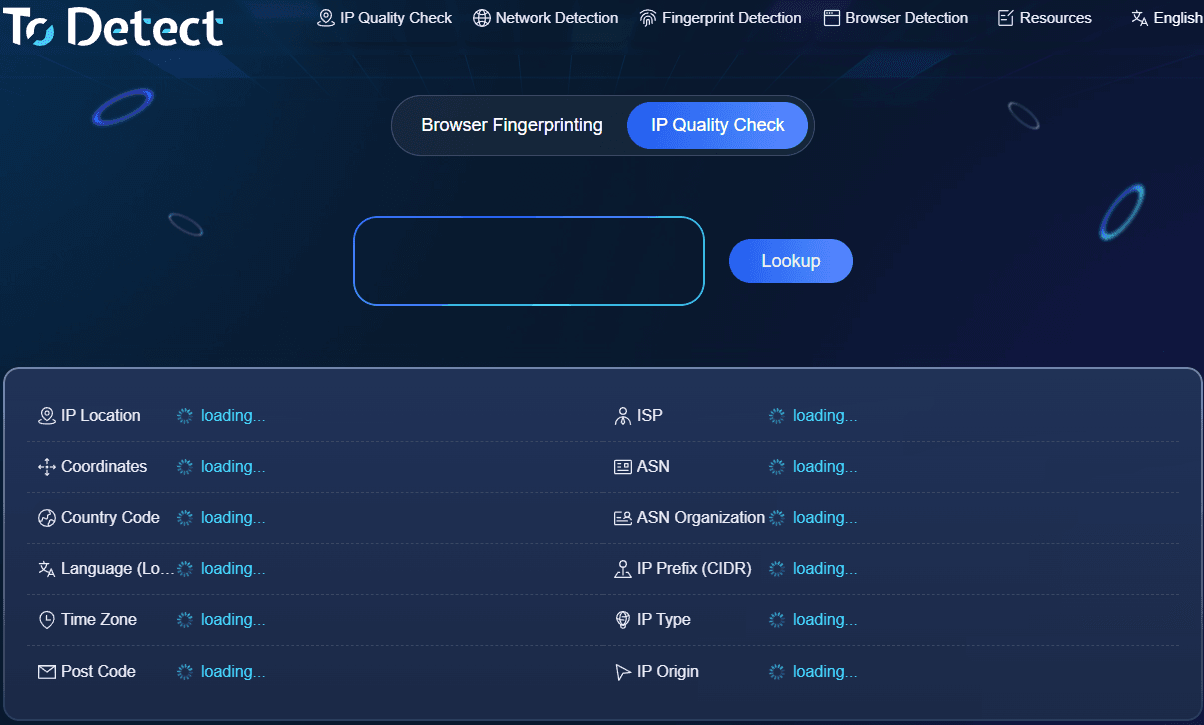
When using the tool, do not focus only on the final detection conclusion. Truly valuable information is often hidden within detailed fields—for example, whether the IP is identified as residential or data center, whether proxy signatures exist, whether the ISP appears normal, and whether it has been indexed by risk databases.
For bulk operations, it is recommended to randomly sample a subset of IPs for testing first. Sampling allows you to quickly assess the quality of the entire IP pool before deciding whether to expand the testing scope. This saves time and prevents deploying large volumes of low-quality IPs directly into operations.
7. How should IP quality check results be interpreted?
Many beginners assume an IP is ready for immediate use upon seeing a "Low Risk" result, which is not entirely accurate. IP quality is a relative concept, and different business use cases have varying requirements for IPs.
For example, general web browsing may have low demands on IP quality, requiring only normal connectivity without obvious malicious records. However, for tasks like account registration, e-commerce operations, or other scenarios sensitive to network environments, residential attributes, historical reputation, proxy signatures, and IP stability become critical factors.
Therefore, the recommended practice is to define your usage scenario first before setting detection standards. For instance, if you need to determine "whether this IP is suitable for account login," you should focus primarily on proxy characteristics, historical risk, and IP stability.
In Summary
Evaluating an IP's quality goes far beyond checking its displayed country or city. A truly valuable IP quality check requires synthesizing IP location, network type, ASN, proxy attributes, and historical risk records together.
You can use tools like ToDetect to quickly complete individual IP checks. It is recommended to establish unified evaluation standards and scoring mechanisms that combine IP type, anonymity attributes, risk records, and actual operational performance.
When performing IP testing, always clarify your specific usage scenario first and set testing criteria tailored to your actual requirements. Only then will your IP quality assessment carry practical value, helping you minimize unnecessary access restrictions and risk control triggers in subsequent operations.