Resources
 Feature overview

 Ganesh
 2026-09-01 10:20
Evaluating the quality of an IP is actually not as complicated as it seems. By using online IP lookup and detection tools, you can assess an IP address from various dimensions including its IP address, geolocation, ISP, ASN, IP type, proxy attributes, and risk history.
Many online tools are available today to complete these queries directly without requiring deep technical knowledge of complex network parameters. As long as you inspect key indicators in the proper order, you can quickly gain a clear understanding of an IP's actual condition.
Today, let's take a detailed look at what content should be checked during IP quality detection, how to operate online IP detection tools, and how to interpret the parameters displayed by these lookup services.

1. What Is IP Quality Detection Actually Checking?
IP quality detection involves a comprehensive assessment of an IP address's network attributes and security risk status. Many people mistakenly believe that identifying the country, city, and ISP completes an IP check, but that is only basic geolocation lookup.
Determining whether an IP address is suitable for long-term use requires checking its usage category, associated ASN, proxy status, and abuse or risk history. Instead of focusing solely on IP location, evaluate all these indicators holistically.
2. How to Perform an Online IP Check? Step 1: Confirm the IP Address
Before conducting an online IP test, first verify which exact IP address you are inspecting.
If you are testing your current network connection, visit an online IP lookup tool that automatically detects your public IP. If you are checking a specific target IP, input that address directly into the tool's search field.
Your public IP address can change after switching networks, modifying network hardware, or rotating environments. If you analyze Address A while actually operating on Address B, the quality detection metrics will be irrelevant.
3. Check IP Geolocation to Verify Reasonable Location
Standard IP tools display the country, region, city, and occasionally latitude/longitude coordinates. Note that IP geolocation is not GPS tracking, so minor discrepancies at the city level are normal.
Focus on verifying whether the target country and region match your requirements. Geolocation data serves to confirm broad positional logic rather than strict street-level accuracy.
4. Focus on ISP and ASN: Often Overlooked Steps
ISP and ASN represent critical indicators when evaluating IP quality.
The ISP identifies the Internet Service Provider assigned to the IP, while the ASN represents the Autonomous System Number handling routing. Together, these metrics reveal the underlying infrastructure type.
For instance, two IP addresses located in the same country may have completely different profiles if one belongs to a local residential broadband provider while the other originates from a data center infrastructure.
Always check ISP and ASN data alongside country information. If the ISP or ASN conflicts with your expected network type, perform a closer inspection.
5. How to Select an Online IP Detection Tool?
Various IP lookup tools are available, but their detection priorities differ. Some focus on basic geolocation, others prioritize IP reputation scores, and comprehensive platforms consolidate IP type, ASN, and proxy detection into a single dashboard.
Basic tools suffice for occasional public IP checks. For frequent quality checks, choose platforms offering detailed parameters, fast response times, and clear data layouts.
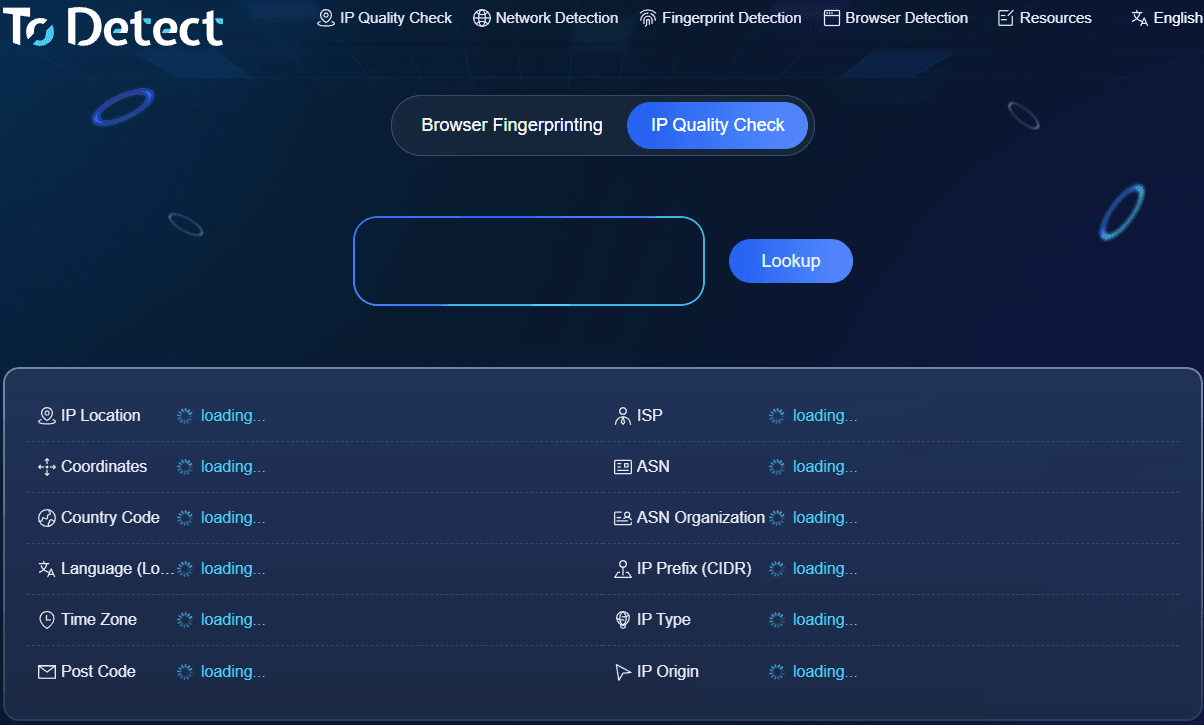
Tools like ToDetect work well for comprehensive online IP testing. When selecting a tool, evaluate its metric coverage, interface readability, and overall ease of use.
6. IP Quality Detection FAQ
1. Why do detection results for the same IP vary across platforms?
This variation occurs frequently. Different IP detection services rely on distinct databases, update intervals, and scoring methodologies, leading to variations in geolocation, IP classification, or risk ratings. Cross-reference results across multiple databases like ToDetect to identify consensus data.
2. Does a lower risk score guarantee higher IP quality?
Risk scores alone do not determine quality. Overall quality depends on ISP category, ASN classification, proxy flags, and historical abuse records. Treat numerical risk scores as reference points while evaluating the broader set of indicators.
3. How do you identify a clean IP address?
Analyze the IP category, ISP, ASN, proxy markers, and blacklist records via online tools. An IP can generally be considered clean if multiple platforms show no active abuse flags and the network attributes align with your intended use case. Note that "cleanliness" lacks a standardized industry definition.
4. Does a Residential IP classification ensure high quality?
Not necessarily. A residential label indicates the network origin type but does not guarantee clean IP reputation. Quality evaluation requires reviewing ASN, ISP reputation, proxy indicators, and historical risk records together. Residential status does not automatically equal premium quality.
7. Common Misconceptions in IP Detection
First, do not assume a normal geolocation implies a clean reputation. Location data reflects physical assignment, not security trustworthiness.
Second, avoid relying on a single risk score. Databases apply different scoring criteria, making multi-metric analysis far more accurate.
Third, do not equate network types like "Residential" or "Data Center" strictly with good or bad quality. IP classifications reflect infrastructure origins, and suitability depends on your specific application needs.
Finally, discrepancies between different tools do not necessarily mean a database is wrong. Variations stem from differing data sources, update cycles, and detection models. Evaluate overlapping metrics alongside your practical requirements.
Summary: IP Quality Detection Is Simple
Performing a thorough online IP check does not require advanced network engineering skills. Confirm the target IP address, check its geolocation, ISP, ASN, and IP classification, then verify proxy flags and risk records to complete a full evaluation.
If you perform routine IP quality checks, establish a standardized inspection workflow. Integrated tools like ToDetect display core IP parameters alongside risk indicators in a centralized view for efficient analysis.
Judging an IP address requires evaluating its overall profile rather than relying on a single metric. By analyzing IP classification, network provider, proxy flags, and security history together, you can quickly decide whether a given IP fits your operational needs.