



 Resources
 Feature overview
 Ganesh
 2026-07-24 12:20
After actually starting to build a TikTok matrix, many people realize that it is not as simple as they imagined: accounts may encounter login issues, unstable traffic, frequent verification, and even restrictions shortly after investing time and effort.
In addition to content planning, account growth, and operational strategies, the IP environment is equally important. A clean, stable, and highly trusted IP can reduce the risk of account abnormalities and improve the stability of matrix operations.
Today, we will explain how to build a TikTok matrix, what factors should be considered when selecting IPs, and how to use an IP detection tool to determine whether an IP is suitable for long-term use.

1. What Is a TikTok Matrix? Why Are More People Building One?
A TikTok matrix refers to creating multiple accounts to form an account ecosystem. Different accounts take on different roles to achieve wider traffic coverage and commercial conversion.
• Main account: responsible for brand presentation and official content output;
• Product accounts: responsible for reviews, product recommendations, and sales conversion;
• Vertical niche accounts: target different audience groups with specialized content;
• Regional accounts: operate localized content for different countries and markets.
Compared with operating only one account, the biggest advantage of a TikTok matrix is increasing exposure opportunities while reducing the impact of failure from a single account.
However, multi-account operations also mean that platforms pay more attention to the relationship between accounts. If multiple accounts continuously use the same device, network environment, or abnormal IP, they may trigger platform risk controls. Therefore, network environment management is a crucial part of building a TikTok matrix.
2. What Core Factors Should Be Considered When Building a TikTok Matrix ?
Many beginners think building a TikTok matrix simply means registering a large number of accounts. In reality, an effective matrix system requires planning in account positioning, device environment, content strategy, and data management.
1. Define Account Positioning and Avoid Duplicate Content
Before building a TikTok matrix, the first step is to define the role of each account. For example, a beauty brand can create:
• Account A: Professional product introduction;
• Account B: Real user experience sharing;
• Account C: Beauty tips and tutorials;
• Account D: Influencer collaboration content.
Different accounts should complement each other instead of simply copying identical content. If many accounts publish highly similar videos, it may negatively affect user experience and reduce account performance.
2. Maintain Account Environment Isolation
Environment isolation is extremely important in TikTok matrix operations. Common factors that need management include: login devices, browser environments, Cookie information, network IP addresses, and geographic locations.
Especially regarding IP addresses, if multiple accounts continuously share the same IP, the risk of account association may increase. Therefore, many professional operation teams use independent IP environments to provide each account with a more stable network condition.
3. Maintain a Stable Operation Rhythm
New accounts should not perform large-scale operations immediately. Newly registered accounts need a period of natural usage.
For example: browsing content from target regions, following relevant accounts, watching videos, and performing normal interactions. This helps account behavior appear closer to real users rather than automated batch operations.
3. TikTok Matrix Operation IP Detection Reference Table
| Detection Item | Main Purpose | Characteristics of a High-Quality IP | Potential Issues |
|---|---|---|---|
| IP Type Identification | Determine whether the IP belongs to residential, data center, or other network types | Authentic type and close to the network environment of target market users | May be identified as a proxy node, affecting account stability |
| ASN Information Analysis | Check the network provider and source of the IP | Normal carrier information with clear network ownership | Abnormal source may indicate shared proxy resources |
| Risk Score Detection | Evaluate the overall historical risk level of the IP | Low risk level without obvious abnormal records | May contain blacklist records or previous violations |
| DNS Matching Detection | Determine whether IP resolution information appears natural | DNS information matches the geographic environment | Abnormal DNS may reduce environment credibility |
| WebRTC Detection | Check whether browser environments contain leaks or abnormalities | Network information remains consistent without conflicts | Mismatch between IP and actual environment may increase association risk |
| Geographic Accuracy | Determine whether IP location matches the target market | Accurate country and city positioning | Displayed location does not match operational target |
| Connection Stability Test | Evaluate long-term reliability of IP usage | Stable latency and low disconnection rate | Frequent disconnections affect daily account management |
| Historical Usage Analysis | Analyze whether the IP has been heavily reused | Normal usage history with high exclusivity | Multiple users sharing the IP increases account association risks |
4. Why Does TikTok Matrix Operation Require IP Quality Detection?
1. Whether the IP Has Been Used Extensively
Some low-quality proxy IPs may have been repeatedly used by many users or even involved in previous violations. These IPs are more likely to be included in platform risk databases.
This may result in increased login verification, frequent account reviews, reduced video recommendations, and lower account stability. Therefore, performing an IP purity test before usage is highly recommended.
2. Whether the IP Location Matches the Actual Target Market
TikTok is sensitive to regional environments. For example, when operating a US TikTok account, using a local US IP is usually more natural than using an IP from another region.
Through online IP lookup, users can check: IP country, city location, ISP information, and network type. This helps confirm whether the IP location matches the target market.
3. Whether the IP Type Is Stable
Different IP types are suitable for different scenarios. Common IP types include: data center IPs, static residential IPs, dynamic residential IPs, and mobile network IPs.
For long-term operations such as TikTok matrix management, stability and authenticity are usually the key factors. A high-quality IP should have: low risk records, accurate location, stable connection, and clean usage history.
5. How to Use IP Detection Tools to Select Clean and Stable IPs?
Step 1: Perform an Online IP Lookup
First, check the basic IP information. Through online IP lookup, you can quickly obtain: IP address, country/region, ISP provider, ASN information, and network type. This step helps determine whether the IP meets the requirements of the target market.
For example, if you operate a UK TikTok account, an IP detected as being located in the UK with reasonable ISP information is generally more suitable for operation.
Step 2: Perform an IP Purity Test
IP purity is an important indicator for evaluating IP quality. Through IP purity testing, users can check whether the IP has: blacklist records, spam history, risk labels, or extensive sharing history.
If the IP shows a high risk level during testing, it is not recommended for TikTok matrix operations even if the price is cheaper. The future account operation cost may become much higher.
Step 3: Check IP Quality Analysis Results
Besides purity, overall IP quality should also be evaluated. Through IP quality checking, users can analyze: IP reputation score, proxy detection results, data center attributes, and risk levels.
For example, although an IP may successfully access websites, if it is recognized as a proxy node, it may still create certain risks when used for long-term social media account operations.
6. What Is the Role of IP Detection Tools Like ToDetect ?
There are currently many IP detection services available. Tools like ToDetect are mainly used to help users quickly analyze the quality of their IP environment.
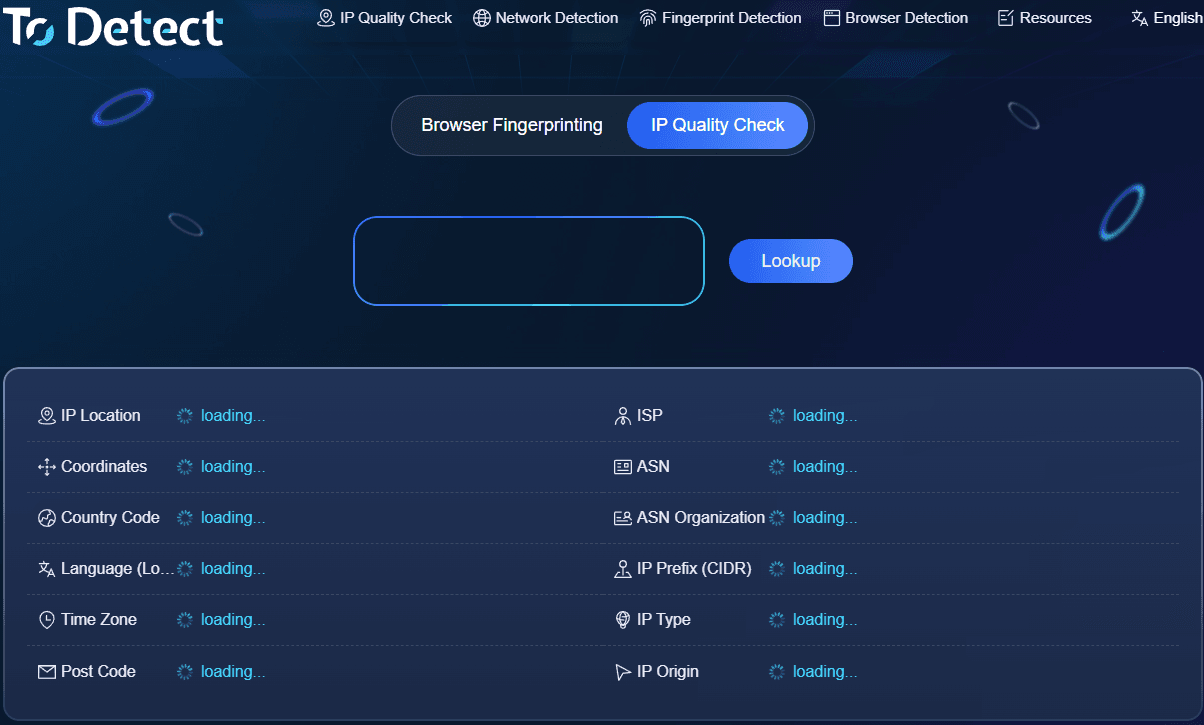
Through IP detection, users can better prepare for: TikTok account operations, cross-border e-commerce environments, overseas advertising campaigns, and social media account management.
When using IP detection tools, focus on: whether the IP location is accurate, whether the IP has risk records, whether it is easily identified as a proxy, whether the network environment is stable, and whether the IP usage history is normal.
7. Practical Tips for Choosing IPs for TikTok Matrix Operations
1. Do Not Focus Only on Price
Low-cost IPs often mean inconsistent resource quality. If an IP has been repeatedly used by many users, even if it is inexpensive, it may negatively affect account operations. When selecting IPs, stability should come before price.
2. Avoid Frequently Changing IPs
TikTok accounts require a stable operating environment. Using a US IP today, switching to Europe tomorrow, and then changing to Asia afterward may create abnormal network behavior and increase account risks.
3. Match IP Location with the Target Market
Different markets should use matching regional environments. For example: US market with US IPs; UK market with UK IPs; Southeast Asian markets with local IPs. The closer the regional match, the more natural the account behavior appears.
Conclusion: A Stable IP Environment Is Essential for TikTok Matrix Success
Building a TikTok matrix is not simply about registering multiple accounts. It is a complete operational system involving account positioning, content planning, device isolation, and network environment management. Every step can influence the final results.
A high-quality IP is only one part of TikTok matrix operations. To achieve long-term success, businesses also need to continuously optimize content strategies, improve account activity, and establish standardized account management processes.
Choosing suitable tools such as ToDetect IP detection solutions, combined with standardized operational strategies, can help fully unlock the traffic value of TikTok matrices.