Resources
 Feature overview

 Ganesh
 2026-07-14 12:06
When using proxy IPs, the first thing many people think about is whether the IP they purchased is a real residential IP, whether it comes from a genuine home network, and whether the IP quality is stable enough.
Determining whether an IP is a native residential IP cannot rely only on a simple detection result. It also requires verification through multiple aspects, including IP ownership, ISP information, database records, and actual access performance.
Today, we will explain how to quickly determine whether an IP belongs to a native residential IP and what methods can be used to test IP authenticity and cleanliness.

What Is a Native Residential IP? Why Is It Important?
A native residential IP can be simply understood as a real network address directly assigned by an Internet Service Provider (ISP) to ordinary home broadband users.
However, not all residential IPs have the same value. In addition to determining whether an IP is residential, it is also necessary to consider factors such as IP history, usage frequency, sharing status, and whether abnormal access activities exist.
Detect IP Methods to Determine Whether It Is a Native Residential IP
Determining whether an IP is a native residential IP usually cannot depend on a single detection result. Multiple dimensions need to be analyzed together. The following methods can help you better understand the actual attributes of a proxy IP.
Method 1: Check IP WHOIS Registration Information
WHOIS lookup is one of the important methods for identifying the source of an IP. By checking IP registration information, you can view the organization, carrier, and IP range details associated with the address. Pay attention to the following information:
• Organization
• ISP (Internet Service Provider)
• NetRange (IP Range)
• CIDR (IP Block Information)
If the result shows a regular home broadband provider, the probability that the IP belongs to a residential network is significantly higher. If it shows a server company, it is more likely to be a data center IP.
Method 2: Check Reverse DNS (PTR Record)
Reverse DNS, also known as a PTR record, is a method of querying the domain name associated with an IP address. Some data center IPs may contain obvious identifiers in PTR records, such as: cloud, hosting, server, and data-center.
If these keywords appear in the detection results, it usually indicates that the IP is more likely from a server environment. Residential IP PTR records are more complex. Some residential IPs may not have reverse DNS configured, while others may display normal ISP allocation formats without obvious data center identifiers.
Method 3: Use Professional IP Databases for Analysis
Many IP analysis services currently classify IP types based on accumulated global IP data, such as: ISP (regular network provider); Hosting (hosted server); Business (enterprise network); Residential (home network); Mobile (mobile network).
Through API interfaces, users can quickly obtain detailed information about target IPs. When using an IP detection API, you can focus on: ISP name; ASN number; organization information; whether it belongs to a proxy network; whether it belongs to a data center.
Recommended Common Online IP Cleanliness Detection Tools
Note: Before testing, make sure your current network has already switched to the proxy IP you want to check. Otherwise, the detected information will only show your local real network.
1. ToDetect IP Detection Tool
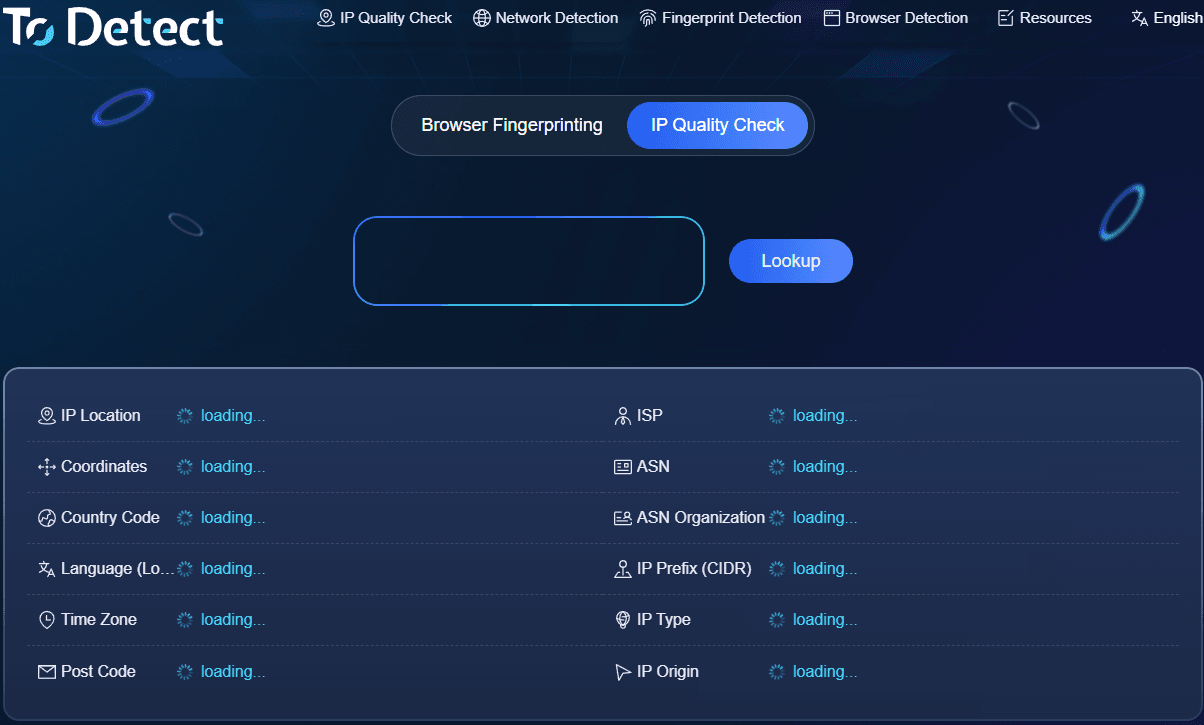
ToDetect provides proxy IP environment detection services that help users view basic IP information, including IP location, network provider, ASN information, anonymity level, and IP type classification. After connecting through a proxy, users can visit the detection page to directly view the network environment associated with the current IP, helping determine whether the IP matches residential proxy characteristics. This type of comprehensive detection tool can save significant manual lookup time.
2. IP2Location
IP2Location is mainly used to query IP geographical location and network ownership information. It provides details such as country/region, city location, ISP name, network type, and geographic coordinates.
3. WhatIsMyIPAddress
This is one of the earlier websites providing IP lookup services. It can display the current IP address, hostname, network provider, and location information. Its functions are relatively simple.
How to Choose a Reliable Native Residential Proxy IP?
After using various detection methods, many users discover that truly high-quality native residential IPs are not easy to obtain.
Building a residential proxy network independently requires high costs and involves complex challenges such as IP sourcing, stability, maintenance, and management. Therefore, for users with long-term business needs, choosing a professional proxy service provider is usually more efficient.
IPDEEP focuses on providing residential proxy solutions and owns residential IP resources covering multiple countries and regions, meeting the requirements of different business scenarios for network locations and IP stability.
Frequently Asked Questions About IP Detection
Q1: Why Is Access Still Restricted Even Though the Detection Shows a Residential ISP?
An IP belonging to a residential ISP is only an important reference for determining residential attributes. It does not mean that the IP is completely risk-free. For example, if a residential IP has been repeatedly used by many users for a long time, websites may still reduce its trust level even if it originates from a real home network.
Q2: Are Residential Proxy IPs Always Slower Than Regular Proxies?
Since residential proxies pass through real home network nodes, their theoretical speed may not be as high as some high-performance data center IPs. However, high-quality residential proxies usually improve connection stability through intelligent routing optimization, allowing speeds to meet most business requirements.
Q3: How Should Dynamic Residential IPs and Static Residential IPs Be Selected?
The main differences between them are IP change methods and usage scenarios.
Dynamic residential IPs are more suitable for businesses requiring large numbers of different IP environments, while static residential IPs are suitable for businesses that need to maintain a consistent identity for a long time. If your focus is stable login and long-term management, static residential IPs are usually more suitable.
Q4: Can I Specify a Residential IP From a Specific Country, City, or Region?
Yes.
Professional residential proxy services usually support more precise location selection. This capability is especially important for businesses that need to simulate local user access environments. By selecting residential IPs from target regions, the access environment can become closer to that of real local users.
Conclusion
Determining whether an IP is a native residential IP requires analysis from multiple perspectives, including WHOIS information, ISP ownership, PTR records, IP database classification, and actual access performance.
A high-quality residential IP not only needs to come from a genuine source but also requires good historical reputation and stability. For users with overseas business needs, choosing a reliable residential proxy service can effectively improve access success rates and reduce problems caused by abnormal network environments.
ToDetect provides multiple types of residential proxy resources and can offer dynamic residential IP and static residential IP solutions according to different business requirements, helping users build a more stable and secure overseas network access environment.