Resources
 Feature overview

 Alani
Alani 2026-07-03 11:28
In recent years, people working in cross-border e-commerce and overseas social media operations have clearly felt that platform risk control systems are becoming increasingly “fine-grained.” What used to be subtle operations are now likely being silently logged by the system.
Platforms are no longer focusing on a single factor. Instead, they combine IP, device, shipping address, operating rhythm, and content structure into a unified model for correlation analysis. In other words, actions you believe are safe may simply be “not flagged yet.”
Today, let’s talk about how risk control systems identify correlations, and how to build multi-account anti-association systems and environments to reduce overall risk.

1. Risk control in 2026 is no longer about a single factor
Many people still hold the early-stage belief that using different IPs and devices means a “clean environment.” However, modern platform algorithms focus more on behavioral graph recognition.
In other words, systems do not only monitor one point. They comprehensively evaluate whether login environments match, whether payment paths overlap, whether shipping addresses are concentrated, whether operating times are regular, and whether accounts exhibit similar behavioral patterns.
Therefore, sharing shipping addresses alone does not necessarily trigger risk control. But when combined with other “similar behaviors” such as identical devices, templates, or product structures, the probability of being flagged increases significantly.
2. Why shared shipping addresses are high-risk
From a platform perspective, shipping addresses are a “strong stable variable.” IPs and devices can change, but shipping addresses are often long-term fixed.
When multiple accounts bind to the same or highly similar shipping addresses over time, the system may form a “cluster label.” Combined with other behavioral signals, these accounts may be identified as belonging to the same operator or team.
This is especially common when multiple stores share the same overseas warehouse address, when multiple dropshipping accounts rely on a single supply chain address, or when new accounts rapidly reuse existing address structures.
If combined with poor isolation in multi-account environments (e.g., identical browser fingerprints or shared cookies), risk control systems are even more likely to flag them.
3. 2026 multi-account risk misjudgment logic table (updated dimensions)
| Misjudgment Scenario | Actual System Logic | Optimization Suggestion |
|---|---|---|
| New account gets restricted after normal posting | Behavior curve is too “smooth,” lacking natural trial-and-error patterns; detected as batch-operated model | Gradual account warming: simulate browsing and engagement before increasing posting frequency |
| Account association warning after device change | Historical device fingerprint and cloud behavior profile are already stored; local changes cannot override cloud labels | Use fully isolated multi-account environments and rebuild behavioral history |
| Same operation detected across different country IPs | Highly consistent cross-account behavioral patterns trigger clustering detection | Increase behavioral differentiation and avoid templated operations |
| Low-frequency accounts still restricted | System detects abnormal “low activity + high consistency” account clusters | Increase natural activity density and simulate real user behavior |
| Traffic restriction without interaction | Label mismatch + insufficient cold-start data leads to conservative system judgment | Extend cold-start period and diversify content |
| Multi-platform account fluctuations | Cross-platform ad ID/browser fingerprint correlation is jointly modeled | Separate platform strategies and build independent social media matrices |
4. A truly safe multi-account anti-association strategy
Many operators are no longer focused on whether changing IP helps. Instead, they adopt system-level isolation strategies.
1. Environment isolation is the top priority
Multi-account setup should not rely on simple browser switching. Each account should have an independent digital fingerprint environment, including browser fingerprint, cache system, timezone/language settings, and network exit.
2. Layered shipping address design
Shared addresses are not strictly forbidden, but single-point concentration must be avoided. A better structure includes primary warehouse + sub-warehouses, different shipping nodes per account, and distributed cities within the same country.
3. Avoid synchronized behavioral rhythms
Actions such as simultaneous product launches, bulk price changes, or repeated template posting are easily identified as artificial control signals.
5. Cross-border social media matrix risk exposure
Many teams now run dual-track operations: e-commerce + content marketing, operating multiple TikTok, Instagram, and Facebook accounts simultaneously.
However, if these accounts share shipping addresses, identical traffic funnels, or identical conversion paths, platforms may reverse-detect association from the traffic side.
The recommended approach is to separate content strategies across social media matrices and split supply chains on the e-commerce side.
6. Value of tools like ToDetect
In practice, many teams use tools like ToDetect for pre-checking risk signals.
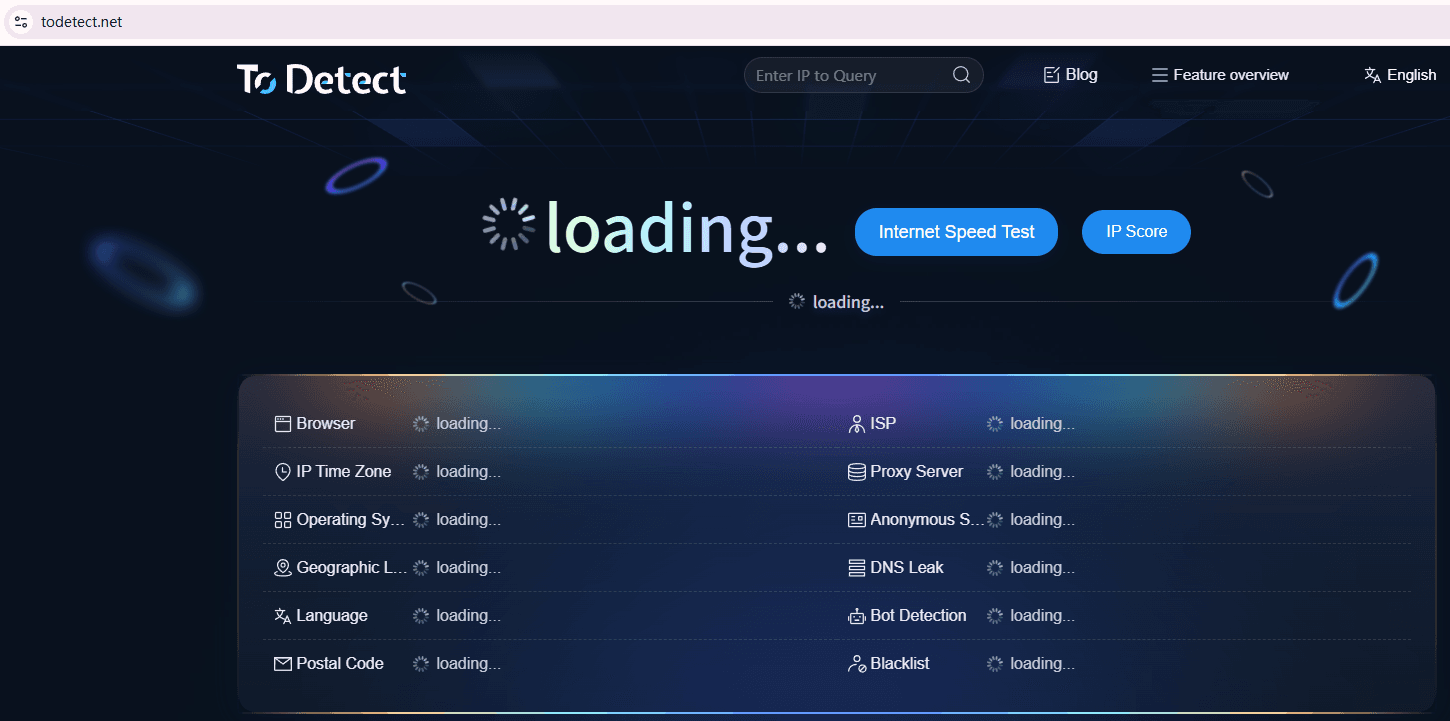
It helps detect whether environment fingerprints are overly concentrated, whether accounts share similar patterns, whether devices and networks show consistency, and whether high-risk configurations exist.
However, tools are only auxiliary. Real safety comes from system architecture design, not single-point detection.
7. Often overlooked long-tail risk factors
Beyond shipping addresses, other hidden risks include identical logistics tracking logic, duplicated product titles/descriptions, overlapping payment methods, and identical customer service scripts.
Overall conclusion
Shipping address is only one piece of the puzzle. IPs, device fingerprints, operating rhythms, content structure, and even operational habits are all gradually incorporated into platform risk models.
Instead of debating whether addresses can be shared, it is better to restructure the entire operation into truly independent systems: anti-association strategy, environment isolation, supply chain segmentation, and content differentiation.
When your system is sufficiently decentralized across these dimensions, occasional overlaps (such as shipping addresses) are far less likely to trigger risk control.