Resources
 Feature overview

 Alani
Alani 2026-08-05 12:01
Whether you are engaged in cross-border business, social media account management, or using proxies, an "unclean" IP can lead to access anomalies, account risk controls, increased CAPTCHAs, and even business restrictions. Currently, more and more IP detection tools are available on the market, ranging from simple online IP lookup tools to professional IP quality detection platforms. Different tools vary in their focus and core capabilities.
Next, let's explore what commonly used IP purity test websites are available in 2026, which tools are better suited for evaluating proxy IP quality, and provide a detailed analysis of several popular IP purity detection tools through a practical feature comparison.

1. Why Do You Need to Check If an IP is Clean?
Many users believe that as long as an IP can normally access a website, it means the IP has no issues. However, this is not entirely true. Normal internet connectivity only indicates that the IP is currently usable; it does not mean it has a good reputation.
IP purity detection is especially crucial in the following scenarios:
First, cross-border e-commerce and overseas social media management. Different platforms are highly sensitive to login environments. If there are anomalies in IP location, network type, or user behavior, risk control measures can easily be triggered.
Second, web scraping and data collection operations. Stable, high-quality proxy IPs can reduce failed requests and improve data collection efficiency.
Third, online advertising and overseas marketing. A poor IP reputation can jeopardize advertising account stability.
Fourth, remote work and overseas server management. A reliable IP environment lowers the probability of access exceptions.
Therefore, before using a proxy IP, screening it through professional IP quality checking tools is a necessary step.
2. What Key Metrics Determine IP Purity?
Determining whether an IP is clean involves evaluating multiple factors rather than relying on a single score.
First, IP blacklist records. This is a critical indicator for evaluating IP risk. If an IP was previously involved in sending spam, malicious attacks, or policy violations, it is likely flagged in security databases.
Second, IP type. Common IP types include residential IPs, data center IPs, hosting IPs, and mobile IPs. Different IP types suit different use cases. Some data center IPs carry higher risk probabilities due to heavy user sharing.
Third, proxy detection. Many websites determine whether a current IP belongs to a proxy server. If proxy characteristics are obvious, access may be restricted on stricter platforms.
Fourth, IP geolocation and ISP information, including country, region, carrier, and ASN data. If the IP location does not align with your actual business requirements, it may compromise account safety.
Fifth, historical IP reputation. Professional IP detection platforms combine multiple databases to analyze an IP's past activity, serving as a key reference for judging IP purity.
3. Recommended IP Purity Testing Websites in 2026
1. ToDetect: Comprehensive IP Quality Detection Tool
Among numerous IP detection platforms, ToDetect has gained significant user attention in recent years. It primarily provides online IP lookups, IP risk analysis, and proxy IP detection, making it ideal for users needing quick IP quality assessments.
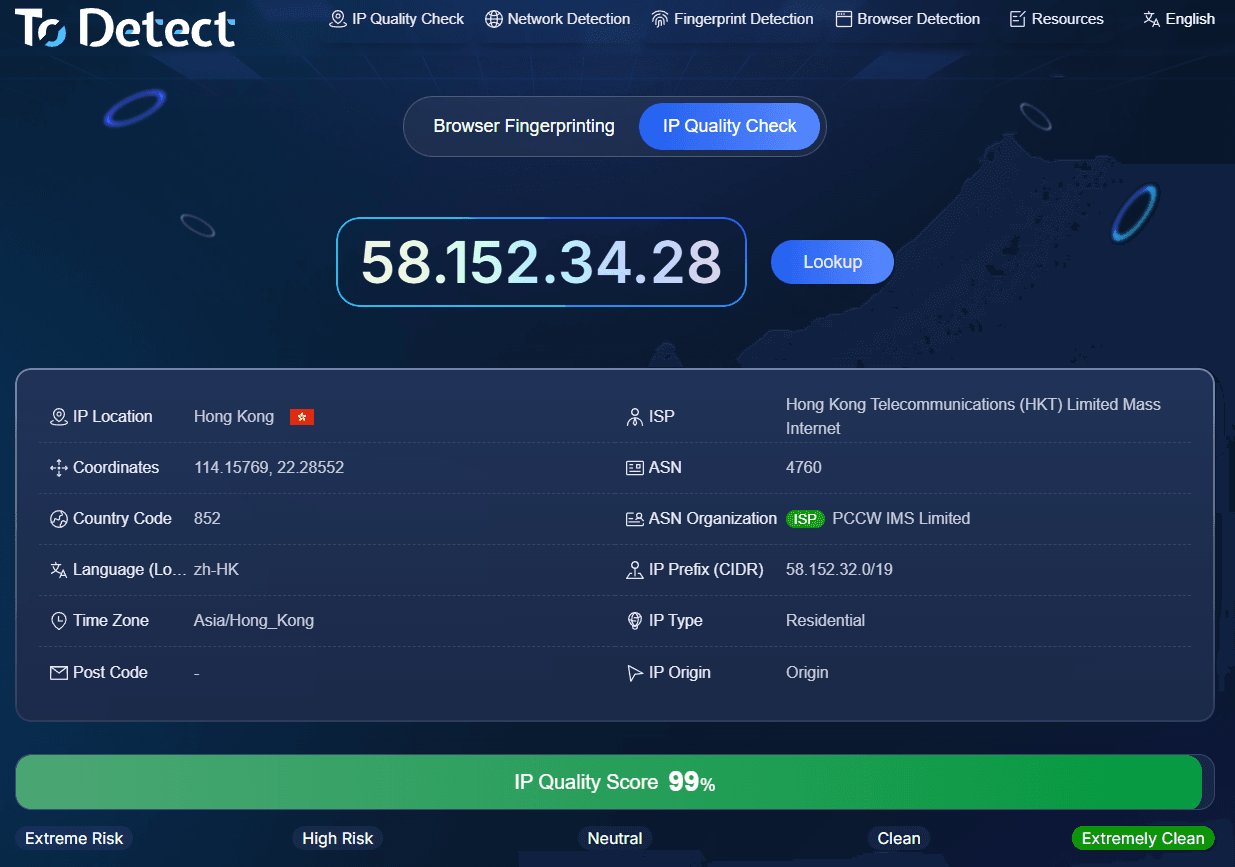
When running a test on ToDetect, users can check the IP location, ISP details, proxy status, risk level, and more. This information is highly practical for anyone purchasing proxy IPs or testing overseas network environments.
Compared to sites that only offer basic IP lookups, ToDetect focuses heavily on IP quality analysis, helping users identify obvious risks. It is especially convenient for users performing proxy IP lookups or bulk-screening IP resources.
Of course, data sources and detection standards vary across IP checking platforms, so cross-referencing multiple tools during practical use is recommended.
2. AbuseIPDB: Focused on Security Risk Detection
AbuseIPDB is a well-known IP reputation service that focuses primarily on tracking historical malicious activity records for IPs.
Its advantage lies in an extensive database of user-submitted security reports, helping verify whether an IP has been involved in cyberattacks, spamming, or other abusive behaviors.
However, because it leans towards security event logging rather than proxy IP purity analysis, it should be combined with other IP tools for a full proxy evaluation.
3. IPQualityScore: Professional IP Risk Assessment Platform
IPQualityScore is another popular platform among international businesses, delivering comprehensive IP risk analysis capabilities.
It detects proxies, VPNs, data center IPs, and fraud risks, offering valuable insights for financial operations, e-commerce, and security audits.
If your goal is to determine whether an overseas IP is suitable for long-term use or if it might trigger platform risk controls, this professional detection tool is very helpful.
4. IPinfo: Suitable for Basic Online IP Lookups
If you simply need to view your IP address, geolocation, and ISP information, IPinfo is a widely used online lookup tool.
It presents information clearly, allowing you to quickly inspect your current network exit point, including country, city, ASN, and organizational details.
However, IPinfo is primarily an information lookup service rather than a dedicated IP purity checker. To assess IP risk levels, pair it with dedicated risk analysis platforms.
4. Comparison of Mainstream IP Purity Detection Tools in 2026
| IP Detection Tool | Main Features | IP Purity Detection Ability | Proxy IP Identification | Blacklist / Risk Detection | Overall Evaluation |
|---|---|---|---|---|---|
| ToDetect | Online IP lookup, IP quality detection, proxy detection, risk analysis | ★★★★★ Supports multi-dimensional IP quality analysis to comprehensively assess business suitability | ★★★★★ Detects proxy IPs, data center IPs, and other network attributes | ★★★★★ Comprehensive risk assessment to evaluate historical IP reputation | High professionalism, full-featured, and better suited for real business scenarios |
| AbuseIPDB | IP security reputation lookup, malicious record querying | ★★★ Focuses mainly on security incidents with limited overall IP quality analysis | ★★ Relatively limited proxy IP detection capability | ★★★★ Strong detection for attack logs and spam records | Strong security query capabilities, but not suitable as a standalone IP purity solution |
| IPQualityScore | IP risk scoring, fraud detection, proxy identification | ★★★★ Rich set of risk evaluation dimensions | ★★★★ Strong proxy IP detection capability | ★★★★ Supports risk analysis and reputation scoring | Comprehensive detection dimensions, though some features lean towards specialized enterprise use |
| IPinfo | IP address lookup, geolocation, ASN queries | ★★ Mainly displays basic IP info | ★★ Average proxy IP identification capability | ★★ Relatively limited risk coverage | Convenient for lookups, but lacks deep IP quality detection capabilities |
| Standard Online IP Lookup Sites | Check public IP, geolocation, ISP | ★ Basic info lookups only | ★ Generally lacks proxy detection support | ★ Virtually no risk analysis capabilities | Only suitable for simple IP lookup requirements |
5. How to Choose the Right IP Detection Tool for You?
Different users have different IP testing requirements, so selection should not be based solely on popularity. If you just want to check your public IP address, a simple online lookup site will suffice.
When buying proxy IPs, prioritize proxy detection, blacklist records, and IP reputation scores. For enterprise deployments, choose platforms capable of delivering comprehensive IP quality audit reports.
Additionally, test results should not be treated as absolute. Because database update speeds vary, newly emerging risks might not be flagged immediately. The safest approach is cross-testing across multiple IP purity detection websites.
For example, you can first analyze a proxy IP's overall quality via ToDetect, cross-check its threat record in security databases, and finally test it within your target application. This workflow ensures much higher accuracy.
6. Practical Tips to Maintain High IP Purity
Beyond testing IPs, maintaining a clean IP environment in daily operations is equally important.
First, avoid sharing a single IP among multiple users for heavy operations. The more users share an IP, the higher the risk of contamination.
Second, refrain from switching login environments frequently. If an account uses a fixed-region IP long-term, jumping suddenly to an entirely different location can trigger automated security flags.
Third, choose reliable proxy providers. Low-cost proxy IPs often suffer from inconsistent quality and heavy recycling.
Fourth, conduct regular proxy IP checks and quality audits. Network conditions change over time; a clean IP today could accumulate risks tomorrow based on usage patterns.
Conclusion
Each tool has its own strengths. Some focus on basic IP lookups, others specialize in security event logs. Determining if an IP fits your business needs requires evaluating IP type, proxy status, risk score, and overall reputation together.
ToDetect provides comprehensive analysis across IP purity, proxy detection, and risk assessment, giving users a clear view of their IP reliability.
Ultimately, test results serve as a guide—long-term business needs and stability should dictate your decisions. Establishing routine IP quality checks and selecting dependable IP resources will best protect your network environment and operational efficiency.