Resources
 Feature overview

 Ganesh
 2026-08-22 10:48
Introduction
The internet has become an essential part of modern business, enabling companies to collect data, reach global audiences, monitor competitors, and automate countless online processes.
At the same time, websites have become increasingly sophisticated in identifying unusual traffic patterns and blocking suspicious activity.
As a result, businesses and individuals alike are turning to residential proxies to improve privacy, access geo-restricted content, and perform online tasks more efficiently.
Whether you are involved in digital marketing, e-commerce, cybersecurity, SEO, or large-scale data collection, understanding how residential proxies work can help you choose the right solution for your online operations.
This guide explains what residential proxies are, how they work, why they are important, and the most common scenarios where they provide significant advantages.
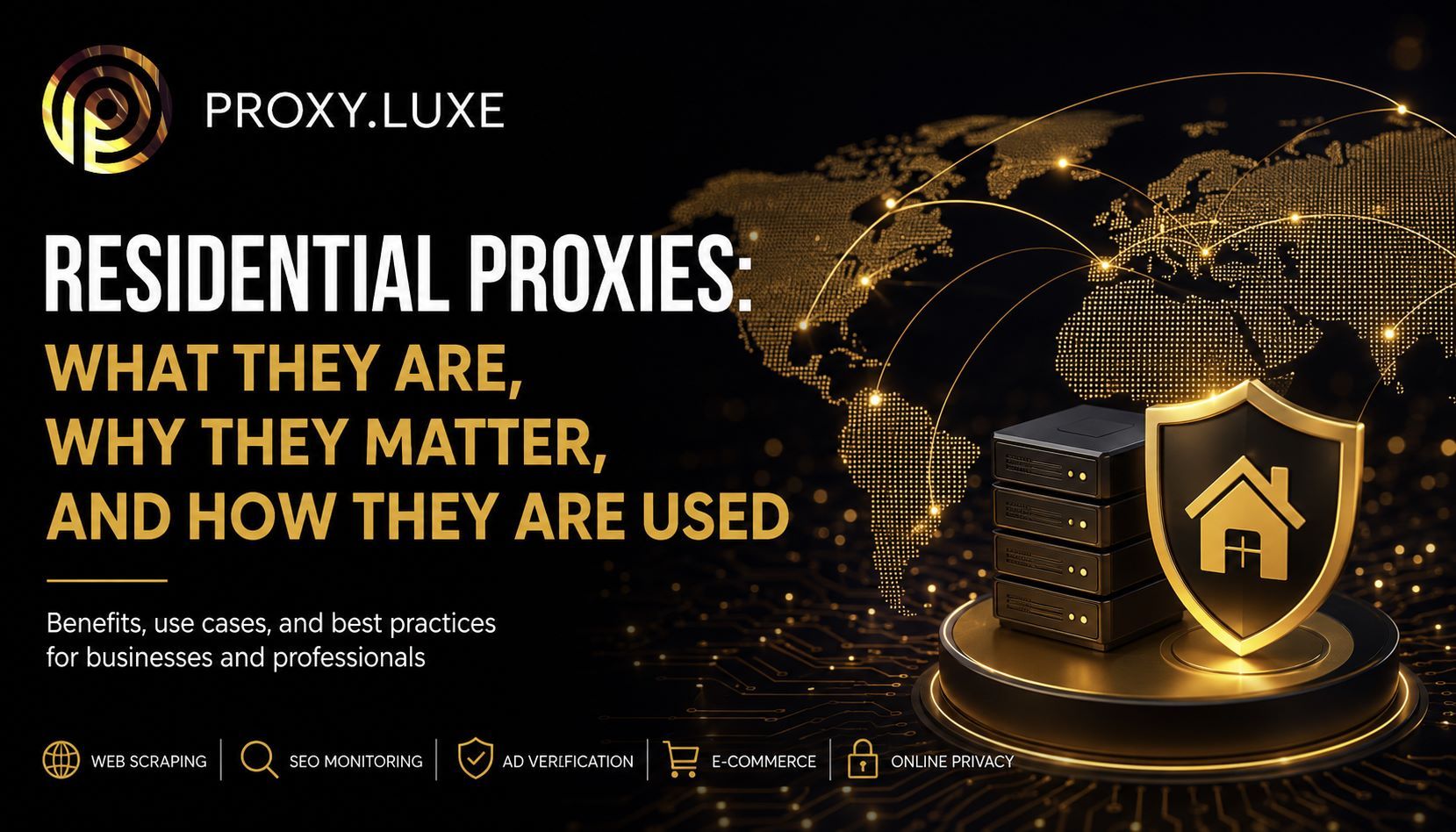
What Are Residential Proxies?
A residential proxy is a proxy server that routes internet traffic through a real residential IP address assigned by an Internet Service Provider (ISP).
Unlike datacenter proxies, which use IP addresses hosted on cloud infrastructure, residential proxies use IPs that belong to actual households and residential internet connections.
Because these IP addresses appear to originate from genuine users, websites are much less likely to identify them as proxy traffic. This makes residential proxies one of the most trusted and reliable proxy solutions available today.
In simple terms, residential proxies allow users to browse websites through real residential devices, making their online activity appear more natural.
How Residential Proxies Work
Every internet-connected device has an IP address that identifies its location and network.
When using a residential proxy, your requests are sent through an intermediary server that replaces your original IP address with a residential IP assigned by an ISP. The destination website sees the residential IP instead of your own.
The process typically follows these steps:
1. A user sends a request through a residential proxy.
2. The proxy forwards the request using a real residential IP address.
3. The website processes the request as if it came from a normal home internet user.
4. The requested information is returned through the proxy to the user.
This additional layer improves anonymity while helping users avoid restrictions that commonly affect datacenter IP addresses.
Why Are Residential Proxies Important?
Many websites actively monitor visitor behavior and automatically block requests that appear suspicious. This is especially common for websites that receive large volumes of automated traffic.
Residential proxies solve this problem by making traffic appear authentic.
Some of the biggest reasons businesses use residential proxies include:
· Maintaining online anonymity
· Protecting sensitive business operations
· Collecting public data at scale
· Testing localized websites
· Verifying online advertisements
· Monitoring search engine rankings
· Accessing geo-specific content
· Managing multiple online accounts
As anti-bot technologies continue to evolve, residential proxies have become an essential part of many professional workflows.
Benefits of Residential Proxies
Higher Trust and Lower Detection Rates
The biggest advantage of residential proxies is their authenticity.
Because the IP addresses belong to real residential users, websites generally consider them trustworthy. Compared to datacenter proxies, residential proxies experience significantly fewer CAPTCHA challenges, IP bans, and access restrictions.
This makes them ideal for long-term online projects.
Improved Online Privacy
Protecting your real IP address helps reduce exposure while browsing online.
Residential proxies create an additional privacy layer that prevents websites from directly identifying your original location.
Although they should not be considered a replacement for cybersecurity practices, residential proxies contribute to safer internet usage by masking your real identity.
Access to Geo-Restricted Content
Many websites customize content based on the visitor's location.
Examples include:
· Local search engine results
· Country-specific pricing
· Regional promotions
· Streaming platforms
· Local news
· Language-specific websites
Residential proxies allow users to connect through IP addresses located in different countries, cities, or regions, enabling accurate location-based testing and research.
Better Success Rates for Automation
Businesses running automated software often experience blocked requests when using ordinary IP addresses.
Residential proxies distribute requests through numerous residential IPs, reducing the likelihood of triggering anti-bot systems.
This leads to higher completion rates for legitimate automation tasks.
Common Residential Proxy Use Cases
Web Scraping and Data Collection
One of the most common uses of residential proxies is web scraping.
Companies collect publicly available information from websites for purposes such as:
· Market research
· Price monitoring
· Competitor analysis
· Product tracking
· Financial research
· Academic studies
Residential proxies help distribute requests across multiple IP addresses, allowing organizations to gather data more efficiently while minimizing interruptions caused by rate limiting.
SEO Monitoring
Search engines personalize results depending on user location.
SEO professionals use residential proxies to:
· Track keyword rankings
· Monitor local SERPs
· Analyze competitors
· Verify search visibility
· Test localized content
Using residential IPs provides more accurate search engine results than relying on a single location.
Ad Verification
Digital advertisers invest billions of dollars every year.
Unfortunately, ad fraud remains a major challenge.
Residential proxies enable advertisers to verify:
· Whether ads appear correctly
· Geographic targeting accuracy
· Ad placement quality
· Display frequency
· Regional campaign performance
This helps companies detect fraudulent advertising activity before it affects marketing budgets.
E-Commerce Price Intelligence
Online retailers frequently change product prices based on region, demand, inventory, or competitor activity.
Residential proxies help businesses monitor:
· Product prices
· Discounts
· Flash sales
· Shipping availability
· Stock levels
· Regional offers
This information supports dynamic pricing strategies and competitive analysis.
Brand Protection
Counterfeit products and unauthorized sellers continue to create problems for global brands.
Companies use residential proxies to identify:
· Fake online stores
· Unauthorized marketplaces
· Trademark violations
· Brand misuse
· Fraudulent listings
Monitoring the web from multiple geographic locations improves brand protection efforts.
Social Media Management
Marketing agencies often manage dozens or hundreds of social media accounts.
Residential proxies help separate account activity by assigning different residential IP addresses, reducing the risk of triggering automated security systems while supporting legitimate account management workflows.
Cybersecurity Testing
Security professionals frequently test websites and applications from different network locations.
Residential proxies support:
· Threat intelligence
· Fraud detection research
· Security assessments
· Geographic testing
· Access verification
Using residential IPs helps simulate real-world internet traffic during testing.
Residential Proxies vs Datacenter Proxies
Choosing between residential proxies and datacenter proxies depends on your objectives.
While datacenter proxies offer excellent speed and affordability, residential proxies deliver higher reliability when interacting with websites that actively detect automated traffic.
Rotating Residential Proxies
Many providers offer rotating residential proxies.
Instead of using one IP continuously, the proxy automatically switches between different residential IP addresses after each request or after a specified time interval.
Benefits include:
· Lower detection rates
· Better scalability
· Reduced IP blocking
· Improved scraping efficiency
· Enhanced anonymity
Rotating residential proxies are particularly useful for large-scale web scraping and market intelligence projects.
Dedicated vs Shared Residential Proxies
Residential proxy providers usually offer two primary options.
Shared Residential Proxies
Multiple users access the same residential IP pool.
Advantages:
· Lower cost
· Large IP pool
· Excellent for general tasks
Dedicated Residential Proxies
A single customer uses assigned residential IP addresses.
Advantages:
· Greater stability
· Consistent identity
· Better control
· Improved performance
The best choice depends on workload, budget, and project requirements.
Choosing the Right Residential Proxy Provider
Not all proxy providers offer the same level of quality.
When selecting a residential proxy service, consider:
Large IP Pool
A provider with millions of residential IP addresses offers greater flexibility and lower detection risk.
Global Coverage
Choose providers with IP addresses across numerous countries, cities, and regions.
Fast Response Times
Reliable infrastructure improves browsing speed and data collection performance.
High Uptime
Business-critical projects require stable proxy connections with minimal downtime.
Security
Look for encrypted connections, secure authentication methods, and transparent privacy policies.
Flexible Rotation Options
The ability to rotate IP addresses automatically improves long-term success rates.
Are Residential Proxies Legal?
Residential proxies are legal in many jurisdictions when used responsibly and for legitimate purposes.
Common legal use cases include:
· Public market research
· SEO analysis
· Price monitoring
· Website testing
· Cybersecurity research
· Advertisement verification
However, users should always respect local laws, website terms of service, and applicable privacy regulations.
Residential proxies should never be used for unauthorized access, fraud, or illegal activities.
Best Practices for Using Residential Proxies
To maximize efficiency and maintain responsible usage:
· Use residential proxies only for legitimate purposes.
· Rotate IP addresses during high-volume requests.
· Respect website rate limits whenever possible.
· Secure your accounts with strong authentication.
· Monitor proxy performance regularly.
· Choose reputable proxy providers with transparent policies.
· Stay compliant with applicable laws and platform rules.
Following these practices helps ensure stable performance while minimizing disruptions.
Frequently Asked Questions
Are residential proxies better than datacenter proxies?
For websites with strong anti-bot systems, residential proxies typically achieve higher success rates because they use genuine residential IP addresses.
Can residential proxies improve online privacy?
Yes. Residential proxies hide your original IP address and make your browsing activity appear to originate from another residential location, adding an extra layer of privacy.
Who uses residential proxies?
Residential proxies are widely used by:
· Digital marketing agencies
· SEO professionals
· E-commerce companies
· Data analysts
· Cybersecurity teams
· Researchers
· Software developers
· Brand protection specialists
Are rotating residential proxies worth it?
For large-scale automation, web scraping, and market research, rotating residential proxies often provide better reliability by reducing the likelihood of IP blocking.
Conclusion
Residential proxies have become an indispensable tool for organizations that require secure, reliable, and location-aware internet access.
By routing traffic through real residential IP addresses, they help businesses overcome geographic restrictions, reduce detection by anti-bot systems, and collect publicly available data more efficiently.
From SEO monitoring and ad verification to web scraping, e-commerce intelligence, cybersecurity testing, and brand protection, residential proxies support a wide range of legitimate business applications.
As websites continue to strengthen their security measures, using high-quality residential proxies remains one of the most effective ways to maintain privacy, improve operational efficiency, and ensure consistent access to online resources.
Choosing the right residential proxy provider—and using these services responsibly—can significantly enhance both the reliability and scalability of your online operations.