



 Resources
 Feature overview
 Ganesh
 2026-07-25 14:22
For Amazon sellers, multi-account operation is a common strategy to expand business scale and mitigate the risks associated with a single account. However, Amazon possesses a rigorous risk control system, and its core logic is:
A single seller entity is generally only permitted to own accounts that comply with platform policies in principle.
Once the platform determines through technical means that multiple accounts are controlled by the same entity, it will trigger "account linkage" risks, resulting in product delistings or even the suspension of all linked accounts altogether.
Within this complex linkage detection system, IP addresses are one of the crucial network environment signals that the platform can acquire.
This article will delve into how Amazon assesses linkage risks and why IP detection is a vital step in ensuring account security.

In-Depth Analysis: The "Four-Layer Signals" of Amazon's Linkage Detection
Amazon's determination of account linkage does not rely on a single factor, but rather on a multi-dimensional composite scoring mechanism. It primarily covers the following four dimensions:
Network Layer: Includes login IP, network operators, ASN information, geographical location, and network environment characteristics.
Device/Browser Layer: Captures browser fingerprints via JavaScript—such as Canvas, WebGL, User Agent, plugins, time zones, and fonts—to generate highly distinguishable device environment features.
Profile Layer: Business licenses, legal representative information, credit cards, payout accounts, phone numbers, email addresses, and office addresses used during registration.
Behavioral Layer: Operator's login time patterns, product listing rhythms, listing similarities, and keyword search habits.
Among these four layers of signals, IP addresses serve as a critical digital identifier connecting the network environment with the seller's identity.
If multiple accounts frequently log in from the same IP range or the exact same IP, the system will conduct a comprehensive risk assessment.
Why IP Types Are Crucial for Account Environment Management
When performing IP detection, identifying the underlying properties of an IP is vital. Currently, IPs on the market are mainly divided into two types:
1. Datacenter IPs (IDC / Data Center IPs)
Datacenter IPs originate from large data centers or cloud service providers.
Risk Point: Because some datacenter IPs have long been used for cloud services, automated access, and similar scenarios, they may be more easily flagged by risk systems, and their historical records are relatively complex.
2. Residential IPs (Home Broadband ISP IPs)
Residential IPs are allocated to ordinary home users by genuine internet service providers.
Characteristics: This network attribute typically closely mirrors a regular user's browsing environment, helping to mitigate certain basic risk assessments and making it quite common in practical operations.
IP Detection: An Essential Step for Anti-Linkage Early Warning
Before logging into your accounts, auditing your environment through professional detection tools can help sellers proactively uncover potential network environment risks.
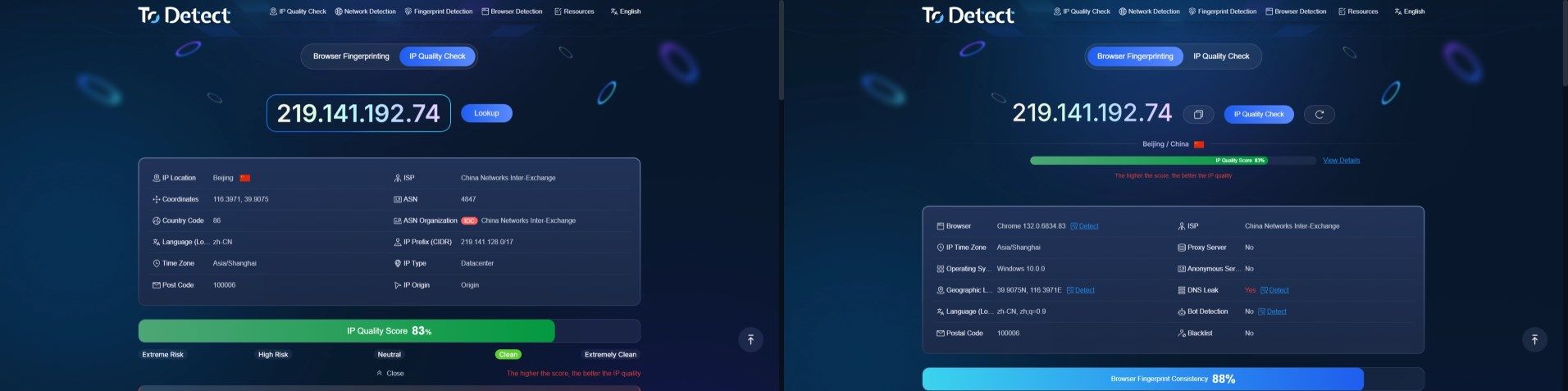
1. Identifying IP Purity and Type: Check whether an IP belongs to a "datacenter" or a "residential/ISP" network to evaluate overall network health.
2. Eliminating DNS and WebRTC Leaks: Prevent your real IP characteristics from being accidentally exposed due to network configuration vulnerabilities.
3. Consistency Checking: Ensure that the geographical location of the IP matches the browser's time zone and language settings, preventing risk control scrutiny triggered by glaring parameter conflicts.
Establishing a Healthy Anti-Linkage Isolation System
To reduce linkage risks, it is recommended to follow these management strategies:
Standardized Environment Isolation: For operations requiring account environment isolation, maintaining independent and stable network and device environments is a standard management practice.
Completely Independent Physical Data: Each account's credit card, phone number, and payout account must be completely unique, avoiding any cross-usage.
Using Professional Tools for Detection: Cultivate the habit of checking the IP environment before every login to ensure a stable environment state.
Through refined environment management and rigorous IP quality control, sellers can better safeguard the stable operation of their businesses.
If you need to perform an in-depth audit of your current operational environment, welcome to visit the ToDetect Detection Tool Official Website to access professional IP quality queries and browser fingerprint detection services.
Frequently Asked Questions (FAQ)
Q1: Does changing the IP guarantee that an account is safe?
Not necessarily. If your browser fingerprint remains unchanged, or if your registration details overlap with other accounts, you may still be flagged for linkage.
Anti-linkage is a multi-dimensional, comprehensive management practice spanning accounts, devices, networks, and payments.
Q2: Can dynamic residential IPs be used to operate Amazon?
For store operations and account login scenarios, frequently fluctuating IPs easily trigger abnormal login verification.
Stable residential or ISP-type IPs are typically better suited for business scenarios that require long-term, stable logins.
Q3: What are the obvious differences between datacenter IPs and residential IPs in detection results?
Datacenter IPs usually display as cloud service providers in ASN organizations, and the IP type will be explicitly labeled as a datacenter.
In contrast, residential IPs display genuine local telecommunications operators and typically possess attributes much closer to a regular user's network environment.
Q4: What should I do if an IP is found to be abnormal or flagged?
It is recommended to troubleshoot your network configuration first, and confirm that the environment has returned to normal before proceeding with operations. When necessary, switch to an exclusive static residential IP with higher stability.