



 Resources
 Feature overview
 Ganesh
 2026-07-27 12:15
Many new Amazon sellers often misunderstand one thing: they believe that simply changing to a new IP address is enough to stay safe. In reality, information such as the IP location, network type, usage history, and whether it belongs to a residential network can all affect the credibility of the account environment.
A suitable anti-association IP not only needs to match the target region but also needs to provide high authenticity and stability. Performing online IP checks and IP detection in advance can help sellers identify potential risks in time.
Today, we will explain how to evaluate IP quality through IP type lookup, residential IP detection, proxy IP checking, and other methods, helping sellers choose a more suitable network environment for Amazon operations.

1. Why Does an Amazon Account Need an Anti-Association IP?
To maintain platform fairness, Amazon monitors possible connections between seller accounts. For example, when the same seller operates multiple stores, if multiple accounts consistently use the same network exit point, Amazon may determine that these accounts are associated.
• Common factors that may trigger association risks include:
• Multiple accounts logging in through the same public IP address;
• Using data center IP addresses to register or manage stores;
• Frequent IP changes that create an abnormal network environment;
• Using proxy IP addresses shared by a large number of users;
• A mismatch between the IP location and account information.
Among these factors, proxy IP quality is an issue many sellers overlook. Some low-quality proxies may be inexpensive, but their IP addresses have already been used by many users or may have been marked as risky by Amazon. Such IPs may not reduce risk and could instead increase the probability of account verification or restrictions.
2. What Type of Anti-Association IP Should Amazon Sellers Choose?
Currently, IP addresses on the market are mainly divided into data center IPs, server proxy IPs, residential IPs, and mobile network IPs. Different IP types have significant differences in stability and security.
1. Data Center IP
Data center IPs usually come from cloud server facilities, such as server IP addresses provided by cloud computing providers. These IPs are relatively inexpensive and available in large quantities, but they are easier to identify.
Because many users may share the same IP range, platforms can often detect that these IPs belong to proxy environments. Therefore, data center IPs are not the ideal choice for Amazon account registration or long-term store operations.
2. Standard Proxy IP
Proxy IPs can hide the user's real network address, but the quality varies significantly. Some proxy IPs come from public proxy pools and may have problems such as multiple users sharing the same IP or abnormal historical usage records.
Before using proxy IPs, it is recommended to perform proxy IP checks to review information such as IP location, carrier, and risk level, avoiding contaminated IP resources.
3. Residential IP
Residential IPs are generally considered a type of IP that is closer to a real user network environment. They originate from real household broadband networks and have more natural access characteristics.
For Amazon sellers, residential IP detection is an important step when selecting an anti-association network. By checking whether a residential IP is authentic, whether it belongs to a residential network, and whether its location matches the target market, sellers can reduce abnormal network environment risks.
3. Comparative Analysis of Different Anti-Association IP Solutions
| IP Solution Type | Network Source | Stability Performance | Suitable Use Cases | Main Advantages |
|---|---|---|---|---|
| Static Residential IP | Real home broadband network | High | Long-term Amazon store operation and independent multi-account management | Close to a real user network environment, stable IP address, suitable for long-term fixed usage |
| Dynamic Residential IP | Residential network resource pool | Medium | Market research, data collection, and short-term access | Large IP resource pool with coverage across multiple regions and countries |
| Data Center Proxy IP | Cloud server data center | Relatively Low | General web browsing and testing environments | Lower cost, fast deployment, and easy access to resources |
| ISP Proxy IP | IP resources provided by Internet service providers | Relatively High | Business scenarios requiring both access speed and network authenticity | Combines ISP network characteristics with proxy flexibility and provides stable access speed |
| Shared Proxy IP | Proxy resources shared by multiple users | Unstable | Low-risk access and temporary network requirements | Low cost, easy to use, and quick availability |
4. How to Use Online IP Detection to Determine Whether an IP Is Suitable for Amazon?
Before using an IP address, it is recommended to perform an online IP check first. Professional IP detection tools can provide detailed information about the current IP address. A complete IP inspection usually includes the following aspects:
1. Check IP Location
First, confirm the country, city, and carrier information associated with the IP address. For example: a US Amazon account should ideally use a US IP address; European marketplace accounts should match European IP locations; and the IP location should remain consistent rather than changing frequently.
If the account information shows the United States but the IP detection result shows another country, it may create an abnormal environment and increase risk.
2. Check IP Type
Through IP type lookup, sellers can determine whether the current IP belongs to a residential IP, data center IP, or another type. Different IP types have different risk levels when being evaluated by platforms, making IP type analysis an important part of selecting an anti-association IP.
Generally speaking:
Residential IPs: Higher authenticity and suitable for long-term stable use;
Data center IPs: Easier to identify and not recommended as the primary operating environment;
Shared proxy IPs: Risk depends on previous usage history.
3. Check IP Reputation History
Some IP addresses may have previously been used for violations, such as bulk account registration or malicious activities. Continuing to use these IPs may affect account security.
Therefore, before purchasing proxy services, it is recommended to use online IP checking tools to evaluate IP reputation and risk levels.
5. How Does ToDetect Help with IP Detection?
For sellers who need to manage multiple Amazon accounts over a long period, manually evaluating IP quality can be difficult. In this situation, professional detection tools can provide valuable assistance.
ToDetect is a network environment analysis tool that helps users perform IP detection, IP type lookup, and proxy environment analysis. It can provide information including:
• IP location information;
• IP ownership and carrier information;
• Whether the IP belongs to a proxy;
• Whether the IP belongs to a residential network;
• Whether the network environment contains potential risks.
When selecting an Amazon anti-association IP, sellers can first purchase a small number of IP resources and then use ToDetect for testing. Based on the detection results, sellers can determine whether the IP is suitable for long-term use.
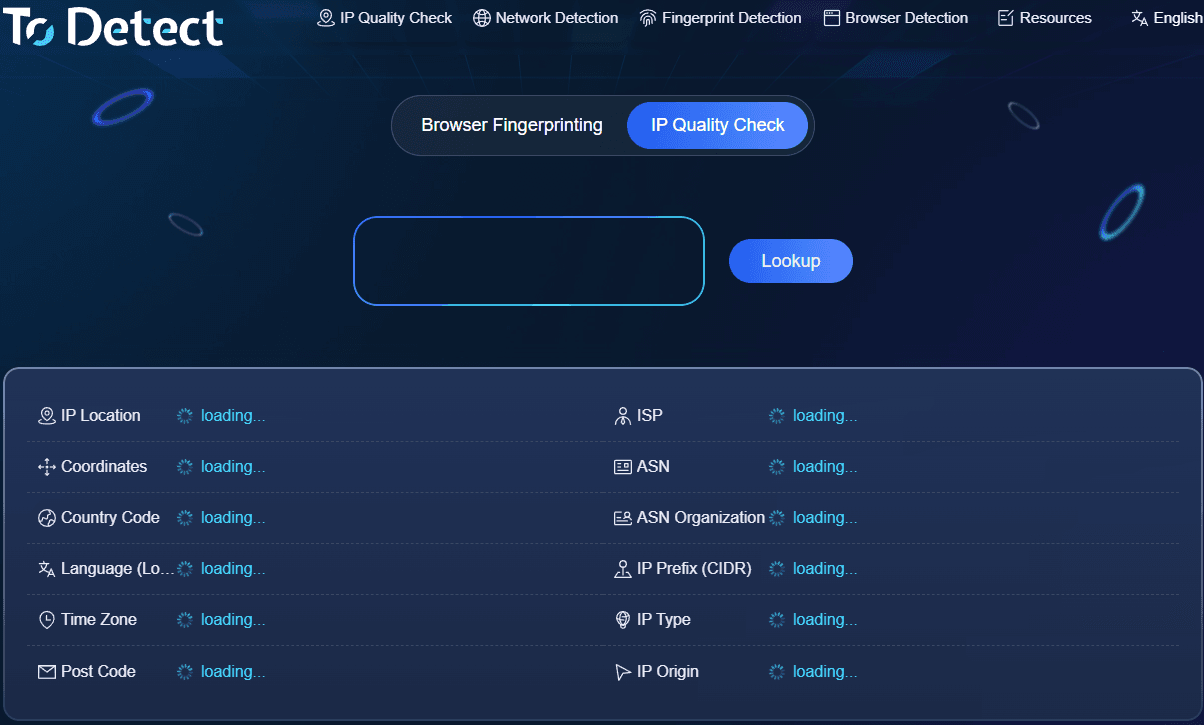
It should be noted that any detection tool only provides assistance in evaluation and cannot completely guarantee that an account will never become associated. A truly secure operating method also requires combining independent devices, separate browser environments, and standardized account management processes.
6. What Should Amazon Sellers Consider When Choosing a Residential IP ?
Although residential IPs have obvious advantages, not every residential IP is suitable for Amazon operations. Sellers should pay attention to the following factors when selecting one.
1. Whether the IP Is Stable Long-Term
Frequent IP changes may cause abnormal changes in the account's network environment. For stores that are already operating, it is generally better to choose a stable fixed residential IP rather than changing to a new IP address every day.
2. Whether the IP Location Matches
For example, when operating the US marketplace, it is better to use a local US residential IP. If the IP location differs significantly from the account registration information, it may increase the possibility of risk control checks.
3. Avoid Shared IP Usage
Some low-cost residential proxies use shared models, where the same IP address may be used by many different users. Although the price is lower, security cannot be guaranteed.
When performing proxy IP checks, sellers should confirm whether the IP is dedicated and whether it has excessive historical usage records.
4. Detect Before Using
Do not directly log in to Amazon Seller Central immediately after obtaining an IP address.
The recommended process is:
Purchase IP → Online IP Check → IP Detection → IP Type Lookup → Confirm Residential Attribute → Use for Account Management
7. What Other Factors Should Be Considered for Amazon Anti-Association?
Many sellers focus all their attention on IP addresses, but in reality, account association is caused by multiple factors working together. In addition to selecting a secure residential IP, sellers should also pay attention to:
• Using an independent browser environment;
• Avoiding multiple accounts logging in from the same device;
• Not sharing cookies or browsing data;
• Maintaining authentic account information;
• Avoiding frequent changes to the login environment.
An IP address is only one part of the overall account environment. A stable and clean network environment requires multiple factors to work together.
In Conclusion
Amazon anti-association is not simply about changing an IP address. It is about building a more authentic and stable operating environment.
When choosing an Amazon anti-association IP, residential IPs are generally more suitable for long-term use compared with ordinary proxy IPs. However, they must be carefully tested before being used.
Through online IP checking, IP detection, IP type lookup, residential IP detection, and proxy IP checking, sellers can better understand IP quality and avoid risky IP resources.
By combining professional detection tools such as ToDetect with comprehensive IP environment analysis, sellers can make account operations more stable and reliable.
Anti-association protection does not rely on a single technical method. In addition to selecting suitable residential IPs or high-quality proxy IPs, sellers also need to optimize device isolation, browser environment management, and account operation practices.