Resources
 Feature overview

 Ganesh
 2026-07-13 11:43
Many sellers believe that as long as they purchase an overseas IP and can log in to their store normally, everything will be fine. However, the actual situation is much more complicated. Whether an IP is a real residential network IP or a data center IP may create potential risks for account security in the future.
Therefore, when carrying out Amazon anti-association operations, the first step is often not registering an account or configuring a browser environment, but first confirming whether the network environment is secure.
Today, we will explain how to use an online IP lookup tool to verify static residential IPs, how to perform proxy IP detection and static IP lookup, and how to use IP type detection tools to evaluate IP quality.

1. Why Amazon anti-association requires an Online IP Lookup first?
Many new sellers misunderstand proxy IP purchases and assume that simply using different IP addresses is enough to stay safe. Amazon evaluates whether accounts are connected through multiple factors, and IP addresses are one of the most important factors.
In reality, there are significant differences between different IP types. For example, some shared proxy IPs may have already been used by many users and may contain suspicious history records. Some data center IPs are stable, but their hosting characteristics can also be detected by platforms.
Therefore, before building an Amazon operating environment, it is necessary to understand the actual characteristics of an IP through an online IP lookup. This allows sellers to check the IP location, ISP information, IP type, and proxy characteristics to determine whether the network environment is suitable for long-term use.
2. Why are static residential IPs more suitable for Amazon account environments?
In Amazon anti-association operations, the concept of static residential IP is frequently mentioned. A static residential IP can be simply understood as an IP address that is fixed for long-term use and comes from a real home broadband network.
Compared with ordinary dynamic IPs or some proxy IPs, static residential IPs are usually closer to real user network environments. For Amazon accounts that require long-term operation, a stable, clean, and fixed network environment is more natural than frequently changing IP addresses.
Many sellers managing multiple accounts adopt a "one account, one environment" approach, including independent browser fingerprints, independent device environments, and independent IP addresses. Static residential IP lookup is an important step to verify whether the network environment meets expectations.
Of course, not every IP labeled as a residential IP is necessarily reliable. Some residential proxy providers may have shared or recycled IP resources. Therefore, in addition to checking the IP type, proxy IP detection is also required to confirm whether the IP truly belongs to a residential network.
3. Comparison of common IP types and their impact on Amazon operating environments
| IP Type | Network Source | Common Use Cases | Stability Performance | Amazon Operations Suitability |
|---|---|---|---|---|
| Static Residential IP | Real home broadband network with a long-term fixed allocation | Amazon store management, cross-border e-commerce account operations | Highly stable with fewer changes over long-term use | Suitable for long-term account operation environments |
| Dynamic Residential IP | Home network with dynamically assigned IP addresses that may change during connections | General overseas access, short-term business testing | IP may change frequently and requires regular verification | Suitable for temporary use, not recommended for frequent store logins |
| Data Center IP | Generated from cloud servers and data center infrastructure | Data collection, software testing, automated access | Fast access speed, but network characteristics are easier to identify | Requires careful selection for account operations |
| Shared Proxy IP | Proxy resources shared by multiple users | Data scraping, general proxy access | More users share the same IP, creating complex usage history | Not recommended for important account environments |
| Dedicated Proxy IP | Independent proxy address used by a single user for long-term access | Enterprise services, cross-border business operations | Stability depends on the IP source and quality | Should be evaluated together with IP detection results |
4. How to use Proxy IP Detection to determine whether an IP is safe?
When choosing proxy services, many people only focus on price and speed while ignoring IP quality. In reality, whether an IP is suitable for Amazon environments requires comprehensive evaluation.
First, determine whether the IP belongs to a proxy server.
Some IPs can access websites normally but have already been identified in databases as VPN, Proxy, or data center IPs. Using such IPs for Amazon account operations may increase the possibility of abnormal activity.
Second, check whether the IP belongs to a residential network.
Through IP type detection, sellers can further confirm the IP source. If the result shows Residential, it is usually closer to a real user environment compared with ordinary hosting IPs.
Third, check IP stability.
Amazon operations are not short-term activities. They involve long-term login, order management, advertising management, and customer information processing. Frequent IP changes may create abnormal behavior even when the location remains the same.
Therefore, before purchasing proxy IPs, it is recommended to perform static IP lookup and proxy IP detection instead of relying only on provider promotions.
5. What functions does ToDetect online IP lookup tool provide?
There are many IP detection tools available today. Online IP lookup platforms like ToDetect are mainly designed to help users quickly analyze IP information.
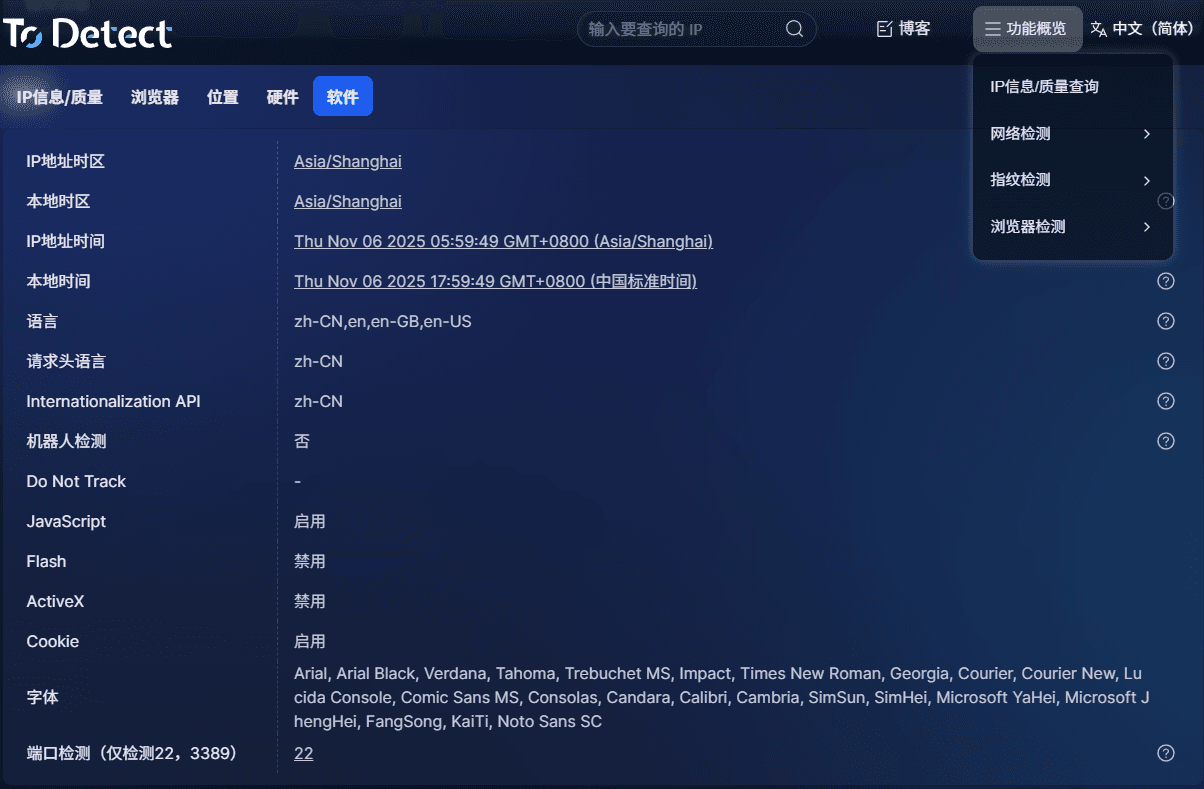
Through ToDetect, users can check IP location, network provider, IP type, and proxy risk information. For Amazon sellers, the greatest value of these tools is identifying potential problems in advance instead of waiting until account issues occur.
Besides Amazon anti-association operations, online IP lookup tools are also commonly used for cross-border e-commerce account environment checks, advertising account security inspections, and overseas business access testing.
6. What should be considered when performing IP Detection for Amazon anti-association?
Many sellers believe that detecting a residential IP means complete safety. This is not entirely accurate. During actual operations, it is recommended to develop the following habits:
First, do not use newly purchased IPs immediately. Perform online IP lookup and proxy IP detection first to confirm there are no obvious risks.
Second, avoid frequently changing IP addresses. Long-term use of one stable IP is more consistent with normal user behavior than switching locations every day.
Additionally, do not allow multiple accounts to share the same network environment. Even if the IP quality is good, simultaneous logins from multiple stores may still create association risks.
For new sellers starting Amazon multi-account operations, establishing a proper network detection process is extremely important. Do not wait until account problems occur before discovering hidden IP risks.
Conclusion
Amazon anti-association is not simply about changing an IP address. It is about creating a more realistic, stable, and secure operating environment. Online IP lookup is the most fundamental step in this entire process.
By using online detection tools such as ToDetect to confirm IP type and risk levels in advance, Amazon account operations can become more stable while reducing unnecessary losses caused by network environment issues.
A reliable network environment is an important foundation for secure Amazon account operations. Detect first, then use — this is much more effective than trying to fix problems afterward.