



 Resources
 Feature overview
 Ganesh
 2026-07-25 11:59
In cross-border e-commerce, overseas social media operations, and other practical business scenarios, many teams often encounter a common dilemma:
Even with fully compliant operations, logging into platforms like Amazon, eBay, or TikTok immediately triggers CAPTCHA verifications or even results in account bans.
As platform risk control systems become increasingly intelligent, the network environment is often a critical factor influencing access risk, while IP quality and purity serve as essential references for platforms evaluating those risks.
This article examines the necessity of IP inspection from a professional perspective and provides a standardized network environment check guide to help enterprises optimize their account operation environment.

Why Is IP Inspection a "Must-Learn" for Cross-Border Operations?
Within platform risk control systems, an IP address is not merely a simple physical label, but rather a complex "credit profile," known as IP Reputation.
Mitigating Association Risks: Platforms conduct security evaluations for multi-account operations, and IP addresses represent one of the direct dimensions used to detect association.
If multiple accounts share the same IP over an extended period while simultaneously exhibiting similar characteristics such as:
device fingerprints, login behaviors, and browsing environments.
Platforms may determine that an association risk exists between the accounts, thereby triggering security restrictions.
Identifying IP Fraud Risks: Risk control systems evaluate an IP's fraud score. If an IP is listed in global blacklist databases (such as Spamhaus), login attempts may face direct blocking or strict verification.
Determining the Authenticity of IP Attributes: Certain data center IPs are frequently flagged by risk systems due to their heavy usage in automated access and proxy services.
In contrast, residential or ISP-allocated IPs provided by genuine broadband operators are typically much closer to the real network environment of ordinary users, making it easier to maintain a stable access environment compared to data center IPs in certain business scenarios.
Core Metrics for Network Environment Inspection
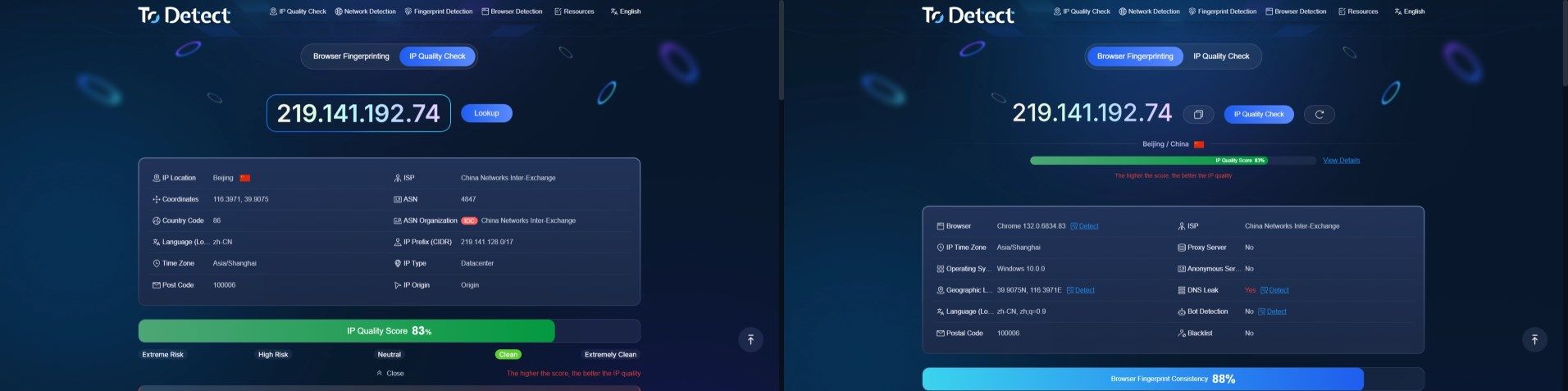
To ensure network environment stability, it is recommended to use professional tools (such as ToDetect) to conduct deep checks across the following dimensions:
IP Type Identification: Detect whether an IP belongs to a data center or a residential/ISP network. For operations requiring long-term stable logins, stable residential or ISP-type IPs are typically more suitable.
Blacklist Monitoring: Check whether the IP has left poor records in reputation databases such as DNSBL.
Geographic Consistency: Verify whether the country, city, and time zone of the egress IP align with operational requirements.
Anonymity and Leakage Detection:
DNS Checks: DNS anomalies can expose the real network environment, creating a noticeable mismatch between the egress IP location and the DNS resolution environment, thereby increasing the probability of anomaly detection.
WebRTC Leaks: Under certain browser configurations or network environments, this protocol may expose additional network details.
IP Quality Scoring: Based on tool definitions, comprehensively analyze IP risk tiers, blacklist statuses, and historical records to evaluate the overall health of the network environment.
How to Build a Secure Cross-Border Network Foundation
Establishing a routine network environment checking mechanism is a reliable path for global-expanding enterprises to minimize risk control exceptions.
Maintaining Reasonable Network Isolation: For operations requiring account environment isolation, keeping a stable and independent network environment helps reduce abnormal association risks.
Environment Isolation Technology: Utilize anti-detect browsers or professional cross-border security browsers to create isolated working spaces for each account, simulating dedicated device attributes.
Pre-screening: Before deploying operations, it is advisable to use tools for IP purity testing to evaluate its fraud score and risk tier.
Keeping Network Environments Stable: Frequently shifting countries, regions, or network environments over a short period may increase the probability of anomalous login detection. It is recommended to prioritize long-term stable and fixed IPs that do not change arbitrarily.
If you need to analyze IP attribution, risk status, and fingerprint consistency in real-time, consider visiting the ToDetect Tool Official Website for professional IP quality lookup services.
Frequently Asked Questions (FAQ)
Q1: Why do purchased "overseas dedicated IPs" still encounter verifications or restrictions?
Many so-called "dedicated IPs" are actually data center IP ranges or IPs that have already been polluted or blacklisted by previous users.
Additionally, if DNS anomalies or WebRTC leaks are present, platforms may still capture other network characteristics.
Q2: Are dynamic IPs safer than static IPs?
For high-frequency operations such as web scraping, dynamic IPs offer higher efficiency;
however, for store management and social media logins, frequently shifting IPs can easily trigger "abnormal login" risk controls. Stable residential or ISP-type IPs typically provide a more consistent egress environment.
Q3: Can turning on a browser's "Incognito Mode" prevent account association?
No. Incognito mode only clears local cookies, but it cannot mask IP addresses, DNS statuses, WebRTC characteristics, or advanced browser fingerprint features like Canvas.
Q4: Is IP purity permanent?
No. IP quality changes dynamically, and a healthy IP today may be indirectly affected by the rule-violating actions of shared users. Therefore, routine checks on the health of your network environment are essential.