Resources
 Feature overview

 Ganesh
 2026-07-16 11:39
When operating a Facebook/Instagram matrix, if multiple accounts use the same IP address and the same network environment for a long time, it is easy to trigger platform risk control, resulting in account verification, traffic limitation, or even account suspension.
Many people focus on the number of registered accounts, content publishing frequency, and follower growth, but the real challenge of multi-account management is not "whether accounts can be registered", but "whether accounts can be used stably for a long time".
Today, we will explain how to build a Facebook/Instagram matrix, how multiple accounts should perform IP query and IP detection, and provide a practical social media matrix IP detection tutorial.

1. Why does the Facebook/Instagram matrix need IP Query Detection ?
Facebook and Instagram are both global social platforms with comprehensive account security risk control systems. The platforms not only analyze account content but also monitor account login behavior, including login locations, device information, IP addresses, and network types.
Therefore, when operating a Facebook/Instagram matrix, it is necessary to perform IP query detection in advance to understand whether the current IP is clean, secure, and free from risk labels.
Through IP query, you can check: current IP address location; IP type (residential IP, data center IP, mobile IP, etc.); whether the IP is marked as a proxy or risky address.
2. The Importance of IP Environment in Facebook/Instagram Matrix Operations
The biggest challenge of multi-account operations is not registering accounts, but maintaining long-term account stability. Platforms may determine account relationships through the following factors:
• IP address association. Using the same IP to log into multiple accounts is one of the easiest factors to detect.
• Device environment association. Browser fingerprints, system parameters, and device information may also cause account connections.
• Login behavior association. For example, frequently switching accounts or repeatedly logging in and out within a short period may trigger security verification.
Therefore, professional Facebook/Instagram matrix operations usually adopt: independent IP environments; independent browser environments; independent account information; stable login habits.
3. IP Environment Configuration for Different Facebook/Instagram Matrix Scenarios
| Operation Scenario | Account Scale | Recommended IP Environment | Detection Focus | Common Issues |
|---|---|---|---|---|
| Personal Instagram Account Operations | 1-5 accounts | Stable residential network or fixed proxy IP | Whether IP location is normal, network stability | Security verification caused by changing login locations |
| Small Facebook Marketing Matrix | 5-20 accounts | Reasonable separation between accounts and IPs | IP duplication rate, proxy type, risk records | Multiple account association, account restrictions |
| Cross-border E-commerce Social Media Operations | 20-100 accounts | Independent account environments combined with stable IPs | IP authenticity, regional matching, DNS status | Advertising account abnormalities, page restrictions |
| Overseas Brand Promotion Team | More than 100 accounts | Establish a batch IP management system | IP quality score, batch detection capability | Mass account association risks |
| Influencer/KOL Account Operations | Multi-region account deployment | Match local IPs according to target markets | Geographic consistency, network stability | Inaccurate audience location targeting |
4. How to Perform IP Detection for Multiple Account Operations?
1. Check Current IP Basic Information
First, you need to know the IP currently being used. Through an IP query tool, you can obtain: IP address; country and region; city location; ISP provider; network line type.
For example, if your Instagram account targets the US market, the IP used should ideally show a local US network environment rather than another country or region. If your account content targets UK users but you consistently log in with an Asian IP, it may affect account credibility.
2. Detect Whether the IP Has Risks
Knowing the IP address is only the first step. More importantly, you need to determine whether the IP is secure. A high-quality IP detection tool usually checks:
• Whether the IP is shared by many users;
• Whether it belongs to a proxy server;
• Whether there are blacklist records;
• Whether it has been marked by social platforms;
• Whether it belongs to a data center IP.
For Facebook and Instagram account farming, IP quality directly affects account lifespan.
If you use low-quality proxy IPs shared by many accounts, even if the account content is normal, you may frequently encounter verification codes or login restrictions.
3. Check Whether the IP Has Leakage Issues
Many people ignore DNS and WebRTC leaks when using proxy environments. For example, your IP may appear to be located in the United States, but the browser WebRTC exposes your real network address, allowing platforms to determine your actual location.
Therefore, complete IP query detection is not only about checking the IP address, but also detecting: IPv4/IPv6 information; DNS leaks; WebRTC leaks; browser environment information.
5. What Kind of IP Detection Tool Is More Suitable for Matrix Operations?
There are many IP detection tools available on the market, but for Facebook/Instagram matrix operations, choosing a tool should not only depend on whether it can query IPs, but also on several important detection dimensions.
1. Comprehensive IP Information Query
The more detailed the basic information is, the easier it is to evaluate IP quality. This includes: country and region; city location; ASN information; ISP provider; IP type.
2. Support Risk Detection
Basic IP query tools only tell you where the address is located, while professional tools can also determine: whether it is a proxy IP; whether it is a proxy node; whether it is a data center IP; whether it is a high-risk IP.
3. Support Multi-environment Detection
For matrix operation teams, managing one environment per account is more convenient. For example, the ToDetect IP query detection tool can help users quickly view current network environment information and evaluate whether the account login environment is stable.
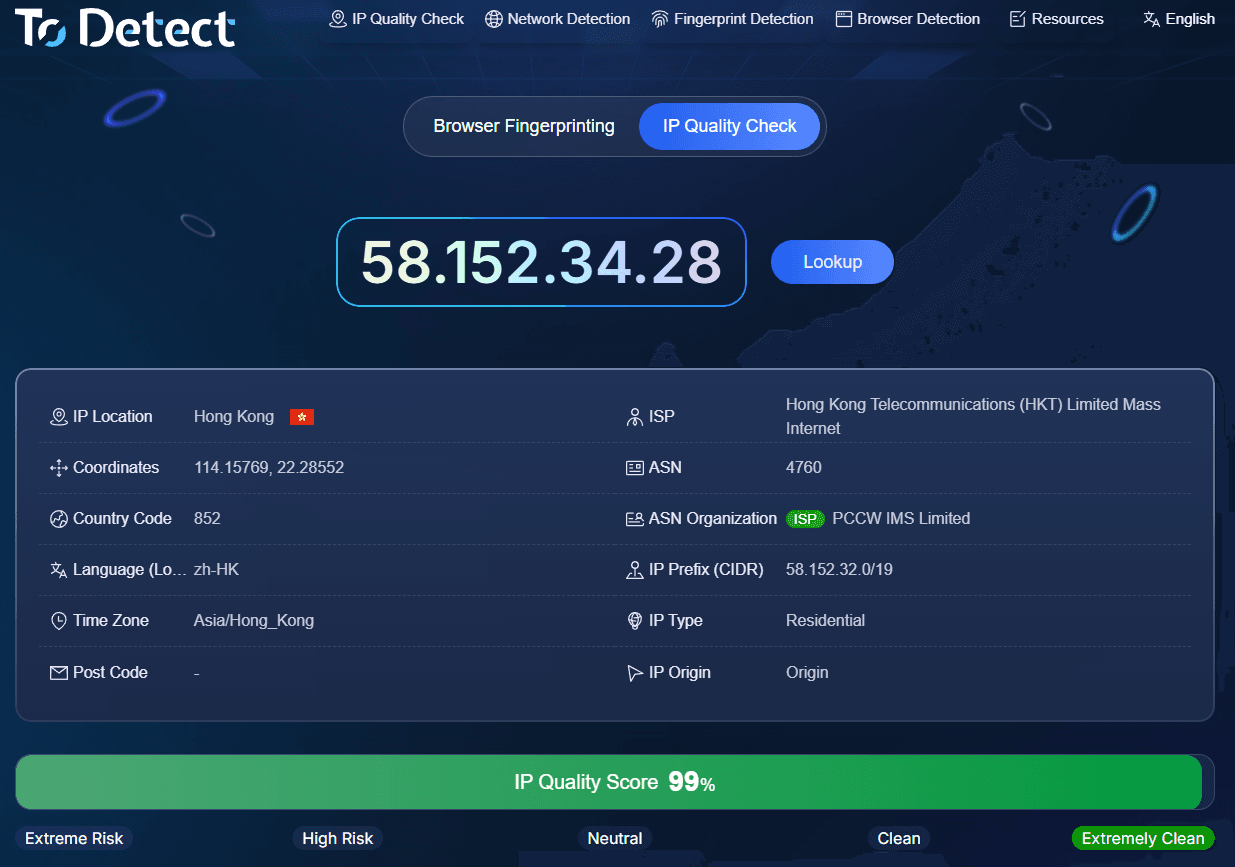
When using similar tools, you can perform detection before registering accounts, logging into accounts, or changing proxy environments to reduce account abnormalities caused by IP issues.
6. Facebook/Instagram Matrix IP Management Tips
Tip 1: Do Not Change IPs Frequently
Many people believe that more IPs mean more security, so they change IP addresses in different regions every day. In reality, frequent changes can trigger risk control. A better approach is to assign one stable IP environment to each account and maintain consistency over time.
Tip 2: Avoid Multiple Accounts Sharing the Same IP
For small-scale operations, such as managing several accounts, try to separate network environments. For dozens or hundreds of accounts, professional account management solutions are required, such as fingerprint browsers, independent proxy environments, and multi-account management systems.
Tip 3: Perform IP Detection Before Registration
Many account failures are not caused by the registration process, but because the registration environment has already been judged abnormal by the platform. It is recommended to perform an IP query detection before registering new Facebook or Instagram accounts.
Confirm that: the IP region matches the target market; the IP has no risk records; the network environment is stable. This can improve the initial quality of the account.
7. The Role of ToDetect in Facebook/Instagram Matrix Operations
For users who need to operate overseas social media accounts for a long time, IP detection has become an essential part of daily operations.
ToDetect can help users quickly complete: IP query; IP quality analysis; network environment detection; risk information evaluation.
For example, when operating a US Instagram matrix account, you can first use the tool to confirm whether the current IP is actually displayed as a US location before deciding whether to use it for account login.
Of course, IP detection is only one part of account security management. A truly stable Facebook/Instagram matrix also requires: high-quality content output; normal user behavior; reasonable account growth cycles; stable device environments. Only by combining multiple factors can accounts develop sustainably over time.
In Summary
A mature social media matrix is not simply about creating multiple accounts. It requires optimization from multiple aspects, including account planning, device environment, login habits, and network IP management.
Through professional IP detection tools, such as ToDetect, users can understand the current IP status in advance, reduce account association risks, and improve the stability of matrix operations.
Of course, the IP environment is only one part of Facebook/Instagram matrix operations. To achieve long-term stable account growth, it is also necessary to combine high-quality content output, reasonable operation schedules, and user behaviors that comply with platform rules.