Resources
 Feature overview

 Ganesh
 2026-07-15 12:18
Even when an account's content is completely normal and there are no violations, users may suddenly encounter login verification, traffic drops, or other restrictions. After a long investigation, the real cause is often found in an easily overlooked area — the IP environment.
Can abnormal IP addresses really affect account reputation? Why do platforms pay attention to users' IP addresses? Why can a simple IP change trigger risk control checks?
Today, we will explain the causes of IP abnormalities, their impact on accounts, and how to use online IP lookup and IP anomaly detection tools to evaluate network environment quality, helping you better understand the importance of IP environments for account management.

1. What Is an IP Anomaly? Why Do Accounts Care About IP Environments?
An IP anomaly refers to a situation where the current IP address shows characteristics that do not match normal user behavior. For example:
• An IP address is used to frequently log in to a large number of accounts within a short period of time;
• The IP location is significantly different from the account's usual location;
• The IP has been reported or marked as a risky address by many users;
• The IP belongs to a data center, proxy server, or shared node;
• The IP has a history of abnormal access activities.
These situations may be detected by platform risk control systems.
Nowadays, many platforms, including social media, e-commerce platforms, payment systems, and content platforms, evaluate whether users are trustworthy through multiple factors such as IP addresses, device information, browsing behavior, and login frequency.
2. Can IP Abnormalities Affect Account Reputation?
A common question is: Can an abnormal IP directly reduce account reputation? The answer is: It may happen, but usually not because of the IP alone.
Search engines and various platforms evaluate account quality through multiple factors, including account activity, content quality, user engagement data, login environment, IP stability, device environment, and whether operating behaviors match real user patterns.
If an account remains in an abnormal IP environment for a long time, such as using many shared IPs, operating multiple high-frequency accounts under one IP, using heavily flagged risky IPs, or frequently switching between countries, the platform may reduce the account trust level.
Possible results include: additional login verification, reduced content exposure, stricter advertising reviews, account feature restrictions, and longer account warming periods. Therefore, maintaining a stable IP environment is very important for users who rely on account operations.
3. Why Use IP Detection Tools ?
Many people think that as long as they can access websites normally, their IP has no issues. However, this is not always true. Platform risk control systems focus on more hidden information:
IP type; IP location; whether it is a proxy IP; whether it exists in risk databases; whether it has blacklist records; network service provider information.
These details cannot usually be viewed directly through a normal browser. This is why more users are starting to use IP detection tools.
Professional IP detection tools can help users quickly understand their current IP status and identify potential risks in advance.
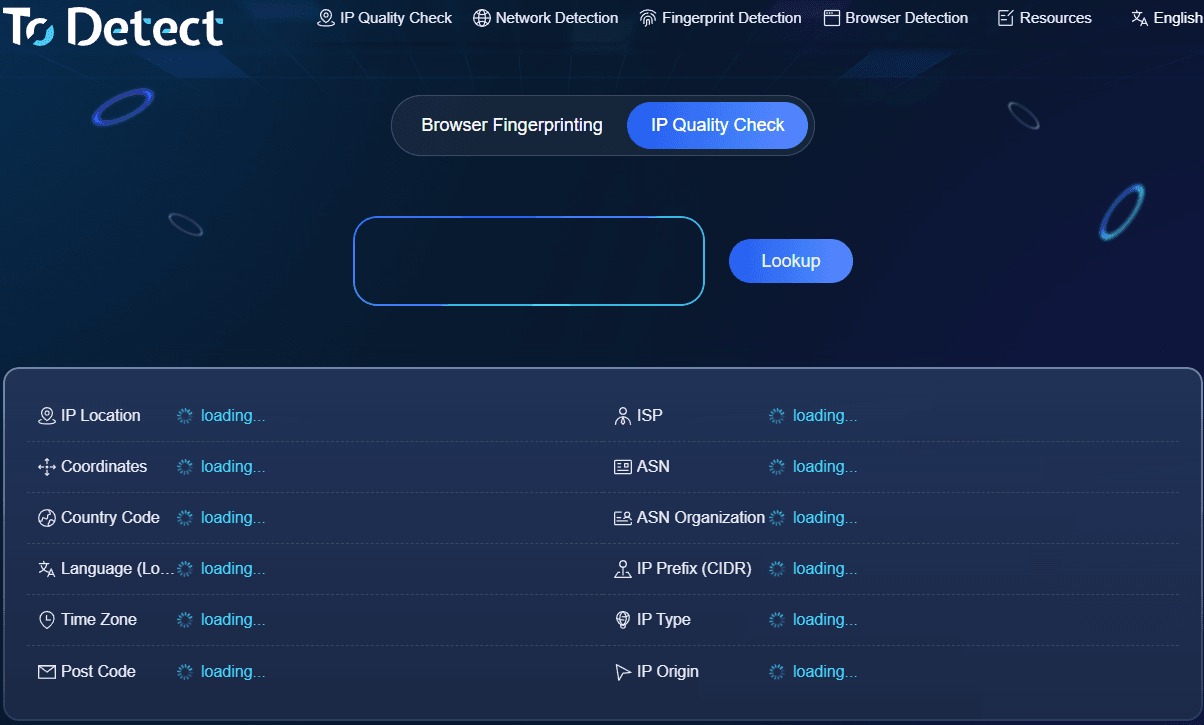
For example, IP detection tools can check: current public IP address; IP country and city; ISP information; IP type; proxy detection results; IP risk score.
For cross-border operations, multi-account management, and overseas marketing scenarios, these data points provide valuable reference.
4. Comparison of IP Risk Concerns in Different Usage Scenarios
| Usage Scenario | Common IP Issues | Key Metrics to Check | Recommended Actions |
|---|---|---|---|
| New Overseas Platform Account Registration | Registration environment differs from future login environment, which may trigger security verification | IP stability, location consistency, network environment changes | Perform IP checks before registration to ensure a stable network environment for future use |
| Cross-border E-commerce Store Operations | Multiple accounts sharing the same network may increase IP association risks | IP independence, IP history records, proxy quality | Use independent and long-term stable network environments for different business accounts whenever possible |
| Overseas Advertising Campaigns | Ad account review issues and frequent payment verification requests | IP reputation, location information, risk score | Use IP anomaly detection before launching campaigns to confirm whether the network environment matches the target market |
| Data Analysis and Market Research | Regional access restrictions or inaccurate webpage content display | IP location accuracy, authenticity of access region | Use online IP lookup to verify the actual exit location and avoid data inaccuracies |
| Enterprise Remote Work | Large changes in employee login locations may trigger security risk detection | Login IP change records, access sources | Establish an IP monitoring system to identify abnormal login activities in time |
| Multi-platform Account Management | Different platform accounts may become associated due to shared network environments | IP reuse frequency, proxy type, historical risk records | Regularly check IP status and replace network nodes with higher risk levels when necessary |
5. What Does IP Anomaly Detection Mainly Detect?
Effective IP anomaly detection does not simply display an IP address. Instead, it analyzes IP quality through multiple dimensions:
1. IP Location Detection
Check whether the actual country and region of the IP match expectations. For example, if an account operates in the US market but frequently shows IPs from other Asian regions, attention should be paid.
2. IP Type Detection
Identify whether the IP belongs to a residential broadband IP, data center IP, mobile network IP, or proxy IP. Different IP types may have different levels of trust in platform risk systems.
3. IP Risk Detection
Determine whether the IP has spam records, blacklist history, malicious access history, or large-scale account usage records. A high-risk IP may affect account stability even if it currently works.
4. Proxy Environment Detection
Many account issues are not caused by proxies themselves, but by poor proxy quality, such as repeated proxy exits, shared IP usage, or heavily polluted IP history.
6. Who Can Benefit From Tools Like IP Detection Tools ?
For ordinary internet users, occasionally checking an IP address may be enough. However, for the following groups, IP detection tools provide significantly greater value:
1. Cross-border E-commerce Sellers
Cross-border e-commerce sellers usually need to manage multiple store accounts, and each account may require a different operating environment. If the IP environment frequently appears abnormal, account review risks may increase. Through IP detection tools, sellers can check the network environment in advance and reduce account risks caused by network issues.
2. Overseas Social Media Operators
When managing overseas platform accounts such as Facebook, Instagram, TikTok, and YouTube, a stable network environment is very important. IP anomaly detection can help determine whether the current network is suitable for long-term account operation.
3. Enterprise Network Administrators
Companies may need to manage access environments for many employees. Through online IP lookup and IP detection tools, administrators can quickly identify abnormal access sources.
7. Are IP Detection Tools Necessary? It Depends on Your Usage Scenario
Many people ask: "I am just an ordinary user. Do I really need to check my IP?" In fact, not everyone needs to use IP detection tools.
For daily web browsing, watching videos, and regular office work, a normal network environment is usually sufficient.
However, if your activities involve overseas account operations, multi-account management, cross-border e-commerce, advertising campaigns, data collection, or overseas business promotion, IP detection tools become highly valuable.
Because identifying IP problems in advance is always more efficient than dealing with account issues after they occur.
8. How to Choose a Reliable IP Detection Tool?
• Data accuracy. A good tool should accurately identify IP location, network provider, and risk status.
• Rich detection capabilities. Tools that only display IP addresses have limited value. Practical tools should include features such as IP risk detection, proxy identification, geographic location lookup, and IP reputation analysis.
• Update frequency. IP databases change frequently. If the data is not updated regularly, detection results may become less reliable.
• User experience. For users who frequently check IPs, simple operation and fast response speed are also important factors.
Summary: IP Anomaly Detection Can Reduce Account Risks
IP abnormalities are not the only factor that causes account problems, but an unstable or risky IP environment may increase the possibility of account verification, restrictions, or abnormal handling.
For occasional users, online IP lookup may be enough to understand network conditions. However, for cross-border operations, e-commerce, overseas marketing, and multi-account management, regularly using professional IP detection tools is a more reliable operating approach.
As platform risk control systems become increasingly intelligent, effective IP environment management can not only reduce the probability of account abnormalities but also make future operations more stable and efficient.