Resources
 Feature overview

 Ganesh
 2026-05-27 10:57
Many people don't pay much attention to whether an IP is clean at first. But when their accounts get restricted by risk control systems or access becomes abnormal, they realize the issue actually comes from the IP itself.
What’s even more frustrating is that these problems are often not caused by “operational mistakes,” but because the IP has already been flagged by platform risk-control systems — and users usually can’t tell at all.
Next, let’s talk about how to judge whether an IP is good or bad, whether IP reputation score checks are reliable, and what IP risk status detection can actually reveal.

1. Why Should You Perform an IP Quality Check ?
An IP address is like your “ID card” in the online world. If that identity has been abused by many users for spam registrations, attacks, fake traffic generation, and similar activities, its reputation will decline.
Once an IP is labeled as “high risk,” it can lead to frequent verification prompts, account bans, blocked access, and stricter e-commerce account risk controls.
Therefore, whether you're running cross-border business operations or managing a regular website, performing an IP quality check is extremely important.
2. What Can Online IP Lookup Reveal?
Many tools now support online IP lookup, but a comprehensive IP detection system usually includes the following core dimensions.
1. IP Reputation Score Check
This is the key indicator for determining whether an IP is “clean.” IP reputation score checks usually combine historical behavior data, such as complaints, attack activity, and abuse history, to generate a score. The higher the score, the safer the IP.
2. IP Risk Status Detection
IP risk status detection focuses more on real-time analysis. It checks whether the IP is a proxy, comes from a data center, has abnormal login records, or appears on blacklists. This step is critical for platform risk-control systems.
3. Online IP Address and Basic Information
This includes country, city, ISP, ASN, and other information used to determine whether the IP source is normal.
3. IP Quality Detection Levels and Recommended Actions
| Detection Level | Common Characteristics | Possible Impact | Recommended Action |
|---|---|---|---|
| Low Risk | Normal access behavior, no proxy characteristics, stable ASN, no abnormal fluctuations | Minimal impact on business operations; accounts and platforms can be used normally | Can be used directly for normal business scenarios; periodic checks are sufficient |
| Medium-Low Risk | Occasionally flagged as a proxy, data-center-origin IP, slight historical anomalies | May trigger more CAPTCHAs or limited platform functionality | Recommended for non-core business tasks or traffic distribution, combined with IP rotation |
| Medium Risk | Multiple risk-control triggers, blacklist records, abnormal behavior patterns | Unstable logins, delayed ad reviews, accounts more likely to require verification | Reduce high-risk operations and prioritize replacing with cleaner IPs |
| High Risk | Clear proxy characteristics, flagged by multiple platforms, attack or abuse history | High probability of account bans, restricted access, increased business failure rate | Stop using immediately and replace the IP resource |
| Extremely High Risk | Included in global blacklists, frequent abnormal activity records, extremely low reputation score | Unable to use mainstream platform services normally | Discard completely; not recommended for any business use |
4. How to Quickly Determine Whether an IP Is Safe?
Method 1: Use online IP lookup tools. These tools can instantly display the IP’s risk status, geolocation, and whether it has been flagged as abnormal.
Method 2: Check the IP reputation score. The higher the score, the cleaner the IP’s historical behavior and the lower the chance of risk-control restrictions.
Method 3: Detect whether the IP is a proxy or VPN. If an IP is identified as a proxy or VPN node, it usually means higher risk-control exposure.
Method 4: Determine whether the IP belongs to a data center. Although data-center IPs are stable, many platforms classify them as higher-risk sources.
Method 5: Review IP risk status results. If the IP is marked as high risk or associated with abnormal access records, it should be used cautiously.
Method 6: Observe actual account feedback after use. If the IP frequently triggers verification or restrictions during login or registration, the IP quality is likely poor.
Method 7: Check historical blacklist records. Even if an IP currently works normally, previous blacklist records may still indicate hidden risks.
5. Which Scenarios Require an IP Reputation Score Check ?
Many people think only technical professionals need this, but in reality, cross-border e-commerce account registration and maintenance, Facebook / Google advertising, email marketing, API security access, and multi-account management all heavily depend on IP quality whenever “bulk accounts” or “platform risk control” are involved.
6. Common Misunderstandings About IP Risk Detection
Misunderstanding 1: “If an IP isn’t blacklisted, it’s safe.” Wrong. Many IPs may not appear on blacklists but are still flagged by platform risk-control models.
Misunderstanding 2: “Changing the IP solves everything.” Not necessarily. If you switch to another high-risk IP type, the same problems will persist.
Misunderstanding 3: “Checking once is enough.” IP status changes dynamically, so regular IP quality checks are recommended.
7. What Is the Value of Tools Like ToDetect?
Tools like ToDetect essentially solve the problem of “information asymmetry.” You don’t need to understand complex network protocols or check multiple databases. Simply enter an IP address to quickly see:
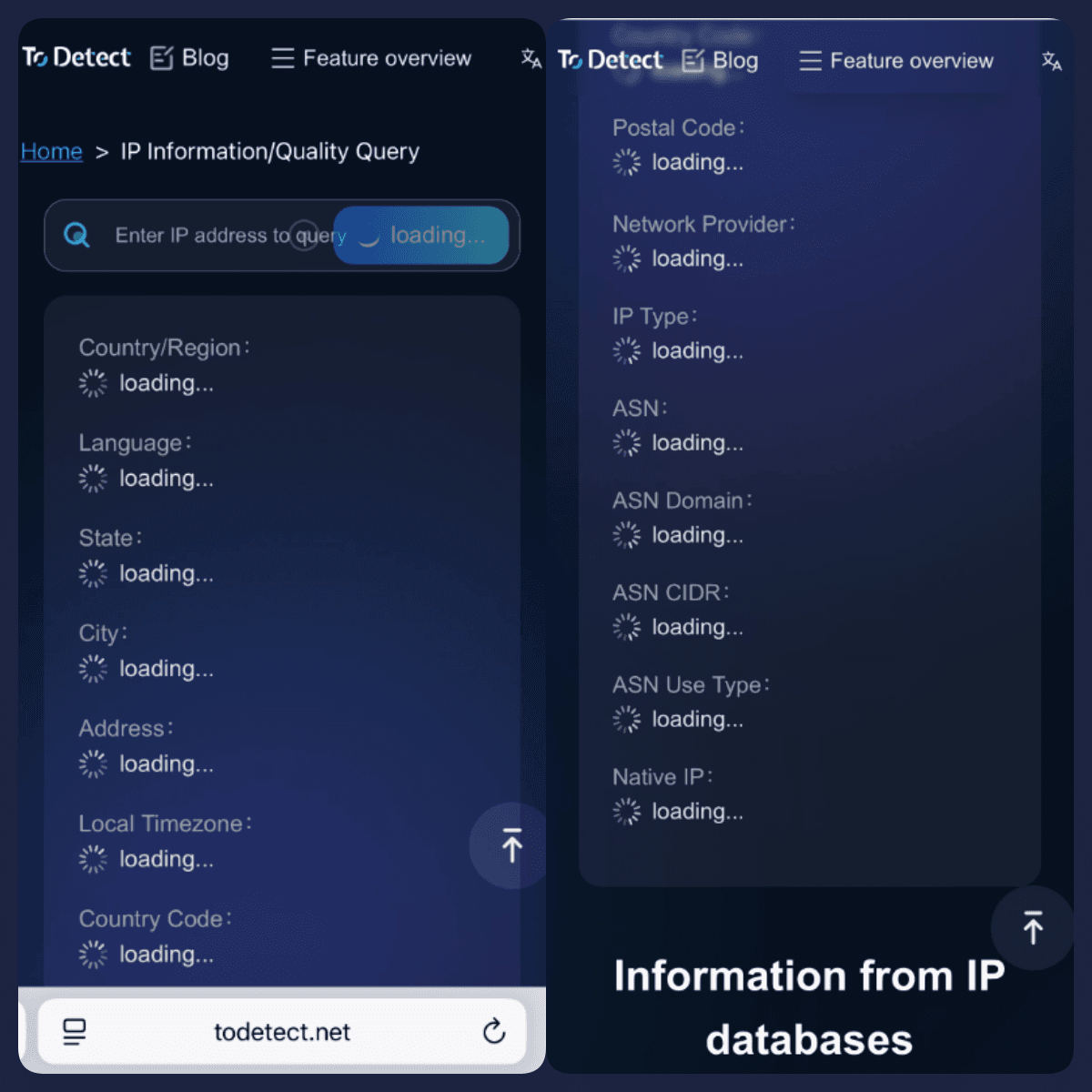
• IP reputation score results
• IP risk status detection
• Whether it is a proxy or data-center IP
• Historical risk records. For ordinary users, this type of “one-click online IP lookup” tool greatly lowers the barrier to use.
8. Online IP Quality Lookup FAQ
1. What indicators are most important in IP quality detection?
IP quality detection mainly focuses on reputation score, risk status, proxy detection, data-center origin, and blacklist records. Only by combining all these indicators can you determine whether an IP is “clean” and suitable for registration, login, or advertising operations.
2. Is it normal for online IP lookup results to differ?
Yes. Different platforms update their IP databases at different frequencies. Some are near real-time, while others are delayed. In addition, different systems use different risk-evaluation models, so the same IP may produce different risk detection results across tools.
3. Does a low IP reputation score affect account security?
Yes. A low IP reputation score usually means the IP has a history of abnormal activity, such as abuse by multiple users or high-risk operations. In such cases, accounts are more likely to trigger platform risk-control mechanisms, including frequent verification, feature restrictions, or even account bans.
4. How can you quickly determine whether an IP is suitable for long-term use?
The simplest method is to perform a complete IP quality check first. If the IP reputation score is normal, the risk status is low, and it is not identified as a proxy or data-center IP, it is generally suitable for long-term use. Regular online IP checks are also recommended to avoid business disruptions caused by future IP status changes.
Conclusion
Many people initially think IP quality is “not a big deal,” but after encountering problems, they realize it directly affects whether accounts survive and whether business operations can run smoothly.
Through online IP lookup, IP quality checks, IP reputation score analysis, and IP risk status detection, you can more clearly determine whether an IP is suitable for use.
The one-click lookup capability provided by ToDetect essentially transforms complex risk analysis into visualized results, allowing users to intuitively understand whether their current IP is safe and suitable for use.