Resources
 Feature overview

 Ganesh
 2026-08-27 11:00
Before using an IP address, many people search for questions like "Is this IP safe?", "Does this IP have risks?", or "How should I interpret the IP risk score?" However, only after actual testing do they realize that analyzing an IP address goes far beyond simply looking at its geographical location.
By using professional IP risk detection tools, you can understand an IP's real-time status in advance—including its risk level, proxy attributes, network metadata, and reputation history—preventing unexpected issues after deploying the IP.
Today, let's explore which IP detection tools are worth using in 2026, how different tools compare, and which online IP detection platform offers the most comprehensive data for practical use.
1. Why Do You Need an IP Risk Score Lookup?
The IP risk score indicates the trustworthiness of an IP address within a network environment. Although evaluation algorithms vary across detection platforms, they generally analyze multiple factors comprehensively, including historical records, network type, proxy attributes, blacklist status, ASN information, and ISP details.
In many cases, an IP anomaly occurs not because of current network operations, but because the IP was heavily shared in the past or carried a history of abnormal traffic patterns.
Performing an IP risk score lookup immediately after acquiring or switching an IP allows you to identify its state early, avoiding access restrictions, extra verifications, or environment instability later on.
2. What to Look for When Choosing an IP Risk Detection Tool in 2026?
1. Basic IP Information Lookup Capabilities
Top online IP detection tools typically provide: country and region locations, ISP operator information, ASN ownership, network type, and IP category identification. These details help users quickly trace the origin of the IP.
However, note that simple geolocation data does not determine IP quality. For instance, two IPs located in the United States might differ vastly: one could be a residential broadband IP while the other is a cloud data center node, resulting in significantly different risk levels.
2. IP Risk Scoring Capabilities
Professional IP risk detection tools calculate risk levels based on multiple data dimensions, such as: blacklist history, proxy status, data center categorization, and historical misuse records.
Because scoring methodologies differ across platforms, you should evaluate the numerical score alongside IP type, network environment, and your specific use case rather than relying on a single metric.
3. Proxy Attribute Detection
Many IP issues stem directly from proxy attributes. A robust IP detection tool should accurately distinguish between: standard residential networks, data center IPs, mobile network IPs, and proxy server IPs.
3. Review of Popular IP Risk Detection Tools in 2026
Below is a breakdown of several common IP detection tools based on feature scope, user experience, and ideal usage scenarios.
| Tool | Core Features | Overall Rating |
|---|---|---|
| ToDetect | IP Risk Detection, IP Quality Analysis, Proxy Identification, Network Environment Testing | ★★★★★ |
| IPinfo | IP Geolocation, ASN, and ISP Lookups | ★★★★☆ |
| IPQualityScore | Risk Scoring, Proxy Detection, Reputation Analysis | ★★★★☆ |
| Scamalytics | Fraud Risk Analysis, IP Reputation Testing | ★★★★☆ |
| Whoer | IP Lookup, Anonymity Testing | ★★★☆☆ |
1. ToDetect: Comprehensive IP Risk Detection Tool
Among many IP detection tools, ToDetect stands out as a feature-rich solution. It supports basic IP lookups alongside deep evaluations of IP quality, risk status, proxy attributes, and network setup.
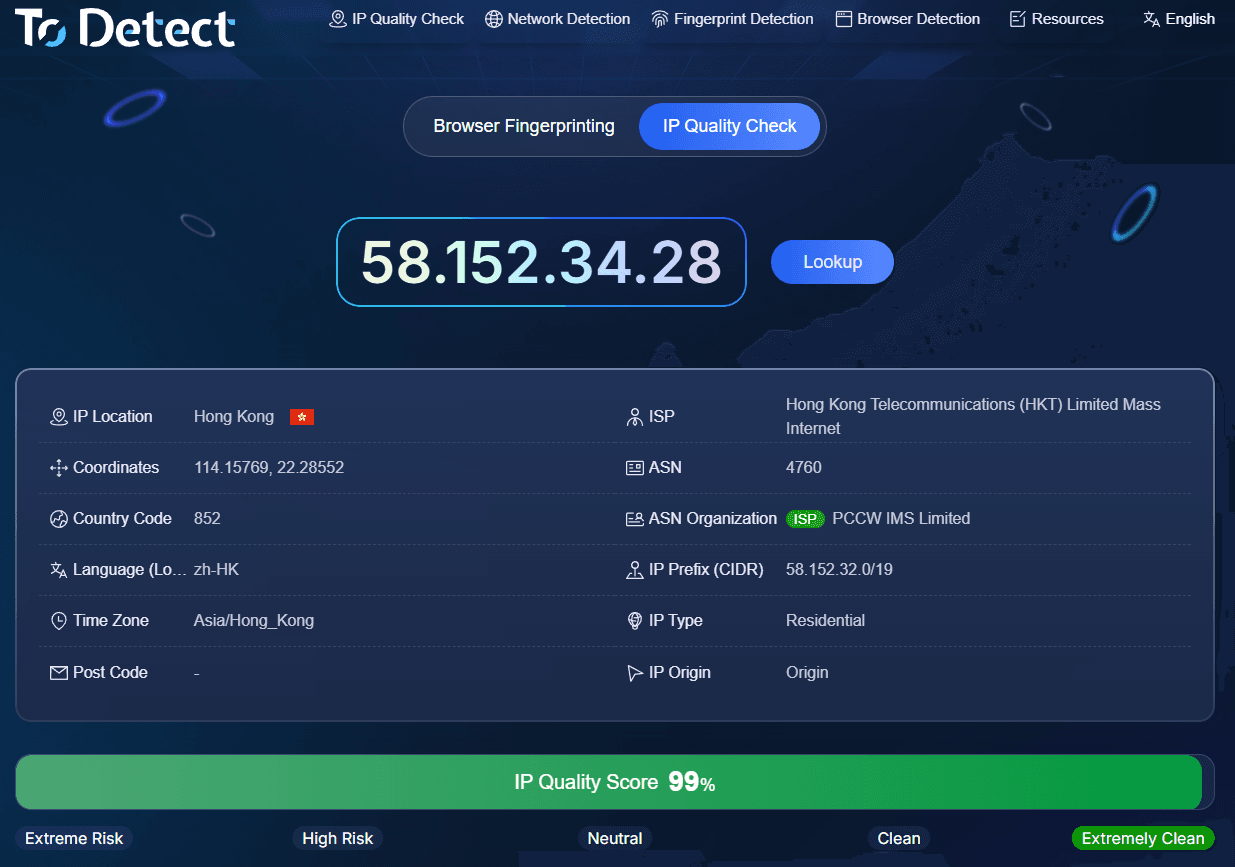
• Rich Detection Dimensions: Unlike basic location lookup sites, ToDetect delivers deeper insights like IP type, ASN, ISP, and risk indicators, enabling users to evaluate quality rather than just location.
• Intuitive Result Presentation: Raw data can be overwhelming for regular users. ToDetect structures detection data clearly, making it easy to spot potential anomalies quickly.
• Broad Application Scenarios: Whether performing standard IP lookups, filtering proxy IPs, or inspecting network environments, ToDetect helps users verify IP status efficiently.
2. IPinfo: Ideal for Basic IP Information Lookups
IPinfo is a well-known provider of IP geolocation, ASN, and ISP data. It works well for developers or users looking to quickly verify the basic background of an IP address.

However, if your focus centers around IP risk scoring, proxy detection, and overall quality analysis, IPinfo alone may need to be supplemented with dedicated security tools.
3. IPQualityScore: Oriented Toward Enterprise Risk Analysis
IPQualityScore focuses heavily on IP reputation analysis, fraud detection, and proxy identification. It provides deep data metrics commonly utilized in enterprise security setups.
For individual users, however, it comes with a higher entry barrier—certain features require account registration or paid subscriptions, making it less instant than web-based checkers.
4. Scamalytics: Focused on Risk History Analysis
Scamalytics specializes in spotting high-risk IPs tied to fraud, spam registrations, and abnormal access patterns. It offers high reference value for users auditing IP reputation histories.
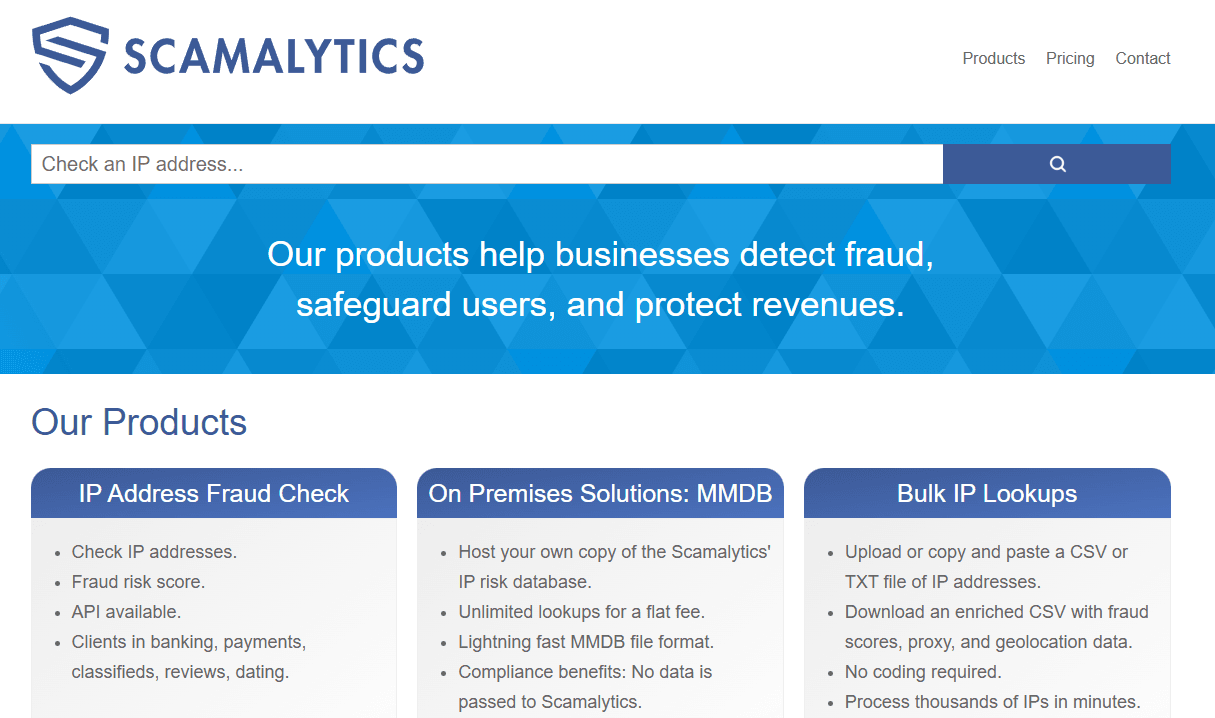
Because of its narrow focus on risk intelligence, users who also need location data, network type details, and complete proxy status may need to pair it with supplementary tools.
4. How to Determine If an IP Risk Score Is Normal?
Many users perform an IP risk score lookup, view the numerical score, but remain unsure of what constitutes an acceptable rating.
Low-Risk IPs: Typically show no blacklist entries, standard network types, clean history logs, and minimal risk tags. These IPs offer optimal stability.
Medium-Risk IPs: May indicate high shared usage, non-standard network types, or average historical records. Evaluate these based on your specific requirements.
High-Risk IPs: Often stem from obvious proxy flags, abusive activity records, or listings across multiple security databases. If high risk is detected, consider changing the IP source or network environment.
5. Common Pitfalls to Avoid During Online IP Detection
When using online IP detection services, many users focus solely on the final score while overlooking key details.
First, different platforms draw from distinct threat intelligence databases, which can lead to variance in scores.
Second, IP risk status is dynamic. An IP that appears clean today may accumulate risk flags later depending on how it is used over time.
Finally, avoid depending on a single metric. Assess IP quality holistically by reviewing: risk score, IP type, network ownership, historical reputation, and target use case. Multi-dimensional evaluation yields the most accurate outcome.
Summary of 2026 Recommended IP Risk Score Lookup Tools
Overall, ToDetect provides a well-balanced platform for IP risk scoring, quality auditing, proxy detection, and seamless online testing, making it ideal for users seeking fast, accurate IP analysis.
Each tool serves different priorities: basic tools excel at simple location queries, while dedicated risk detectors offer deeper insights into proxy status and security scores. For simple geolocation queries, standard lookup tools suffice; for complete quality and risk assurance, a comprehensive detection platform is recommended.
Whether for personal or enterprise use, performing a professional IP risk score lookup prior to deploying a new IP helps uncover hidden issues early and ensures a stable network infrastructure.