



 Resources
 Feature overview
 Ganesh
 2026-07-23 14:15
In global business expansion, multi-account management, and large-scale data collection scenarios, many users still view IP addresses from a basic perspective: whether they can access the internet and whether the location is accurate.
However, as platform risk control systems continue to evolve, simple geographic location lookup is no longer enough to evaluate network reliability.
The key factor is the IP quality profile — including whether the IP has accumulated risk history and whether its network characteristics match normal user behavior patterns.
Based on practical experience, this article provides an in-depth analysis of IP detection and the key factors behind IP quality scoring.

Why Traditional "IP Location Lookup" Is No Longer Enough
Many beginners only check whether the location is accurate after switching to a new proxy IP, which is one of the most common misconceptions.
A "clean IP" generally refers to an IP address that has not been flagged by major security databases, has a relatively low risk history, and provides a stable network environment.
IP reliability is also closely related to factors such as IP type, historical usage behavior, and the number of users sharing the same IP.
For example, an IP located in New York may still be considered high risk if previous users used it for abusive activities, or if the same IP is being heavily shared by many users.
Such IPs are more likely to trigger risk control measures, resulting in account restrictions, access limitations, or frequent CAPTCHA challenges. Therefore, comprehensive IP blacklist checks and proxy IP detection are essential.
Deep Analysis: Four Core Dimensions of IP Detection
To build a complete IP risk score and quality profile, the following key indicators should be considered:
1. IP Type and ASN Attributes (Datacenter vs. Residential)
The ASN (Autonomous System Number) and network type of an IP address are important factors used by risk control systems when evaluating network environments.
Residential IP (ISP): Typically closer to real user network environments and therefore provides more natural network characteristics in many cross-border business scenarios.
Datacenter IP (IDC): Belongs to data centers and is commonly used for servers. On some high-risk platforms, these IPs may receive lower trust scores because they are more likely to be identified as proxy or automated traffic sources.
2. Risk History and IP Reputation Score
Professional detection platforms usually combine multiple data sources, including IP reputation databases, ASN information databases, VPN detection data, and proxy detection databases.
IP Fraud Score: Evaluates the likelihood that an IP address is associated with fraudulent activity (such as Scamalytics scoring).
Abuse Score: Checks whether the IP appears in known lists related to network attacks, spam activity, or other abusive behavior.
Threat Intelligence Records: References historical risk indicators from global security databases and threat intelligence platforms.
3. Network Characteristics and Leakage Risks
Advanced risk control systems may analyze network environments to identify potential inconsistencies:
Proxy Detection: Checks whether the network request contains obvious proxy-related characteristics or exposed proxy headers such as X-Forwarded-For and Via.
DNS and WebRTC Leakage:
Checks whether the real local IP address or DNS information conflicts with the proxy IP location. DNS or WebRTC leaks may expose inconsistencies in the network environment and make it easier for platforms to identify non-standard user connections.
4. Real-World Performance Metrics (For Data Collection and Long-Term Operations)
For engineers working with large-scale data collection, overall IP performance should also be evaluated:
Availability Rate: A low availability rate may indicate issues with overall IP pool quality, network stability, or compatibility with target websites. The results should be evaluated based on specific use cases.
Response Latency: Latency should be evaluated based on the target market and business region. For example, higher latency during cross-continent connections (such as accessing US websites from Europe) can be caused by physical distance and does not necessarily indicate poor IP quality.
Deduplication Rate: Measures the uniqueness of active IP resources and helps avoid excessive reuse of the same IP addresses in business operations.
Expert Recommendations: How to Properly Test IP Quality
Based on long-term industry experience, we recommend the following practices:
Test After Connecting: Always connect to the IP service before opening the detection page to ensure you are testing the actual public exit IP rather than your local network.
Recheck Dynamic IPs Regularly: Dynamic IPs may change after each reconnection, so every new IP should be tested instead of relying on previous results.
Use Multiple Verification Methods: Avoid relying on a single static data source. Professional platforms should combine global reputation databases and analyze network environment consistency.
Monitor Public Exit IPs: Especially in local network or multi-device environments, ensure that each independent device uses a separate and compliant public IP environment to maintain proper network separation.
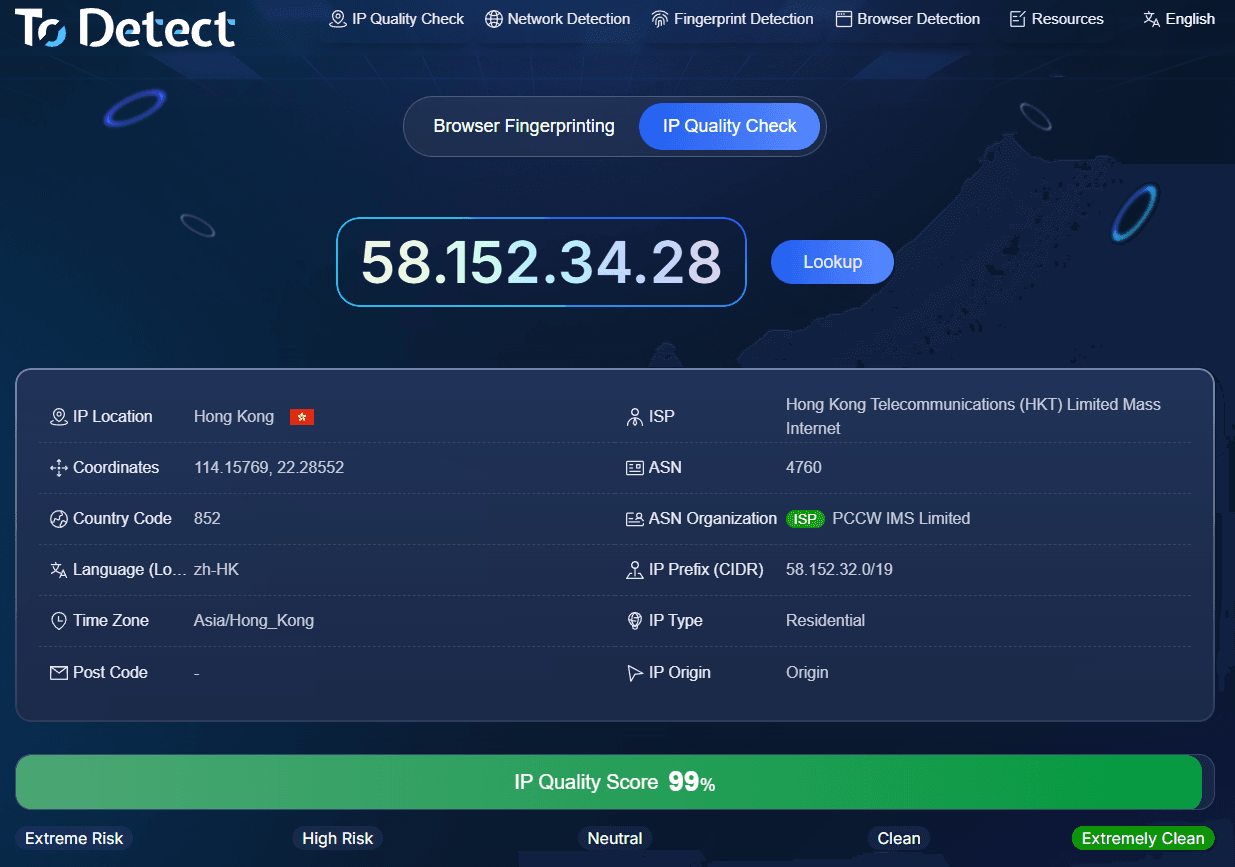
💡 Advanced Tip: For more information about IP quality scoring, ASN information, and network environment analysis, visit ToDetect IP Quality Check for professional online detection support.
Frequently Asked Questions (FAQ)
Q1: Is a static IP always cleaner than a dynamic IP?
Not necessarily. IP quality mainly depends on factors such as historical usage records and the number of users sharing the IP. If a static IP has been abused by previous users and added to risk databases, its quality may be worse than a clean dynamic residential IP.
Q2: Does a "clean" IP detection result guarantee complete safety?
Public detection tools mainly cover major global blacklist databases and reputation databases. Some large platforms also maintain their own private risk control systems.
A positive detection result means the IP has relatively low baseline risk, but a reliable network environment and proper account management practices are still important.
Q3: Why is my IP location correct, but websites still block my access?
This is usually caused by factors such as low IP reputation, identification as a datacenter IP, or DNS/WebRTC leaks. These signals may indicate that the connection does not match a normal user network environment.
Q4: Do regular home users need to check their IP frequently?
Generally, no. IP quality checks are only necessary when you experience frequent CAPTCHA challenges, access issues on specific legitimate websites, or unusual account activity alerts.
Q5: What should I do if my IP has a high-risk score?
The most direct solutions are contacting your network provider for an IP change or switching to higher-quality dedicated or residential proxy services with better reputation to reduce risks caused by IP history issues.
Want to quickly check whether your network environment is reliable? Visit ToDetect Online Detection Tool for comprehensive IP scanning and quality assessment.