



 Resources
 Feature overview
 Ganesh
 2026-09-07 10:39
The biggest feature of a static IP is that its address is relatively fixed, making it suitable for usage scenarios that require maintaining a consistent network outlet over the long term. However, if this IP has a history of abnormal usage or has been blacklisted, you might encounter issues like an increased frequency of CAPTCHAs or access restrictions during subsequent use.
Therefore, after obtaining a new static IP, I generally do not recommend checking only the country, city, and ISP. Instead, find an IP risk score lookup website to examine the IP risk score, blacklist records, proxy attributes, and other information together. A single normal metric does not fully represent the actual condition of the IP.
Today, let's dive into how to evaluate static IP risk scores. How much is the risk score? Has it been blacklisted? What are proxy attributes? What key data should be checked during an online IP lookup?

1. Why Check the Risk Score of a Static IP?
Many people have a misconception about static IPs: they think that as long as the IP is fixed and connects normally, there won't be any quality issues. In reality, "static" is merely the mode of using an IP address and does not directly indicate whether the IP is clean.
Another scenario is that although an IP has no obvious blacklist record, its proxy attributes are very prominent, or it has even been identified by some databases as Proxy, Hosting, or other non-residential network types.
Therefore, when checking a static IP, it is recommended to focus on at least the IP risk score, blacklist status, and proxy attributes. Analyzing these three indicators together provides a result that is generally far more valuable than simply checking whether "this IP is a residential IP."
2. Blacklist Records Are More Important Than You Think
When evaluating a static IP, the blacklist is usually the second thing I look at. The so-called IP blacklist is a record of abnormal IPs maintained by security agencies, anti-spam systems, or risk databases. If an IP was previously involved in spamming, malicious scanning, or other abnormal behaviors, it may be recorded in these databases.
Please note: being listed on a blacklist does not mean the IP is completely unusable.
Different blacklists serve different purposes—some target mail servers, some focus on network security, and others update slowly. Therefore, the query results should be evaluated based on the specific blacklist source and your intended use.
Hence, when looking for a static IP risk score lookup site, it is best to choose a tool that displays both risk levels and blacklist information simultaneously, eliminating the need to search across multiple pages.
3. Check Proxy IP Attributes as Well
Some people buy static residential IPs and start using them immediately after confirming the country and city are correct. In practice, you should further check the IP type, ASN, ISP, and proxy detection results.
If you purchased a static residential IP but multiple test results consistently display it as Hosting, you should at least verify the true network attributes of the IP.
This is why, when conducting a static residential IP risk check, you shouldn't just focus on the word "residential." The IP type, proxy attributes, ASN, and risk records are best evaluated together.
4. How to Use ToDetect to Check Static IP Risk?
If you want to avoid switching back and forth between multiple websites, you can use online tools like ToDetect for a preliminary check.
Step 1: Check basic IP information.
First, confirm whether the detected IP address, country, city, ISP, and ASN match your expectations. If you purchased a static IP for a specific region, this step can rule out obvious mismatches right away.
Step 2: Check the IP risk score.
Perform an IP risk check via ToDetect to observe the current IP's risk level and related risk signals. If the risk score is noticeably high, don't rush to conclusions—continue investigating the underlying reasons.
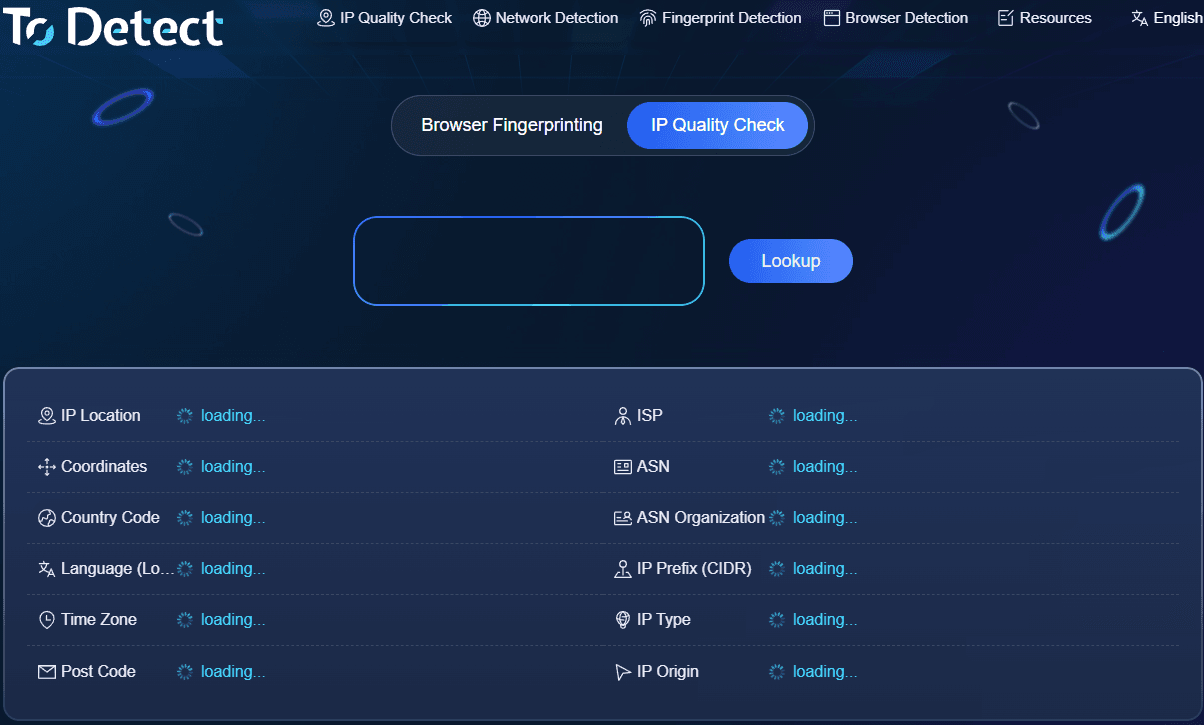
Step 3: Check proxy attributes.
Verify what type the IP is identified as, whether it has obvious Proxy or Hosting features, and combine this with ISP and ASN information for judgment.
Step 4: Check blacklist status.
Check if the IP has any blacklist records, as well as the number and types of matches. If the risk score is high, proxy features are obvious, and multiple blacklists are hit, caution is strongly advised for this IP.
Following this procedure gives you more than just a simple "IP risk score"—it provides a comprehensive basis for judging IP quality.
5. What Counts as a Relatively Clean Static IP?
There is no single fixed answer applicable to all scenarios.
From a routine testing perspective, an ideal static IP typically exhibits: a low IP risk level, few or no abnormal blacklist records, an IP network type matching expectations, normal ASN and ISP information, and no obvious geographical location discrepancies.
Conversely, if an IP simultaneously shows a high risk score, multiple blacklist hits, abnormal proxy attributes, or a network type inconsistent with the purchased product, it warrants further investigation.
Particularly when purchasing a new static IP, you can perform an online IP lookup and save the results, then check again after using it for a while. Comparing the results side by side makes it easier to spot changes in the IP's risk status.
6. IP Risk Score Lookup FAQ
1. Why is the risk score high even though the static IP is not blacklisted?
Blacklists are only one dimension of IP risk assessment. Even without blacklist records, an IP may still receive a high risk score due to obvious proxy characteristics, abnormal historical behavior, or changes in network type. Therefore, you shouldn't rely solely on blacklist results when checking an IP's risk score.
2. Why do scores for the same IP vary widely across different IP risk score lookup sites, and which one is more accurate?
This is very common. Different platforms use different data sources, update intervals, and risk models, leading to variations in scores. Rather than directly comparing specific numerical scores, focus on whether multiple test results consistently flag abnormal proxy attributes, blacklist records, or high-risk warnings.
3. Why did a static IP's risk score increase after being used for a while, even though it was low when purchased?
IP risk scores are not permanently fixed. Access behaviors during usage, updates to IP databases, and re-identification of network attributes can all impact subsequent scores. For static IPs used over long periods, regular IP risk checks are recommended rather than inspecting them only upon purchase.
Summary:
If you have just acquired a static IP, you can start by using ToDetect to run an online IP check, focusing on the IP risk level, network attributes, and relevant basic information. If any anomaly is detected, investigate that specific indicator further rather than jumping to conclusions based on a single risk score.
A more practical detection approach involves piecing together a complete picture of an IP's network attributes and risk profile using online IP checks, IP risk evaluations, static IP testing, IP blacklist queries, proxy attribute detection, and ASN lookups.
Especially for long-term static IPs, spending a few minutes on thorough testing is far more meaningful than just checking "whether the IP connects." After all, a working connection only proves the IP is currently functional, while risk scores, blacklists, and proxy attributes reveal whether the static IP is truly clean.