Resources
 Feature overview

 Ganesh
 2026-06-15 11:17
Many cross-border e-commerce sellers experience sudden login anomalies or even account restrictions despite not violating any rules. Even worse, after extensive troubleshooting, they still cannot find the cause.
In today’s environment where multi-account operations and “store cluster” models are increasingly common, platforms have become extremely sensitive to login environments. Every IP you use may be recorded by the system.
Today, we will explain how to check IPs, how to determine whether they are safe, and what sellers can do to avoid unnecessary risks.

1. Why Cross-border Sellers Must Perform IP Detection
Many beginners overlook one key point: platforms do not only check whether you switch accounts, but also evaluate whether your network environment is consistent.
For example: multiple stores using the same IP, low-quality proxy IPs shared by many users, mismatch between browser fingerprint and IP environment, frequent IP location changes, or datacenter IPs flagged by platforms.
Without proper proxy IP detection in advance, these situations are often interpreted as “one operator managing multiple accounts,” which is a common cause of unexpected account bans.
2. What Can Online IP Lookup Actually Detect?
Simply put, IP online lookup helps you understand your current digital identity. A complete IP query usually includes:
Current IP address, country/city, ISP (network provider), proxy/datacenter identification, risk score, or blacklist status.
With this information, you can quickly determine whether your network environment is “clean.” This is especially important for cross-border sellers, as platform risk systems evaluate similar signals.
3. Cross-border Seller IP Environment Detection Reference Table (Practical Version)
4. How to Properly Use IP Online Lookup
1. Check Current IP Environment First
Open any IP lookup tool to check basic information such as location and ISP.
If the IP shows as Datacenter, or if the IP location is significantly different from the account registration region, or changes frequently, then the environment is considered high-risk.
2. Perform Proxy IP Detection Before Use
Many users directly use purchased proxy IPs, which is a major mistake. You should first verify:
Whether it is residential or datacenter IP, whether it is reused, whether it has historical violations, and whether it is flagged by major platforms. Residential IP quality is especially important.
3. Test IP Stability Before Login
Refresh multiple times to check whether the IP remains stable. Frequent changes in a short time may be flagged as abnormal login behavior.
5. Is ToDetect Reliable for IP Detection?
In practice, many cross-border sellers use ToDetect to evaluate their network environment. Its main function is to quickly determine whether the current IP is safe.
• Includes: IP type identification (residential/datacenter/proxy), risk scoring, multi-dimensional network analysis, and anti-association risk alerts.
• For beginners, its value is not simply telling you the IP address, but determining whether the IP is safe for e-commerce account usage.
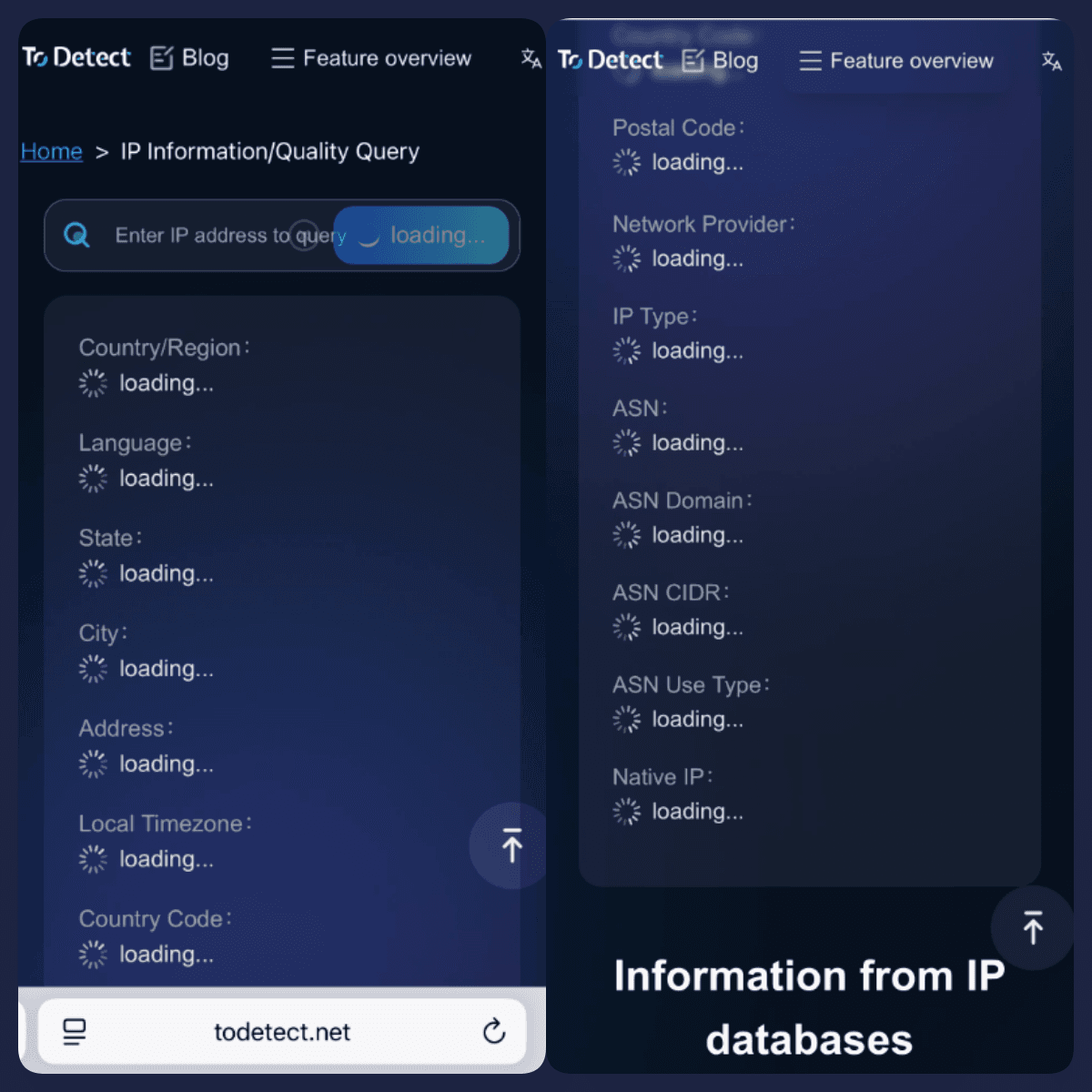
Especially in multi-account or store-cluster operations, performing IP lookup and risk checks in advance can help avoid many unnecessary bans.
6. Practical Tips for Cross-border Anti-Association IP Management
1. One Store One IP Principle
Each store should ideally use a dedicated IP environment. Avoid multiple accounts switching on the same IP frequently.
2. Keep IP Location Consistent
If your account is registered in the US marketplace, maintain a US residential IP. Frequent country switching increases risk.
3. Regular IP Re-checking
Even in use, proxy IPs should be checked regularly to ensure they have not been polluted, flagged, or reused by others.
4. Avoid Free or Low-quality Proxies
Free or cheap shared proxies are usually high-risk due to heavy usage and are easily flagged by platforms.
Conclusion
Many account bans, traffic drops, or store anomalies are not caused by operational mistakes, but by ignoring whether the daily-used IP environment is clean, stable, and trustworthy.
Therefore, IP lookup and IP detection are not just about “checking an address,” but about performing a risk health check for your account. Tools like ToDetect act as early warning systems.
In today’s stricter platform environment, a clean and stable IP is often more important than additional operational tricks. Getting this right can prevent a large portion of unexplained bans.