



 Resources
 Feature overview
 Ganesh
 2026-09-09 10:44
Even when checking the exact same IP address, some IP lookup websites display a specific ISP name, while others show a string formatted as "AS + numbers." Sometimes, even when purchasing a residential proxy IP, the ISP name shown in online IP lookup results doesn't match the proxy provider's brand at all.
In reality, ISP and ASN are not redundant details; they represent different layers of IP network ownership. These two fields provide valuable insights, particularly when evaluating residential IPs, inspecting proxy IPs, or analyzing IP quality.
Below, let's explore what ISP and ASN stand for, how they differ, and how to interpret them effectively when checking IPs using common IP lookup tools and proxy inspection services.

1. What does ISP mean on an IP lookup website?
ISP stands for Internet Service Provider. Simply put, it indicates which organization or network carrier provides the network for the IP address.
For instance, if you purchased a residential IP but the IP lookup tool displays a provider known for cloud computing or server hosting, you should double-check the IP's actual network attributes.
However, you shouldn't draw conclusions based solely on the ISP name. Because network resources can involve reselling, hosting, or carrier partnerships, it is best to analyze the ISP alongside the ASN, IP type, risk score, and geolocation.
2. What is an ASN?
ASN stands for Autonomous System Number.
While it sounds technical, you can think of it simply: different networks across the internet have unique "network identifiers," and the ASN is used to identify these networks.
Common formats look like AS12345 or AS67890, where "AS" stands for Autonomous System and the following digits form the unique identifier.
Therefore, when you see an ASN in an IP lookup tool, avoid viewing it merely as another "ISP name." The ASN represents network-level routing identity, whereas the ISP provides human-readable carrier or service provider information.
3. What is the difference between ISP and ASN?
| Comparison Dimension | ISP | ASN |
|---|---|---|
| Definition | Internet Service Provider / Network Operator | Autonomous System Number |
| Full English Name | Internet Service Provider | Autonomous System Number |
| Primary Purpose | Identifies which network service provider supplies the IP | Identifies which autonomous system network the IP belongs to |
| Common Format | Carrier name, network provider name | AS + Digits (e.g., AS12345) |
| User Interpretation | "Which provider owns this IP network?" | "Which network routing system does this IP belong to?" |
| Determines Residential Status? | Useful reference, but cannot determine status alone | Helps determine network origin, but cannot determine status alone |
| Determines IP Quality? | Cannot determine quality directly | Cannot determine quality directly |
| Role in Proxy Detection | Helps check if the IP originates from broadband, mobile, or data centers | Identifies the network organization and routing origin behind the IP block |
| Common Discrepancy | ISP name may differ from the proxy brand name | ASN label may not fully align with the ISP name |
| Best Evaluation Practice | Analyze alongside IP type, location, and risk score | Analyze alongside ISP, Organization, and IP type |
4. How to check an IP carrier using an IP lookup website?
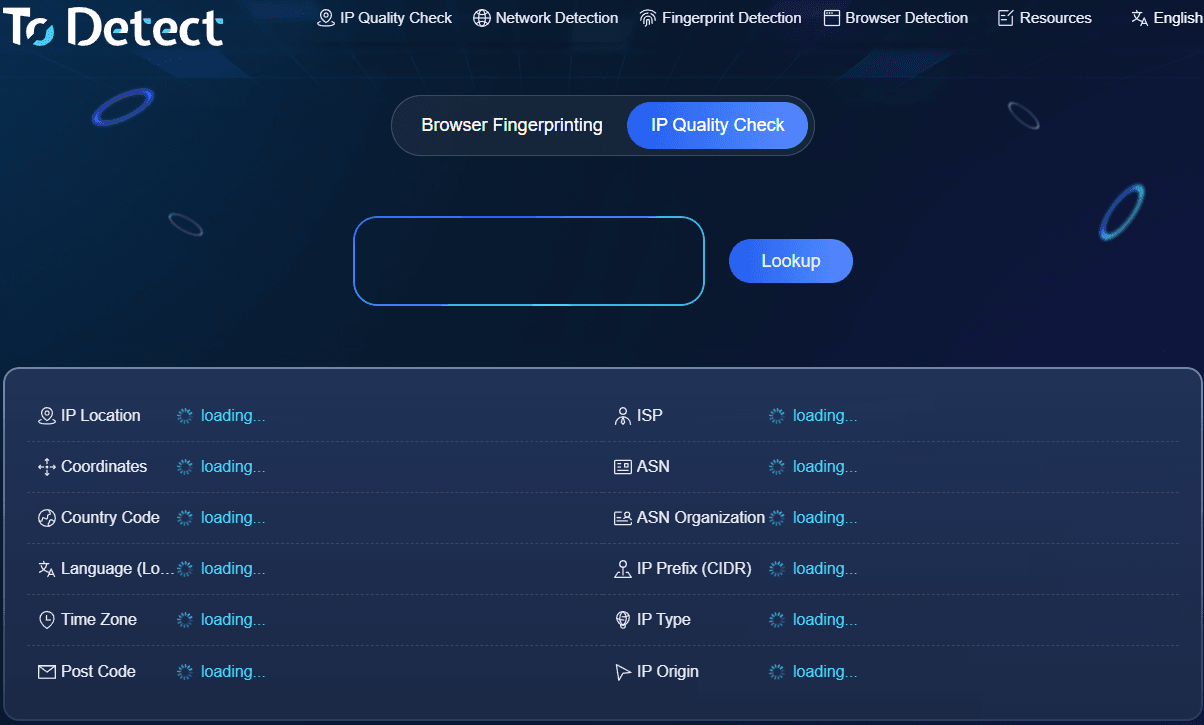
Checking an IP carrier is straightforward using an IP lookup tool that provides detailed network data. Taking tools like ToDetect as an example:
• 1. ISP Information: Check the network carrier first to determine whether it belongs to home broadband, a telecom operator, a mobile network, or a data center network.
• 2. ASN Information: Inspect the Autonomous System Number and network organization corresponding to the IP to verify its network origin.
• 3. IP Type: When inspecting residential or proxy IPs, evaluate attributes like Residential, ISP, or Datacenter alongside the carrier data.
• 4. Geolocation: Check whether the country, region, and city match the carrier information. Significant discrepancies suggest data inaccuracy.
• 5. Risk Information: For IPs intended for long-term use, checking the carrier alone is insufficient. Review risk levels, proxy flags, and usage history.
A comprehensive assessment of IP quality shouldn't rely on a single metric; instead, evaluate ISP + ASN + IP Type + Geolocation + Risk Score together.
5. Why must you check ISP and ASN during proxy IP detection?
Many users only test whether a proxy IP can connect after purchasing it, but connection testing alone is not enough.
For instance, given two US IP addresses—one from a local broadband provider and another from a cloud server facility—both may offer fast connection speeds, yet present significantly different network behaviors across different online tasks.
This is why more users run a proxy IP inspection on an IP lookup site before deploying proxy servers.
For static residential IPs or dynamic residential IPs, verifying the ISP and ASN alongside IP purity scores, risk values, and proxy types gives a complete picture of the IP's profile.
6. Does a normal ISP status guarantee a high-quality IP?
Not necessarily. This is a common misconception. The ISP field only identifies network ownership and service origin; it does not guarantee that an IP address is clean or high quality.
An IP address assigned by a genuine carrier might have been misused by previous users, resulting in elevated risk scores. Likewise, a clean ASN record does not guarantee an anomaly-free IP.
Treat ISP and ASN as baseline information and combine them with other diagnostic metrics during IP quality analysis.
For example, when using ToDetect for IP analysis, review risk ratings, proxy indicators, location details, and network environments for a much more reliable verdict than relying solely on the ISP name.
7. Proxy IP Detection FAQ:
1. Why does the ISP on an IP lookup site differ from my proxy brand?
This is normal. Proxy service brands differ from underlying network infrastructure carriers. The lookup result displays the underlying network operator. Evaluate IP quality by looking at ASN, IP type, and location together.
2. Why is a proxy IP flagged as a Data Center IP when its ISP shows a residential operator?
The ISP name reflects network ownership but does not solely determine IP classification. IP databases also factor in ASN details, historical usage, IP range characteristics, and risk records, which can lead to a residential-looking ISP being categorized as a data center IP.
3. Why do ASN or ISP details for the same proxy IP vary across different lookup sites?
This variation stems from different database sources and update intervals. Rather than relying on a single source, compare whether the ASN, organization name, IP type, and location generally align across platforms.
Summary
Many online IP lookup tools display these data points in one place. For example, checking an IP via ToDetect allows you to inspect basic IP data, network carriers, ASNs, and network attributes in a single view.
The ISP identifies which network service provider supplies the IP, offering a quick overview of carrier ownership. The ASN identifies the autonomous system network, providing deeper visibility into network routing and organization.
Combining ISP and ASN with IP type, geolocation, risk scores, and proxy flags provides a complete and accurate understanding of any IP address during proxy detection or IP purity checks.