



 Resources
 Feature overview
 Ganesh
 2026-07-21 15:56
In today’s global business environment, overseas proxy IPs are no longer just a simple networking tool. They have become a digital foundation that supports store assets, customer data, and brand reputation.
However, many businesses overlook the deeper impact of IP quality while trying to reduce operating costs.
Low-quality IPs with a “bad history” are becoming an invisible risk to overseas operations.

What Makes an IP a Low-Quality Second-Hand IP?
A low-quality second-hand IP usually refers to proxy IP resources that have been heavily used, have a complicated usage history, or carry higher risk levels.
These IPs may have been affected by previous users’ abusive activities, such as sending spam or violating platform rules, resulting in poor reputation and lower trust scores. A large amount of abnormal activity can reduce the reputation of an IP and increase the likelihood of future users triggering security checks.
Three Major Risks of Low-Quality IPs for Overseas Businesses
1. Account Association and Mass Restrictions
For sellers operating on platforms such as Amazon, Facebook, or TikTok, IP reputation is one of the important factors affecting account security.
If a low-quality IP has already been flagged by platforms, logging in through that IP may trigger additional verification, access restrictions, or increase account risk.
More importantly, a compromised IP may increase the possibility of multiple accounts being associated, putting long-term business assets at risk.
2. Frequent CAPTCHA Challenges and Access Restrictions
When accessing websites through low-reputation IPs, one of the most common issues is frequent CAPTCHA verification.
This happens because the target website may detect risk signals associated with the IP, such as abnormal access history, proxy characteristics, or high risk scores from third-party databases.
This not only reduces operational efficiency but may also increase bounce rates for independent websites.
3. Data Privacy and Security Risks
Untrusted proxy providers may pose risks such as activity logging or privacy exposure, especially when using non-encrypted connections.
This could expose sensitive business information, such as pricing strategies and customer data, creating potential security risks for companies.
Avoid Pitfalls: Common Mistakes When Choosing Proxy IPs
1. Chasing Free IPs Without Considering Quality
Free IPs often come with problems such as heavy sharing, complicated usage history, or previous abuse by other users.
2. Assuming “Static IP” Always Means Safer
Many people assume that static IPs automatically mean dedicated and secure resources. However, if the IP was previously used for abusive activities before you acquired it, its historical reputation may still affect future performance.
IP reputation matters more than whether an IP is static or dynamic.
3. Focusing Only on IP Details While Ignoring Overall Network Quality
Many users testing proxy IPs only check whether the location is correct but overlook factors such as ASN type, risk scores, DNS resolution, and overall environment consistency.
An IP showing the correct target location does not necessarily mean it provides a stable and reliable network environment.
How to Evaluate and Maintain IP Quality
To ensure stable overseas operations, businesses should establish a comprehensive IP evaluation process:
Verify IP type: Choose the appropriate IP type based on your business needs. For account operations, native residential IPs are often preferred.
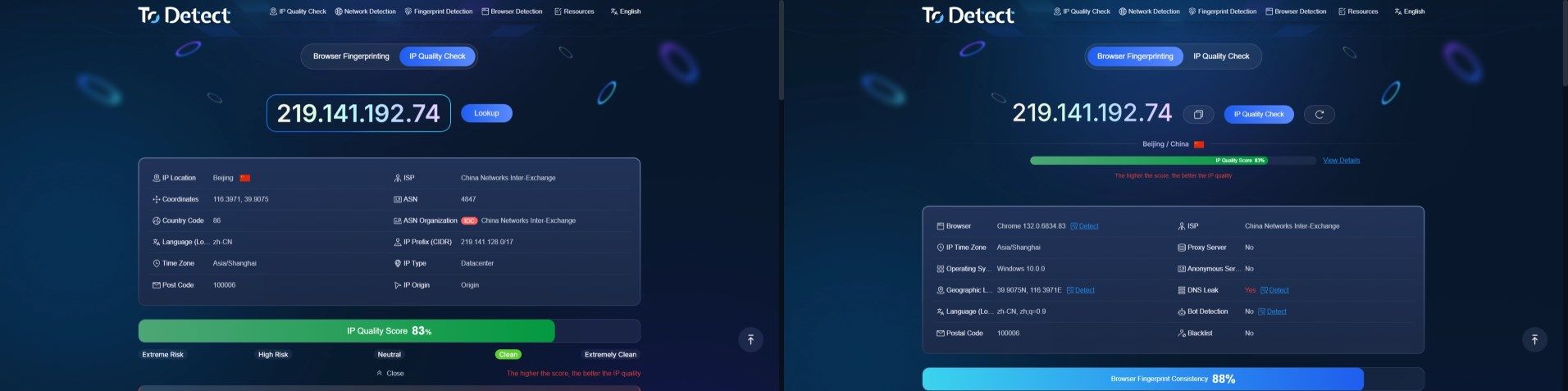
Analyze risk scores: Use professional detection tools to check IP reputation and quality scores.
Check blacklist status: Confirm whether the IP appears in major spam databases or security threat databases.
Perform environment checks: In addition to the IP itself, also check browser fingerprint consistency, timezone matching, and potential DNS leaks.
When choosing a proxy service, treat IP quality as a strategic investment rather than simply a cost. Regularly review and monitor your IP pool to make network requests closer to a real user environment in the target region.
If you want to better understand your network environment or check IP attributes and reputation, visit ToDetect Online Detection Tool for professional testing information and technical support.
Frequently Asked Questions (FAQ)
Q1: What are the signs of an unclean IP?
Common signs include account restrictions, frequent CAPTCHA challenges, or certain websites directly refusing access.
Q2: What should I do if my IP is found to have a poor reputation?
For some residential dynamic IPs, you can try reconnecting or waiting for the ISP to assign a new address. For business-use fixed IPs, contact your provider and request a cleaner dedicated IP resource.
Q3: Why should I check native residential IPs?
Native residential IPs typically have real ISP allocation records and characteristics closer to normal user networks. In some high-risk platforms and account operation scenarios, they generally provide higher trust compared with Hosting IPs.
Q4: Is checking IP quality only necessary once?
No. Dynamic IPs should be checked again after switching nodes, reconnecting, or obtaining a new address. For important business scenarios, regular quality assessments are recommended to reduce the risk of IPs being newly added to blocklists.