Resources
 Feature overview

 Ganesh
 2026-09-21 10:31
Nowadays, many people frequently encounter account anomalies and constant verification prompts after using proxy IPs. Even when switching to a brand-new proxy IP, these issues persist. This leaves many wondering: Is there something wrong with their proxy IP?
In fact, such situations are mostly due to insufficient proxy IP purity—meaning the overall IP quality is low, causing it to be flagged as a risky IP across multiple platforms. Therefore, whenever we get a new proxy IP, it is crucial to perform a thorough IP purity check.
However, with so many online IP check tools available, different websites sometimes yield conflicting results. Today, let’s dive into what data metrics you should actually look for. Does a high risk score always mean poor IP quality? And are residential IPs guaranteed to be cleaner?

Step 1: Start with Basic Online IP Lookup to Verify Data Consistency
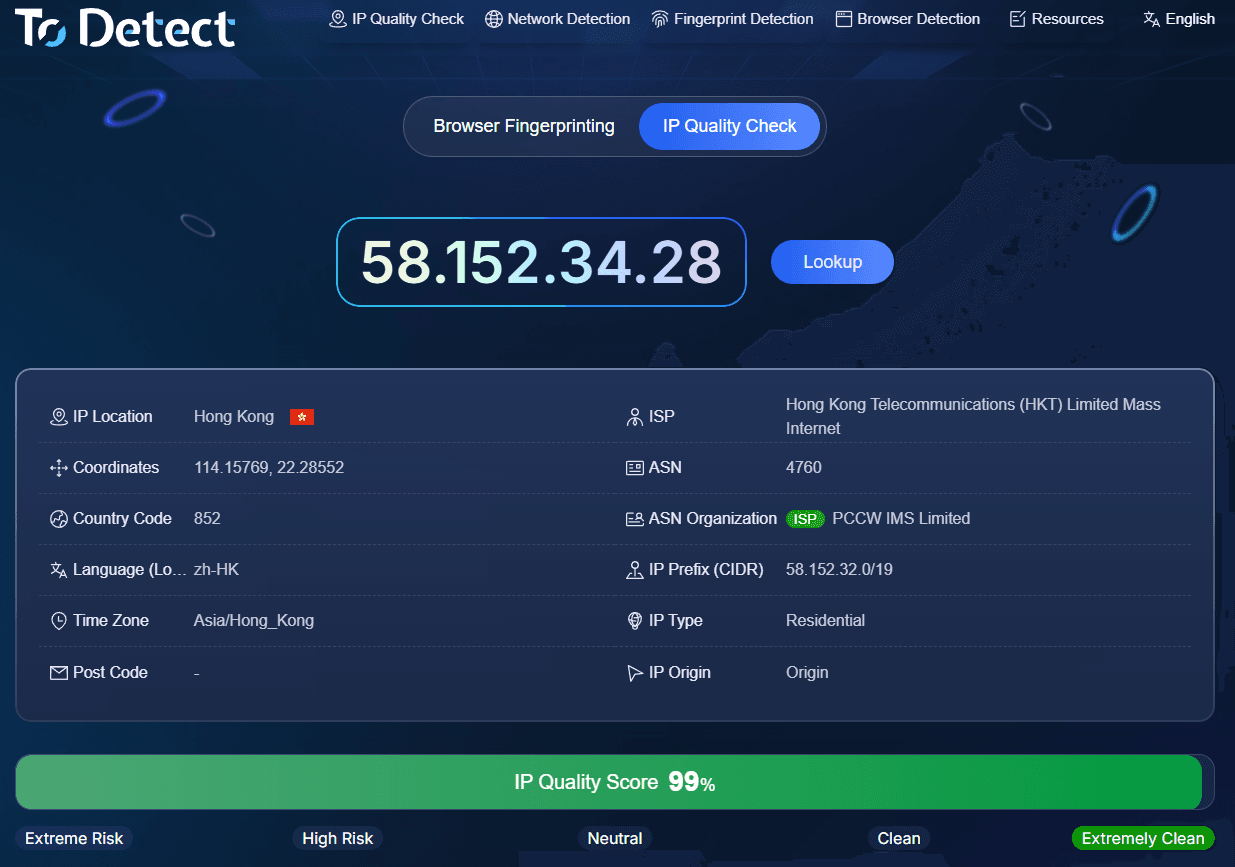
The simplest first step in IP detection is querying its basic information. By opening an online IP lookup site, you can typically view basic data such as the IP address, country, city, ISP/carrier, ASN, and network type.
For a comprehensive IP quality check, it is recommended to review at least the following details:
IP location, ISP carrier, ASN number, network type, IP organization, and basic risk level—to first confirm "what kind of IP this actually is."
If you want to save time, you can directly use IP detection tools like ToDetect to view all these details on a single page without switching back and forth between multiple lookup websites.
Step 2: Perform an IP Purity Check with a Focus on Historical Risks
What truly impacts user experience with an IP is often whether it has accumulated abnormal activity records in the past. Therefore, the second step is to focus on an IP purity check.
So-called "IP purity" is not simply about declaring an IP "good" or "bad." Instead, it involves comprehensively examining the IP's historical status across various databases—such as whether it carries a high risk score, is listed in security databases, or maintains a poor reputation score.
When conducting an IP risk assessment, pay close attention to risk levels, historical abuse logs, blacklist databases, and overall IP reputation scores.
It is worth noting that different IP lookup tools rely on different data sources, so variations in ratings are entirely normal. Do not rush to conclusions just because one site labels an IP as "risky"—it is best to evaluate it across two or three different dimensions.
Step 3: Inspect the IP Type—Don't Just Look at the "Residential" Tag
One of the most overlooked aspects during proxy IP testing is the IP type. In reality, residential IPs, data center IPs, commercial networks, mobile networks, and ISP networks can yield different identification results across different databases.
It is recommended to cross-check these three key areas:
• First, the network type: confirm whether the result shows Residential, ISP, Mobile, or Hosting;
• Second, the ISP name: check whether it belongs to a standard telecom provider or a cloud computing/server provider;
• Third, the ASN information: as ASN details help further clarify which network origin the IP stems from.
Therefore, when evaluating residential IP purity, do not stop as soon as you see the "Residential" tag. IP type is merely one dimension; it must be assessed alongside risk logs, ISP carrier details, and network ownership.
Step 4: Cross-Check Across Multiple Platforms—Never Rely on a Single Result
To ensure more accurate IP purity detection results, the final step is cross-validation. Different online IP lookup platforms integrate different databases, update frequencies, and evaluation rules.
A reliable approach is choosing a comprehensive detection tool as your primary checker, while using other IP lookup websites to assist in verification.
For example, when using ToDetect IP Checker, you can first review the basic IP info, geographic location, network type, and risk status, and then cross-reference ASNs or historical logs with other public databases.
If results across tools are largely consistent—meaning country, ISP, ASN, and network types align well, with no significant risk flags—the credibility of the IP information is generally much higher.
5. What Key Metrics Should You Actually Focus On During IP Quality Testing?
When searching for "how to test IP purity," many users get overwhelmed by complex parameters. In reality, regular users don't need to analyze every single data point—focusing on a few core indicators is more than enough.
First is IP Location, mainly to verify whether the country and region match expectations. Second are ISP and ASN, which help determine the actual network category of the IP. Third is IP Type, used to distinguish between residential, ISP, mobile, or data center networks.
If these core metrics look overall healthy, you have essentially completed a thorough IP quality evaluation. Conversely, performing a simple "IP address lookup" only tells you where the IP is, without revealing its actual operational quality.
6. FAQ on IP Purity Testing
1. Why does an IP purity test show a high risk score?
A high IP risk score is usually linked to historical usage logs, IP type, ASN ownership, blacklist records, or high sharing density. Even if the network functions normally right now, existing abnormal records in security databases can still raise the risk level in purity checks.
2. What risk score indicates a "clean" IP?
There is no universal standard. Different platforms calculate risk scores using different formulas. Therefore, when checking IP purity, pay attention to which specific risk rules were triggered rather than chasing a specific numerical score. Risk scores serve as a reference, not an absolute verdict.
3. Why is an IP labeled as "Residential" still showing low purity?
Residential classification and IP purity are two different concepts. Residential IPs can still suffer from past abuse logs, high sharing rates, or flags in risk databases. When evaluating IP quality, always review risk scores, ASN, ISP, and historical records concurrently.
Conclusion: Testing an IP Means More Than Just Checking Connectivity
Assuming an IP is flawless just because it shows a low risk score, assuming high quality purely because of a residential label, or declaring an IP completely unusable over a single tool's flag—all of these are one-sided judgments.
When acquiring a new IP, use tools like ToDetect to examine basic specs and risk flags first, then troubleshoot based on specific anomalies. This approach provides far greater practical value than simply checking whether the IP can connect to the internet.
Assuming an IP is flawless just because it shows a low risk score, assuming high quality purely because of a residential label, or declaring an IP completely unusable over a single tool's flag—all of these are one-sided judgments.