Resources
 Feature overview

 Ganesh
 2026-09-03 10:41
Evaluating a proxy IP involves looking far beyond basic country and city information; it requires a comprehensive assessment that factors in ISP, ASN, IP type, risk logs, historical reputation, and other key data points.
However, there are easily dozens of online IP lookup tools available. Some platforms primarily check IP geolocation, others focus on risk scoring, and many are tailored specifically for proxy detection and IP purity testing.
Today, we have selected 6 representative tools—ToDetect, IPQualityScore, Scamalytics, IPinfo, IP2Location, and AbuseIPDB—to examine what insights each tool provides and how to best combine them for practical proxy IP testing.

Quick Comparison of 6 Online IP Lookup Tools
Comparing these tools side by side makes their differences much clearer.
| IP Tool | Core Focus | Proxy Detection | Risk Analysis | Basic IP Data | Recommended Use |
|---|---|---|---|---|---|
| ToDetect | IP quality, proxy attributes, risk, network environment | High | High | High | All-in-one proxy IP testing |
| IPQualityScore | IP reputation, proxy detection, fraud scoring | High | High | Moderate-High | IP risk assessment |
| Scamalytics | IP reputation, fraud risk | Moderate-High | High | Basic | Cross-verifying risk |
| IPinfo | ASN, ISP, IP owner data | Basic | Basic | High | ASN / ISP lookup |
| IP2Location | IP geolocation, ISP, network details | Basic | Basic | High | IP location lookup |
| AbuseIPDB | Abuse reports, historical reputation | Low | Moderate-High | Basic | Checking history of abuse |
A quick note beforehand: It is completely normal for different IP tools to return varying results.
The reason is straightforward. Each platform relies on its own IP database, update frequency, risk scoring model, and IP classification algorithms. An IP flagged as low risk on one platform might show different results on another.
Therefore, when assessing IP quality in practice, there is no need to obsess over a single score. A far more effective approach is to combine multiple metrics to draw a complete conclusion.
1. ToDetect: Ideal for Initial Comprehensive IP Quality Testing
If you have just acquired a new proxy IP and don't know where to begin, starting with ToDetect is a great choice.
What makes it particularly convenient is that its evaluation goes far beyond simple geolocation—it evaluates basic IP parameters, risk indicators, and the current network environment side by side.
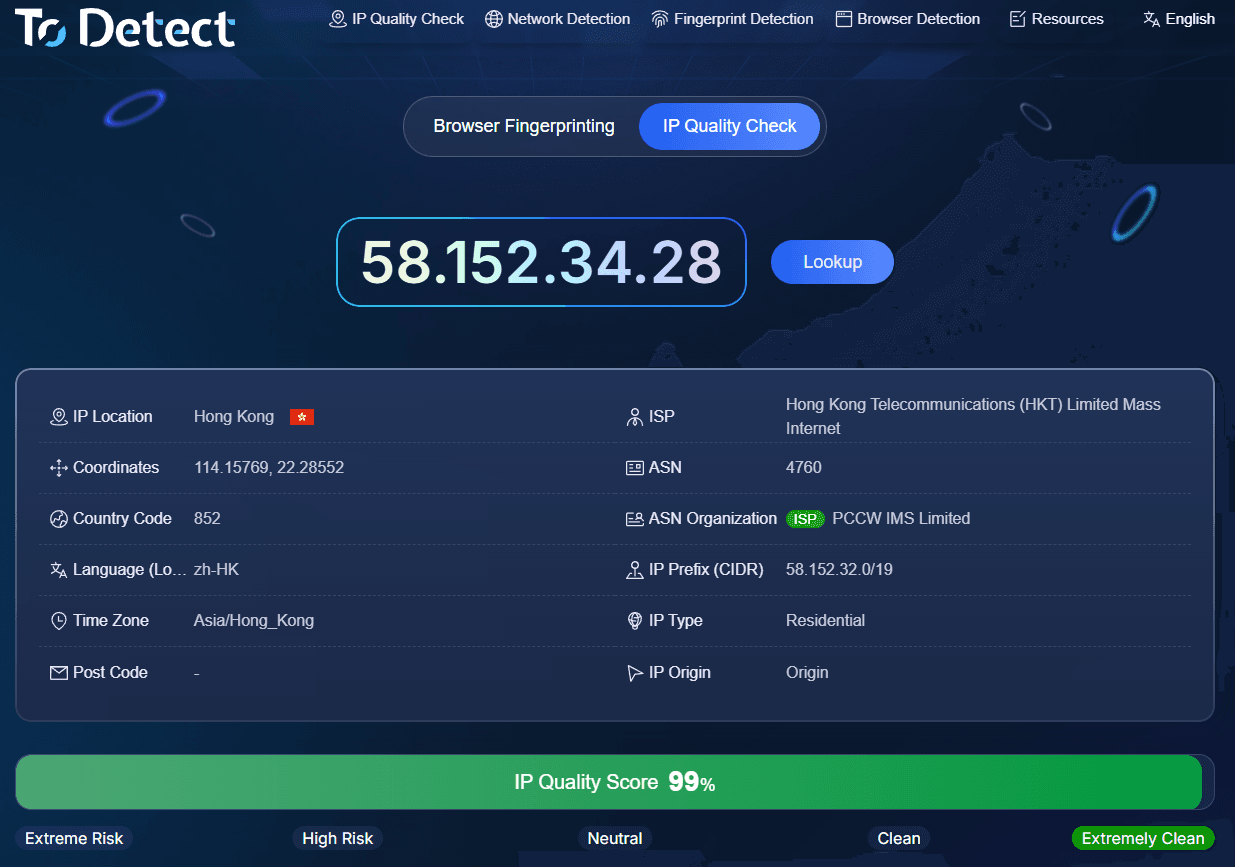
Consider a common scenario: a provider sells an IP labeled as a US residential IP. Although it connects without issue, testing reveals that its network attributes differ significantly from expected parameters. Rather than rushing to deploy it in production, it's better to switch to another IP for testing or cross-check it on other platforms first.
In addition to IP inspection, ToDetect offers environment detection features including DNS leaks, WebRTC leaks, browser fingerprinting, and User-Agent analysis. If your workflow involves both IP checks and browser environment troubleshooting, you won't need to constantly bounce between multiple websites.
2. IPQualityScore: Go-To Choice for Deep Risk Analysis
IPQualityScore is commonly referred to as IPQS. While ToDetect is ideal for getting an initial big-picture overview, IPQualityScore excels when you need deep insights into IP reputation, fraud scores, and proxy detection.
In practical use, you may encounter an IP that connects fine and shows the correct country, yet performance feels sluggish or frequently triggers extra CAPTCHAs. In such cases, re-verifying the location won't help much; checking the IP's reputation and fraud score is much more informative.
However, keep one critical misconception in mind when using risk analysis tools: a risk score is not a definitive sentence. Third-party tools assess risk profiles based on their own proprietary databases and heuristics—a high score does not automatically mean every target site will block that IP.
3. Scamalytics: Convenient for Cross-Checking Fraud Risk
Scamalytics is another widely used platform for auditing IP reputation and threat levels. Its focus is distinct: rather than displaying exhaustive raw IP data, it leans heavily into fraud risk scoring.
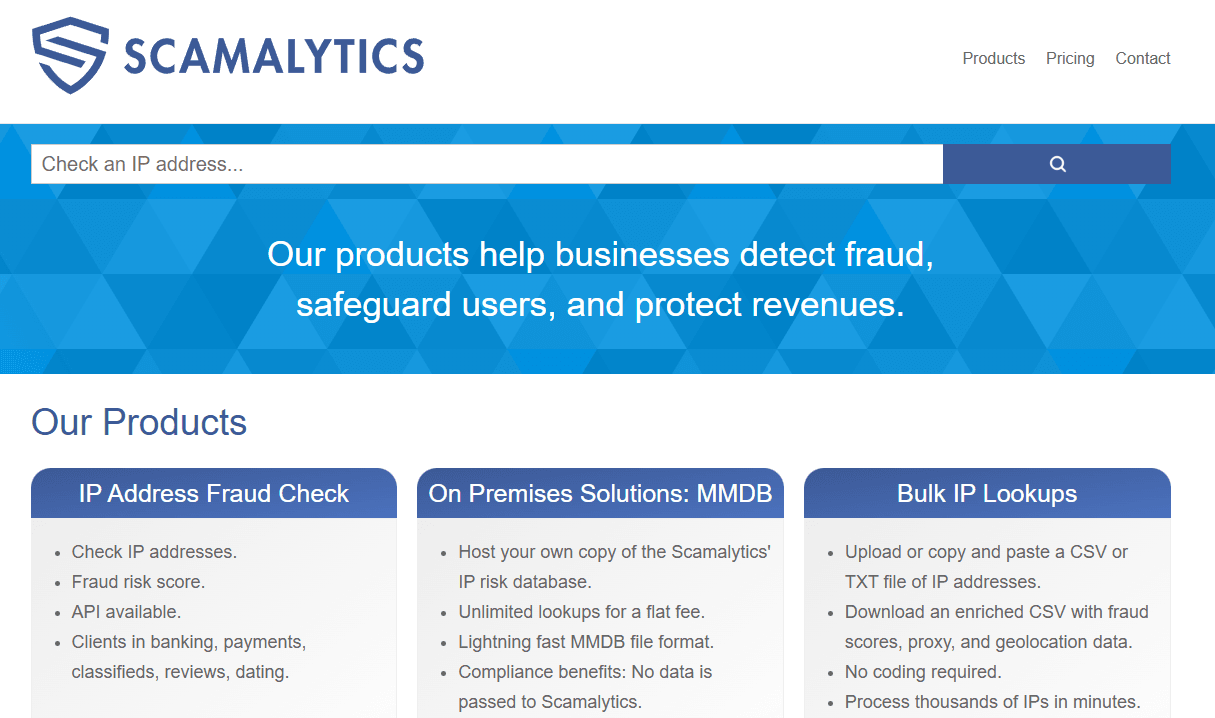
If you have already confirmed an IP's country, ASN, and ISP using other tools, and simply want a second opinion on its threat level, plugging the IP into Scamalytics is an efficient next step.
Cross-checking data sources becomes especially useful when primary tools yield conflicting results. IP quality is determined by multiple factors working together, never by a single standalone number.
4. IPinfo: Practical for ASN and Network Ownership Checks
IPinfo operates with a different focus compared to the tools mentioned above. When testing proxy IP quality, inspecting ASN and network ownership data is vital, though beginner users frequently overlook it.
If data on other IP testing sites seems inconsistent, turning to IPinfo to audit ASN and routing details can clarify the discrepancy. Anyone working regularly with proxy IPs will find it a valuable reference tool to bookmark.
5. IP2Location: Key Tool for Auditing IP Geolocation and ISP
IP2Location is another well-established IP lookup service, renowned for its geolocation and network infrastructure datasets. It allows users to query an IP's corresponding country, region, ISP, and related parameters.
If your primary goal is IP location lookup, proxy location verification, or ISP identification, IP2Location is very straightforward. However, keep in mind that different IP databases may categorize city-level data differently.
Minor discrepancies at the city level across different databases are quite common. Therefore, when evaluating proxy IPs, country origin, network ownership, and IP type should always take priority over strict city alignment.
6. AbuseIPDB: Checking Historical Misuse Records
While previous tools focus on active IP parameters, AbuseIPDB approaches the problem from a historical angle: identifying whether an IP address has a recorded history of malicious activity or abuse.
It is not designed specifically for residential proxy detection, so if your goal is simply to confirm whether an IP is residential, AbuseIPDB shouldn't be your first stop.
Furthermore, past abuse reports don't mean an IP is unusable today. Dynamic IPs or IPs shared across multiple users frequently carry historical logs; treat these records as helpful context alongside real-time diagnostic test results.
Final Verdict: Which IP Testing Tool Should You Use?
Comparing these 6 tools reveals a key takeaway: effective IP quality testing isn't about running a single query on one site and judging an IP solely by one arbitrary score.
When testing a new proxy IP, don't stop at verifying connectivity. Following a workflow of initial detection, cross-verification, and live testing may add a couple of extra steps, but it reliably weeds out low-quality proxies before they cause issues in production.
Using ToDetect as your primary IP quality testing tool allows you to perform an initial comprehensive sweep of IP quality, proxy attributes, and network environment settings. If anomalies appear, you can then cross-examine specific data points against specialized databases for maximum efficiency.