Resources
 Feature overview

 Ganesh
 2026-08-22 10:58
When performing IP risk detection, many people's initial reaction is simply to check "where the IP is and who the ISP is." However, when it comes to proxy IPs, static residential IPs, cross-border businesses, or account network environments, relying solely on this basic information is far from enough.
There are many IP detection websites available online, each with different results and focuses. Some excel at IP geolocation lookup, others emphasize fraud risk analysis, and some tools can simultaneously perform IP quality checks, proxy detection, and network environment analysis.
Next, we have compiled several commonly used IP risk detection tools in 2026, comparing them in terms of detection capabilities, applicable directions, and user experience to help you find the right IP risk query tool faster.

1. What Exactly Is an IP Risk Score?
An IP risk score can be understood as a platform's comprehensive judgment on the trustworthiness of a current IP network. It may involve multiple dimensions such as IP history, network type, proxy attributes, blacklist information, ASN, ISP, and more.
It should be noted that the IP risk score is not a globally unified standard. The scoring ranges and calculation methods of different detection websites can be completely different, so you cannot simply assume that "a score of 20 on a platform is definitely safe, and a score of 80 is definitely dangerous."
Therefore, when conducting IP risk detection, it is recommended not to focus solely on a single score, but to simultaneously check the IP type, proxy detection, network attribution, risk tags, and whether abnormal records exist.
2. Comparison of Commonly Used 2026 IP Risk Detection Websites
| IP Risk Detection Website | Basic IP Lookup | IP Risk Analysis | Proxy Detection | IP Quality Check | Recommendation Rating |
|---|---|---|---|---|---|
| ToDetect | ★★★★★ | ★★★★★ | ★★★★★ | ★★★★★ | ★★★★★ |
| IPQualityScore (IPQS) | ★★★★☆ | ★★★★★ | ★★★★★ | ★★★★★ | ★★★★☆ |
| Scamalytics | ★★★★☆ | ★★★★★ | ★★★★★ | ★★★★☆ | ★★★★☆ |
| IPinfo | ★★★★★ | ★★★☆☆ | ★★★☆☆ | ★★★☆☆ | ★★★★☆ |
| IP2Location | ★★★★★ | ★★★☆☆ | ★★★☆☆ | ★★★☆☆ | ★★★★☆ |
| AbuseIPDB | ★★★★☆ | ★★★★★ | ★★★☆☆ | ★★★★☆ | ★★★★☆ |
3. ToDetect: Comprehensive IP Risk Detection Tool
If you want to view multiple dimensions at once, ToDetect is a option worth trying first.
It not only performs basic online IP detection but also further analyzes IP type, proxy attributes, risk status, and network attribution, while providing capabilities like IP quality checks, DNS leak tests, and WebRTC leak checks.
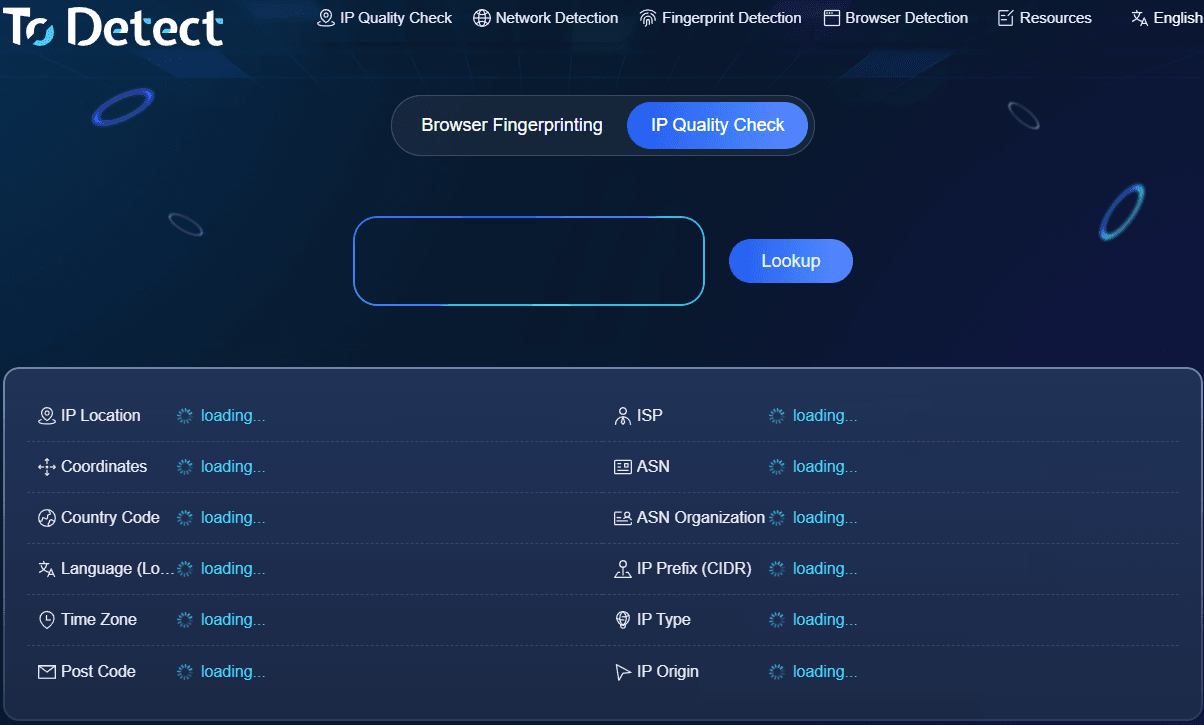
For regular users, its advantage lies in not having to open multiple websites and switch back and forth to check. After entering an IP, you can see the basic information and quality status of the IP quite intuitively.
Especially before purchasing a new proxy IP, static IP, or changing your network environment, you can run a check first. This allows you to detect obvious data center attributes, proxy characteristics, or higher risk levels in advance.
4. IPQualityScore: Geared Towards Professional Risk Analysis
IPQualityScore, commonly known as IPQS, is quite representative in IP risk identification and fraud detection. It is more suitable for enterprises, developers, and risk control scenarios that require in-depth risk analysis, focusing on proxy details and fraud risks.
However, if you are an ordinary user looking to occasionally check an IP, some of IPQS's features may seem overly complex. In other words, it is better suited for professional risk management rather than simply checking "what my IP is."
5. Scamalytics: Focus on Fraud Risk
If your main concern is "how high is the fraud risk of this IP," Scamalytics is worth attention. It provides an online IP Checker where you can directly query an IP's risk score and determine whether it possesses proxy server attributes.
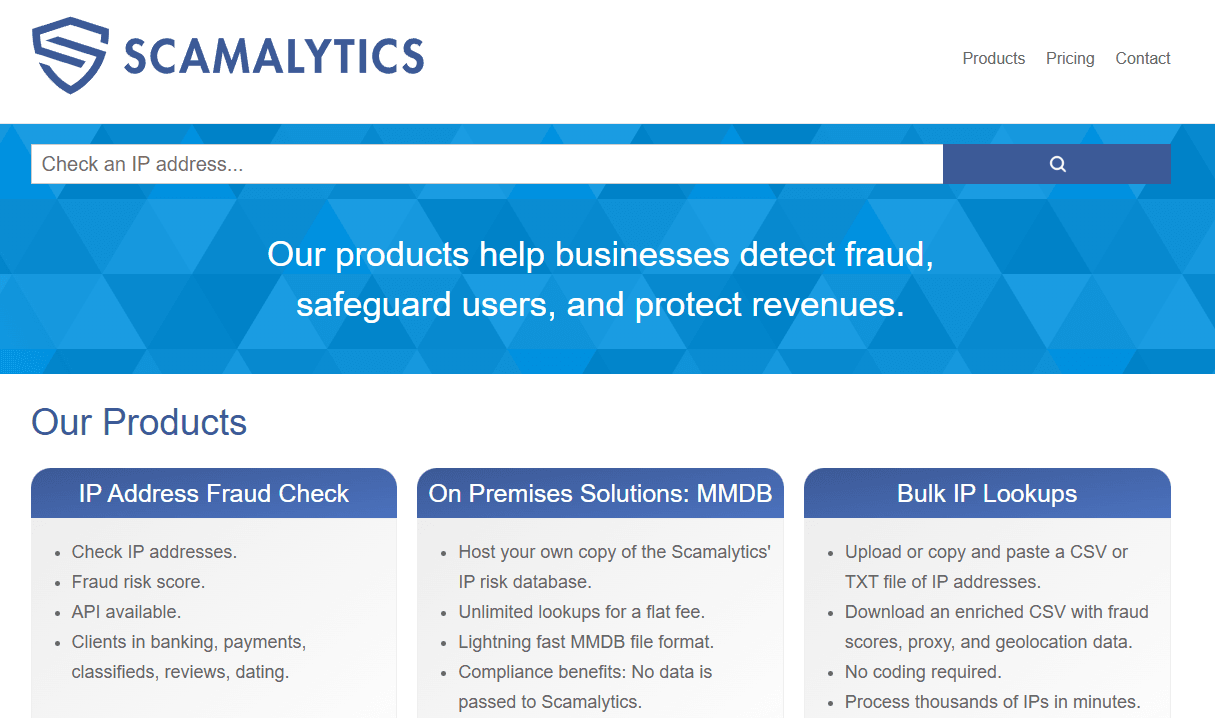
However, its positioning is relatively clear. If you just want to view basic information such as IP address, city, and ISP, there is no need to rely solely on this type of specialized risk management tool.
6. IPinfo: Convenient for Querying IP Attribution Information
IPinfo is more suitable for looking up basic network details of an IP, especially IP geolocation, ASN, ISP, and organization information. For developers, webmasters, or anyone needing to confirm IP network ownership, it is very practical.

However, if your focus is on IP risk detection, IP purity testing, or proxy IP quality assessment, using IPinfo alone may not be enough, as basic IP information and risk analysis are two different directions.
7. IP2Location: Suitable for Querying IP Geolocation and Network Attributes
IP2Location also belongs to mature IP data services, excelling at IP geolocation and network information queries. For instance, country, region, city, ISP, ASN, etc., can all serve as references for judging the actual network attributes of an IP.
If your goal is to do IP data analysis or develop related applications, it will be quite valuable. But for general users who simply want to know "is there any risk with this IP," dedicated IP risk detection tools are still recommended.
8. AbuseIPDB: Focus on IP Abuse Records
AbuseIPDB differs in approach from the previous tools; it focuses more on whether an IP has records of abuse, attacks, spamming, and related malicious activities. This information provides valuable reference for judging an IP's historical reputation.
However, note that having no abuse records does not mean an IP is absolutely safe. An IP without obvious historical reports does not guarantee it belongs to a high-quality residential network, nor does it guarantee high trust across all platforms.
9. How to Choose the Right IP Risk Detection Tool for You?
If you are only occasionally checking your own public IP address, ordinary online IP lookup websites are sufficient.
If you are screening proxy IPs before purchasing, it is recommended to choose a tool that allows you to simultaneously check IP quality, proxy detection, risk score, and network type—such as ToDetect—combined with other risk databases for cross-validation.
If your business involves enterprise risk management, payment security, or requires API integration, you can further consider professional services like IPQualityScore and Scamalytics.
If you mainly research IP geolocation, ASN, and ISP details, IPinfo and IP2Location are more suitable. No single IP risk score website can cover every scenario. Check basic information for attribution, risk detection for reputation, and IP quality for overall performance—combining all three leads to a much more accurate evaluation.
Summary
Overall, when selecting an IP risk score website, you shouldn't just look at a single "risk score." It is advisable to use comprehensive tools that can simultaneously assess IP quality, proxy detection, risk score, and network attributes.
Especially before purchasing or replacing static IPs or proxy IPs, doing a complete IP risk check in advance is usually much more hassle-free than encountering issues after deployment.
Checking attribution, evaluating quality, and testing risk through multi-dimensional cross-verification is the most reasonable approach to IP detection. We hope the tools and methods organized in this article will help you make wiser choices when picking IP risk detection tools in 2026.