Resources
 Feature overview

 Ganesh
 2026-06-02 11:16
If you're using a contaminated IP address—one that has been blacklisted, heavily abused by other users, or flagged by security systems—even completely normal activity can easily be misidentified as risky behavior.
That's why more and more people are paying attention to professional online IP risk checks. Identifying potential issues before they cause problems is far more effective than trying to fix them afterward.
So how do you perform an online IP risk assessment? How can you tell whether an IP address is high-risk? And what IP quality checking methods are available for ordinary users? Let's break it all down.

1. Why Does Your IP Get Flagged?
Here's an uncomfortable truth: what you think is a dedicated IP may actually have been heavily used by hundreds of other users. IP quality issues usually come from the following situations:
• Blacklisted IP Address:
The IP may have previously been used for spam, fake orders, fraud, or other abusive activities. When major platforms blacklist it, the next user inherits the consequences.
• Poor IP Reputation:
IP reputation checks evaluate whether an IP has been shared extensively or previously contaminated. If an IP's cleanliness score is below 70%, it's generally best to avoid using it.
• Browser Fingerprint Exposure:
Many users only check the IP address but ignore browser fingerprint analysis. Even if the IP looks clean, fingerprints indicating a virtual machine or multi-account environment can still trigger platform detection systems.
2. The Core of IP Risk Detection : Blacklists and Historical Activity
Professional IP risk assessment is fundamentally about understanding what an IP address has done in the past.
Common evaluation factors include:
• Whether the IP appears on spam blacklists (such as Spamhaus)
• Whether social media platforms have flagged it for suspicious logins
• Whether it is identified as a proxy or data center IP
• Whether it has a history of high-frequency requests
If an IP receives a high-risk score, caution is recommended even if it currently works without restrictions.
3. IP Types and Risk Characteristics Comparison
| IP Type | Common Source | Risk Level | Characteristics | Recommended Use Cases |
|---|---|---|---|---|
| Residential IP | Home broadband networks | Low Risk | Natural behavior patterns, stable reputation, less likely to be flagged | Account registration, e-commerce operations, social media management |
| Data Center IP | Cloud servers / hosting providers | Medium-High Risk | High traffic frequency, often identified as automated traffic | Web scraping, server deployment, API requests |
| Proxy IP | Proxy service providers | Medium Risk | Frequently changing addresses, may trigger unusual login alerts | Testing environments, privacy-focused browsing |
| Shared IP | Multiple users sharing one outbound IP | Medium-High Risk | Large user base and complex usage history | Public networks, corporate gateways |
| Blacklisted IP | Previously abused IP ranges | High Risk | Already flagged by security systems and subject to restrictions | Not recommended for use |
4. How to Perform an Online IP Address Lookup and Which Tools Are Worth Using?
There are countless IP lookup tools available online, but only a handful provide reliable and up-to-date data. Some free services use outdated databases that haven't been updated for months, making their results nearly useless.
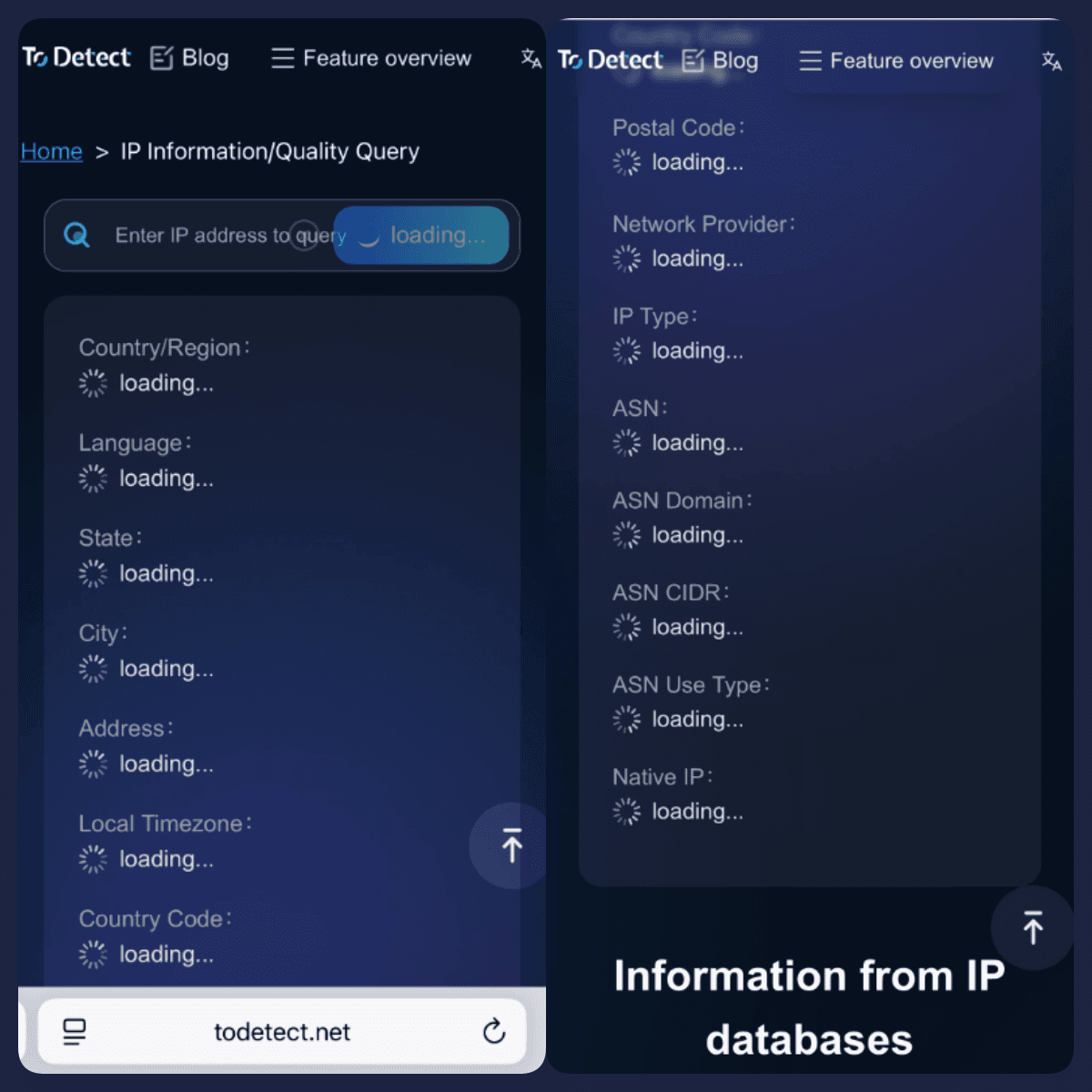
One of the more practical options is ToDetect. It not only evaluates IP risk scores and blacklist status but also performs browser fingerprint analysis, giving you a complete picture of both your IP and browsing environment in one place. For cross-border businesses, this can save significant time and effort.
The process is simple. Open ToDetect, and it automatically collects information about your current IP address, including ISP, geolocation, proxy type, reputation score, blacklist status, and a full browser fingerprint report. The entire scan takes only a few seconds and requires no registration.
5. When Is IP Risk Detection Essential?
1. Cross-Border E-commerce Sellers
Platforms such as Amazon, eBay, and Shopee are highly sensitive to IP reputation. A contaminated IP can result in reduced visibility, account restrictions, or even permanent suspension. Always verify your IP before launching new products or managing accounts.
2. Digital Advertising Specialists
Anyone running Facebook Ads or Google Ads knows that IP quality affects account trust and performance. Screening IPs through reputation checks can significantly reduce the likelihood of being flagged for suspicious activity.
3. Social Media Multi-Account Operators
Managing multiple TikTok, Instagram, or X (Twitter) accounts often involves avoiding fingerprint correlation. Simply changing IP addresses is not enough—browser fingerprint analysis is equally important to prevent platforms from linking accounts together.
4. Web Scraping Developers
IP bans are a common challenge in data collection projects. Running IP risk assessments beforehand helps eliminate problematic IPs and reduces the need for complex retry and rotation logic.
6. Online IP Quality Check FAQ
1. Why am I still getting flagged even though my IP works normally?
This is very common. The issue is often not your internet connection but the IP's historical reputation. Run an IP risk assessment to determine whether it's a data center IP, proxy IP, or associated with previous abuse.
2. Does a "low-risk" score mean an IP is completely safe?
Not necessarily. A low-risk rating is only a reference point. Some IPs may have recently recovered from a poor reputation or experienced temporary abuse. Combining IP checks with browser fingerprint analysis provides a more accurate assessment.
3. Do I have to use residential IPs for e-commerce or advertising?
Not always, but residential IPs are generally recommended. While data center IPs offer stability, they are more likely to be identified as automated environments. If an IP lookup confirms a residential IP with a strong reputation score, account stability is usually much better.
4. Should I run an IP risk check every day with ToDetect?
Daily checks are unnecessary, but you should always verify your IP before critical actions such as registering a new account, logging in from a new device, or launching advertising campaigns.
Tools like ToDetect provide quick IP risk assessments and reputation analysis, making them ideal for pre-operation verification rather than routine daily checks.
Final Thoughts
IP risk management is essentially about avoiding hidden problems before they become expensive mistakes. Spending ten seconds on an IP lookup today could save you days—or even weeks—of troubleshooting later.
Professional platforms such as ToDetect have integrated IP reputation analysis, blacklist checks, and browser fingerprint detection into a single workflow, making it easy for non-technical users to evaluate their online environment.
One practical recommendation: if you frequently manage multiple accounts, operate cross-border businesses, or run advertising campaigns, make online IP checks a standard part of your workflow. It will help you avoid many unnecessary risks.