Resources
 Feature overview

 Ganesh
 2026-09-03 10:35
There are many websites online where you can look up IP addresses today. However, if you truly want to determine whether an IP address is "clean" or "high-risk," looking only at the IP address, country, and ISP is far from enough.
This is especially true when purchasing residential or static IPs; although they may connect normally, their actual quality can vary greatly. That is why more and more people choose to perform a check using a reliable IP risk score lookup website before using a new IP address.
Today, let's look at several common IP risk score checking tools—including ToDetect, IPQualityScore, AbuseIPDB, and Scamalytics—comparing them based on detection features and real-world use cases, while also explaining how to properly evaluate proxy IP quality.

1. What Exactly Is an IP Risk Score?
An IP risk score is a reference metric generated by a detection platform based on an IP's network attributes, historical reputation, and relevant database insights to gauge its potential threat level.
Different IP risk lookup websites utilize different data sources, update intervals, and scoring algorithms. Therefore, it is completely normal for the same IP to show different risk levels across different sites. You shouldn't simply assume one platform is wrong just because it displays a score of 10 while another shows 30.
To truly assess an IP's quality, it is best to evaluate the risk score alongside IP type, ISP/ASN, proxy attributes, and historical reputation together.
2. What Are the Best IP Risk Score Lookup Websites?
Currently, there are many platforms available for IP risk score lookups, IP reputation queries, and IP quality tests, but each has a different focus. Some are tailored toward general users, while others target cybersecurity professionals and enterprise risk control.
1. ToDetect: Ideal for Comprehensive IP Risk Detection
If you don't want to switch back and forth between multiple sites, ToDetect is a great place to start for an all-in-one comprehensive test.
ToDetect does more than just show "what your current IP is." Its detection page displays detailed details including IP location, ISP, ASN, IP type, proxy attributes, and an IP quality rating, helping users quickly gauge overall IP health through a clear risk classification.
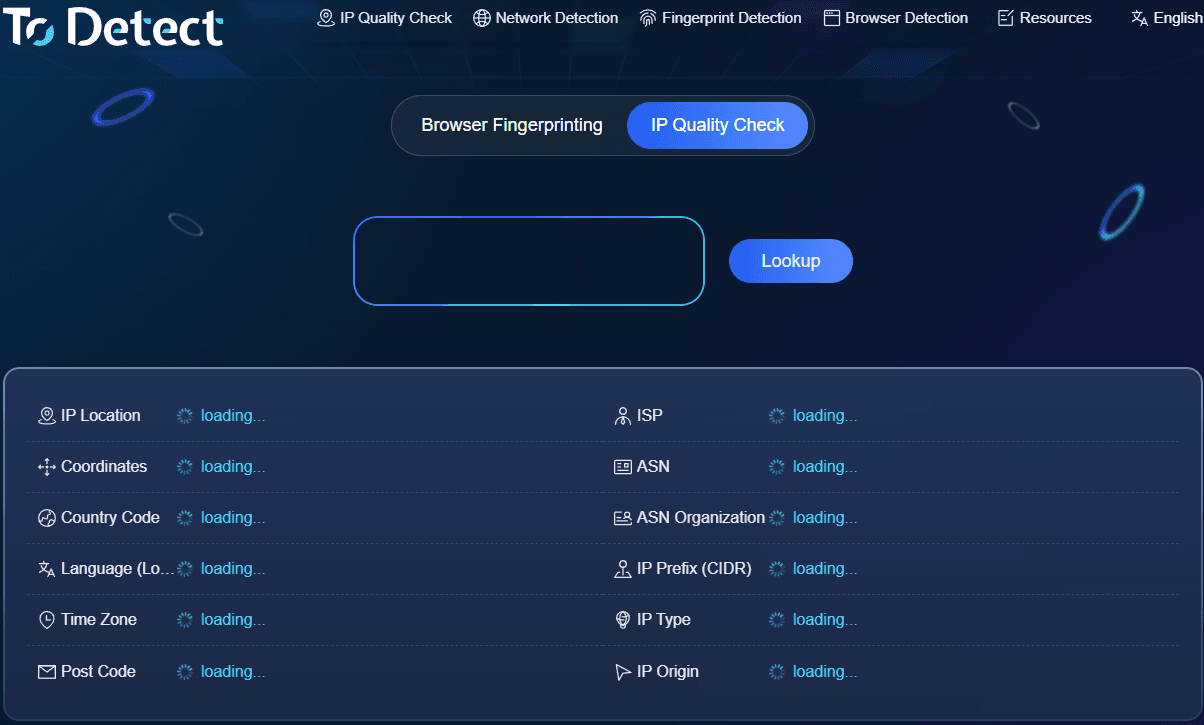
In practice, its main advantage is convenience through centralized results. For instance, when given a new IP address, you can quickly run an online test to verify whether it possesses residential attributes, shows proxy markers, or carries a high risk level without manually querying multiple databases yourself.
Additionally, ToDetect aggregates and displays data from multiple IP database providers. It offers a very low barrier to entry for users seeking free IP risk lookups, residential IP quality checks, or proxy risk testing.
2. IPQualityScore: Focused on Fraud Risk Analysis
IPQualityScore (commonly known as IPQS) is well recognized globally in the field of IP risk detection.

Its primary feature is fraud detection. It allows users to check an IP's Fraud Score while analyzing risk indicators such as proxies and bot activities. If you care deeply about reputation scores and fraud risk analysis, IPQS offers valuable insight.
However, for first-time or casual users, the metrics can appear somewhat complex compared to basic IP lookup tools, making it better suited as a secondary cross-validation tool.
3. AbuseIPDB: Specialized in Historical Abuse Logs
AbuseIPDB operates under a different concept than the tools above. If an IP's basic parameters look clean on paper but you encounter frequent errors or blocks while using it, AbuseIPDB is useful for checking historical abuse records.
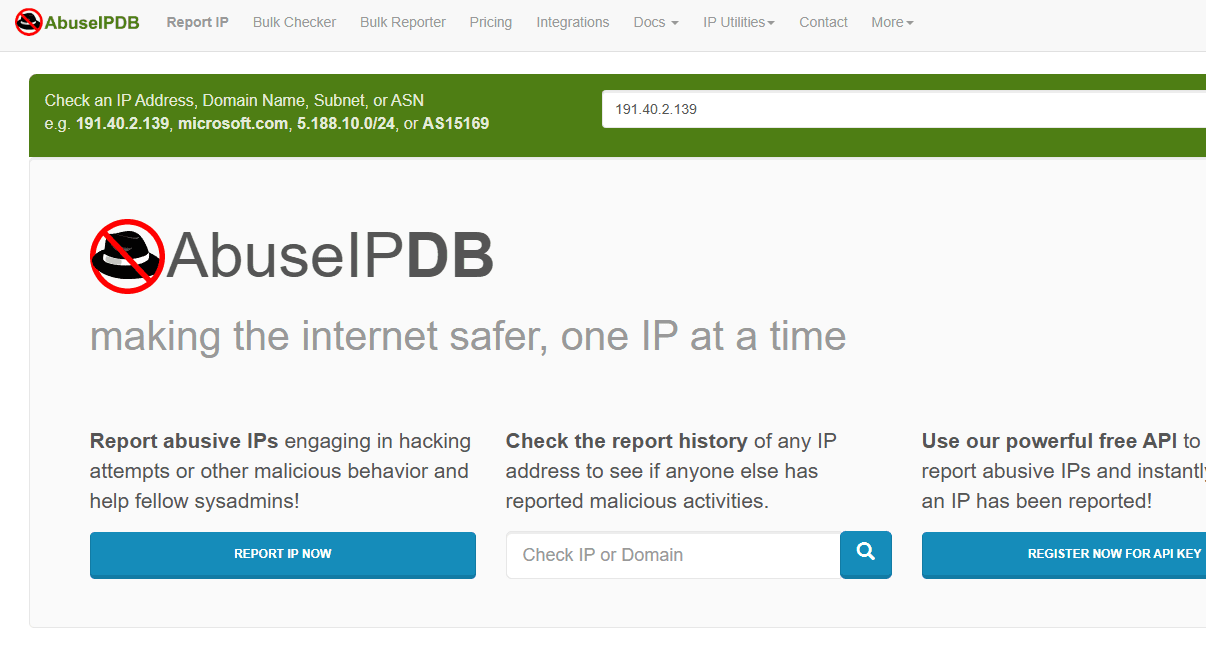
It functions as a central database for reporting and tracking malicious IP behavior. If an IP has a history of port scanning, hacking attacks, spamming, or other abusive activities submitted by webmasters or security tools, you will find records here.
While it excels at IP blacklist verification, abuse log lookups, and reputation tracking, it is not designed to give a single-page overview of the complete network environment.
4. Scamalytics: Useful for Fraud Risk Assessment
Scamalytics is another popular risk analysis platform, best known for its proprietary fraud scoring engine. Using it alongside other tools is generally safer than relying on a single source.
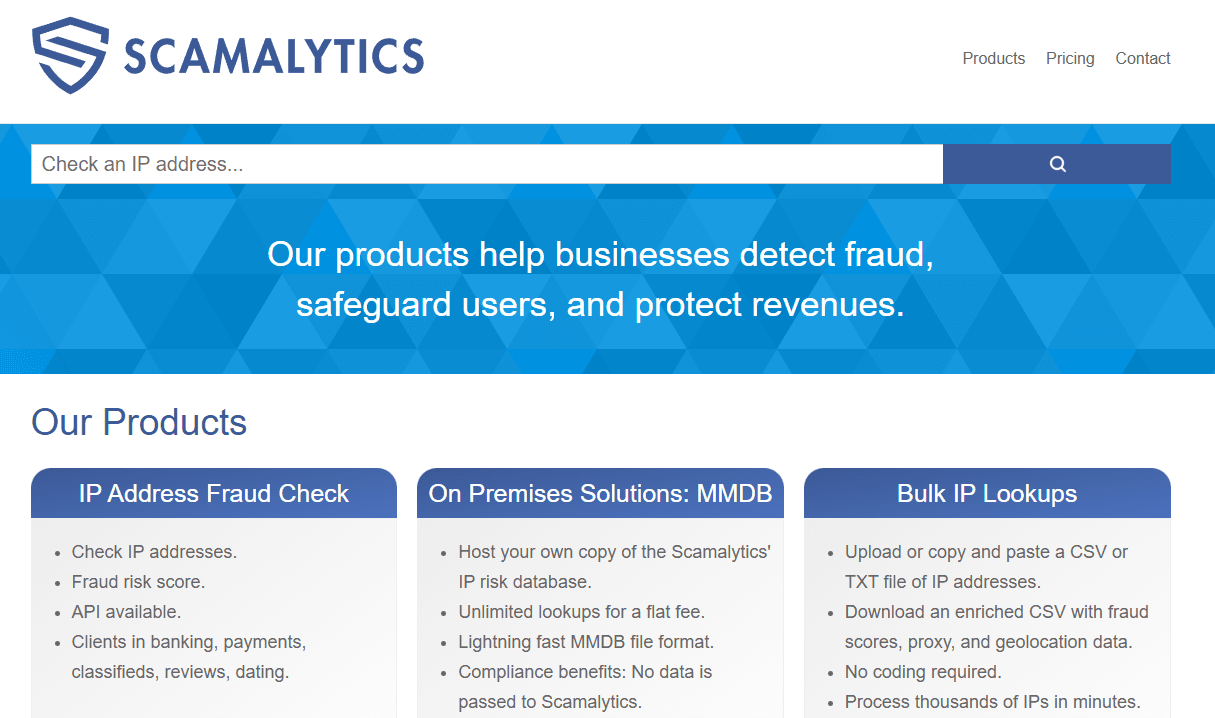
It rates IPs using machine-learning risk models, making it a handy supplementary checker. For example, after running an initial check on ToDetect, you can query Scamalytics to cross-reference how other fraud databases rate the same IP.
3. Why Do IP Risk Scores Differ Across Different Websites?
| Comparison Factor | How Does It Impact the IP Risk Score? |
|---|---|
| Data Sources | Different sites integrate different database vendors, naturally leading to variations in historical records. |
| Scoring Systems | Some platforms use a 0–100 scale, while others categorize IPs directly into Low, Medium, or High risk tiers. |
| Detection Focus | Some focus heavily on proxy flags, others prioritize ad fraud risk, while some center on abuse/spam reports. |
| Update Frequency | IP assignments and behaviors change over time. Differences in refresh rates cause discrepancies across tools. |
| IP Classification | Distinct detection rules for Residential, Data Center, Mobile, or Proxy IPs affect final risk ratings. |
| Historical Logs | One database may have logged past suspicious traffic, whereas another platform has no record of it yet. |
| Risk Modeling | Platforms assign varying weights to metrics like proxy markers, ASN, ISP type, network setup, and behavior history. |
4. How Should You Interpret Free IP Risk Level Check Results?
Finding a testing tool is only step one; knowing how to interpret the results is far more critical. Many users fixate solely on the single "Risk Score" number, which frequently leads to misjudgments.
It is recommended to check at least: first, inspect the IP type and network attributes to see if they match your expectations; second, check whether ISP and ASN details look legitimate; third, analyze risk ratings, proxy indicators, and clear historical abuse flags.
Therefore, a reliable IP quality evaluation method follows this formula: Risk Score + IP Type + ISP/ASN + Proxy Attributes + Historical Reputation
Combining these factors gives a significantly more accurate picture than relying on a single numerical score.
5. Does a Lower Risk Score Always Mean a Better IP?
Not necessarily. A low risk score simply indicates that current databases haven't flagged notable anomalies yet, but whether an IP works well depends heavily on your specific task.
For instance, long-term session maintenance demands IP consistency and network uptime; web scraping prioritizes high connection success rates and availability; whereas site managers care more about geographical region, ISP, and clean search engine results.
Thus, the real objective of checking IP risk scores for free is not to hunt for a "0 risk IP," but to catch obvious red flags early.
For routine checks, you can begin with an all-in-one platform like ToDetect to perform initial online quality testing. If elevated risk flags appear, turn to specialized databases for deeper verification. This workflow is far more practical than jumping to conclusions based on one number alone.
Final Thoughts
Popular IP risk lookup platforms today include ToDetect, IPQualityScore, AbuseIPDB, and Scamalytics, each tailored to distinct needs.
Because underlying databases and scoring algorithms differ, finding variance across sites for the same IP is expected. Rather than worrying about "which score is most accurate," pay attention to whether multiple platforms consistently flag high risk, abnormal network properties, or bad history.
As a final reminder: an IP risk score is only one element of IP evaluation. When testing IP quality, never rely on a single number—always evaluate IP type, network parameters, ISP/ASN, proxy flags, and historical reputation together.