Resources
 Feature overview

 bonnie
 2026-06-01 10:12
Many TikTok creators encounter the same issue: their videos are getting views, but no matter what they do, they just can't break into viral traffic. The reason may lie in an often-overlooked factor — User-Agent parsing configuration.
If your User-Agent settings are abnormal, your browser fingerprint is inconsistent, or your TikTok account environment is not realistic and stable enough, it can be difficult to receive recommendation traffic no matter how many videos you publish.
Today, let's take a closer look at why User-Agent parsing errors can affect TikTok recommendation traffic and how to properly configure your account environment for greater stability.

1. Why Does User-Agent Parsing Affect TikTok Recommendation Traffic?
TikTok doesn't just evaluate what you post—it also evaluates who you are. A significant part of that identity comes from your browser and device environment information, with User-Agent parsing being one of the most critical factors.
User-Agent strings contain information such as device model, operating system version, and browser type.
If your User-Agent settings don't match your actual system, browser fingerprint data conflicts with other parameters, or your simulated environment appears unusually clean or inconsistent, TikTok may classify your account environment as unnatural and reduce its recommendation weight.
2. Common Signs of Incorrect User-Agent Configuration
Many users have already encountered these issues without realizing the cause. Common symptoms include:
• Video views consistently remain between 200–500
• Content receives impressions but very little engagement
• Follower growth becomes extremely slow or stagnant
• New accounts are more likely to experience traffic restrictions than older accounts
• The same content performs dramatically differently across different accounts
In many cases, the issue is not the content itself, but abnormal User-Agent settings or browser fingerprint configurations.
This is especially common for users managing TikTok account matrices. Without a consistent and well-structured account environment strategy, TikTok may classify the activity as large-scale marketing behavior.
3. TikTok Account Environment Quick Self-Check Checklist
| Check Item | Healthy State | Warning Signs | Optimization Suggestion |
|---|---|---|---|
| User-Agent Consistency | UA fully matches the device system (e.g., iOS with Safari/App environment) | UA does not match the operating system or changes frequently | Use a fixed UA strategy and avoid cross-platform spoofing |
| Browser Fingerprint Uniqueness | Fingerprint parameters are unique and stable for each account | Fingerprints are highly similar or duplicated across accounts | Use independent environments and avoid templates |
| IP Stability | One account per IP or stable regional IP | Frequent IP changes or shared IP usage | Use IP isolation or dedicated residential IPs |
| Device Login Behavior | Consistent login patterns using fixed devices | Frequent switching between devices | Limit the number of login devices |
| Timezone & Language Settings | Match the target region (e.g., US = EN + EST) | Timezone and language conflict with IP location | Standardize regional environment settings |
| ToDetect Analysis Results | Fingerprint score is normal with no risk warnings | Duplicate fingerprints, anomalies, or high-risk flags | Adjust environment settings based on the report |
4. The Core Logic Behind TikTok Account Environment Configuration
If you want your TikTok traffic to grow, the priority is not changing your content—it's building a clean and realistic environment first.
1. Identity Consistency: Let the System Recognize Who You Are
TikTok does not rely solely on login information. It evaluates a complete set of device and network characteristics when assessing account credibility.
If your User-Agent configuration appears inconsistent—for example, using an Android UA in an iOS environment, displaying mobile behavior through a desktop browser, or sharing the same UA profile across multiple accounts—TikTok may lower your trust score.
Simply put: inconsistent identity = less human-like account = lower recommendation weight.
2. Environment Independence: Avoid Cross-Account Association
Each account should have an independent environment, including browser fingerprints (Canvas, WebGL, fonts, etc.), IP-location consistency, cookies, local cache status, and unique device identifiers.
Many account matrices appear separate on the surface, but their underlying browser fingerprints are highly similar. In some cases, even the timezone and language settings are identical, making it easy for TikTok to associate them with the same operator.
Therefore, the goal is not simply to log in successfully, but to make every account appear as a different real user.
3. Behavioral Continuity: Build Stable Account History
Frequently changing environments, devices, or IP addresses sends a strong risk signal to the platform.
Normal users typically log in from the same device for extended periods, experience limited network changes, and maintain consistent usage patterns.
Suspicious accounts often switch from a US IP one day to a Southeast Asian IP the next, frequently regenerate fingerprints, clear data, or change browser environments multiple times a day.
This is especially important during TikTok's cold-start phase, when the system distributes a small amount of test traffic. If your environment appears unstable, performance may be suppressed immediately.
5. The Role of ToDetect in Environment Analysis
In real-world operations, many teams use ToDetect to verify environment consistency:
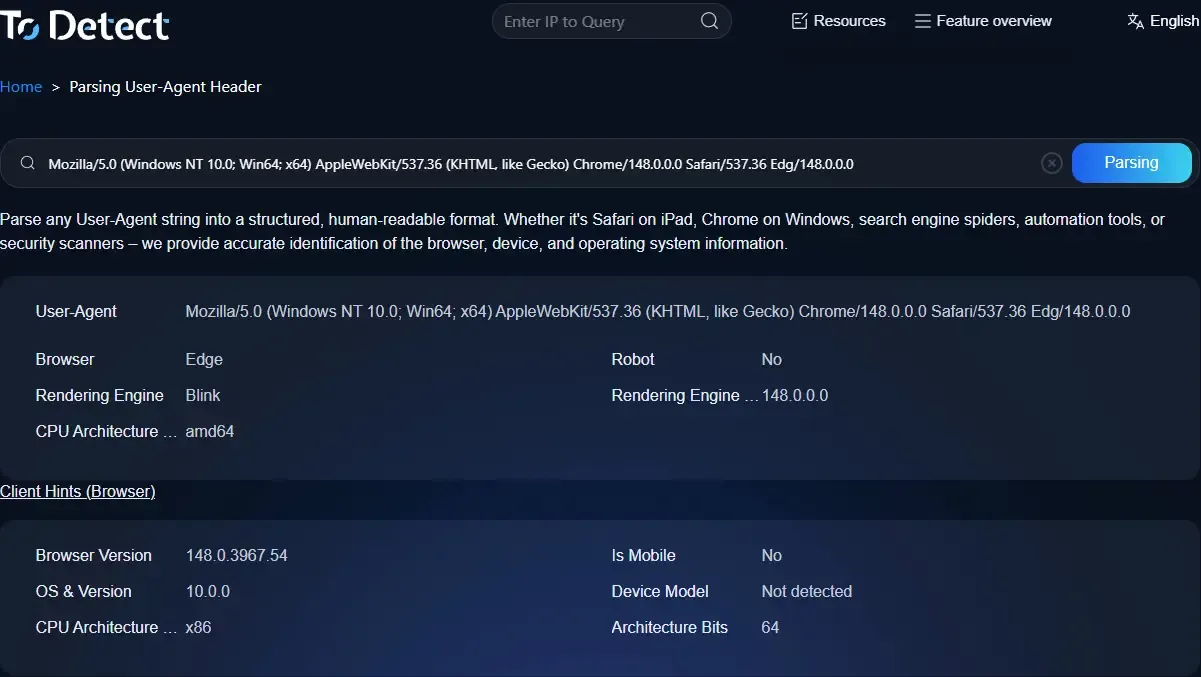
• Verify browser fingerprint uniqueness
• Analyze User-Agent parsing anomalies
• Detect bulk-operation characteristics
• Identify potential account association risks in advance
Especially for TikTok account matrices and cross-border e-commerce campaigns, detecting environment issues early with ToDetect is far more cost-effective than dealing with traffic restrictions later.
6. Frequently Asked Questions About User-Agent Parsing (TikTok Environment & Traffic)
1. If my TikTok traffic suddenly drops, does it necessarily mean there's a User-Agent issue?
Not necessarily, but abnormal User-Agent parsing is one of the most common causes. If you haven't changed your content recently but your views suddenly decline, the issue may be related to a mismatch between your User-Agent and device environment, browser fingerprint conflicts, or account association signals. It's recommended to check your environment first before analyzing content performance.
2. Why am I still not getting traffic even though ToDetect shows no issues?
ToDetect can help identify certain environment-related problems, but it doesn't guarantee that TikTok's risk-control system will fully trust your setup. TikTok's recommendation algorithm also considers behavioral signals such as watch time, engagement rates, and account activity patterns. In other words, "passing technical checks" does not always mean "earning platform trust."
3. Will multiple TikTok accounts using the same device be automatically restricted?
There is a significant risk. Even if you configure different User-Agent settings for each account, TikTok may still associate them if their browser fingerprints or device characteristics remain highly similar. A safer approach is to isolate account environments so that each account has its own independent setup.
4. Which has a greater impact on traffic: Browser Fingerprints or User-Agent?
User-Agent determines whether your device appears legitimate, while browser fingerprints help identify whether multiple accounts belong to the same operator. Together, they influence your account's credibility. Therefore, optimizing only one while ignoring the other is usually insufficient.
7. How Can You Truly Improve Recommendation Traffic?
If your account is currently stuck with low traffic, follow this troubleshooting process:
Step 1: Verify that your User-Agent parsing is consistent and accurately matches your device environment.
Step 2: Use analysis tools to check whether your browser fingerprint is duplicated or abnormal.
Step 3: Optimize your TikTok account environment and establish a "one account, one environment" strategy.
Step 4: Avoid frequently switching IP addresses or login devices.
Step 5: Maintain stable account activity and avoid constantly modifying environment parameters.
In many cases, it's not that TikTok refuses to give you traffic—it's that the system doesn't recognize your account as a normal user.
The Bottom Line
If your User-Agent parsing is inconsistent or your TikTok account environment contains conflicts, even high-quality content can end up trapped in low-traffic pools.
Today's TikTok is no longer a platform where you can simply upload videos and expect them to go viral. Success is determined by a combination of environment credibility, content quality, and authentic user behavior.
Building a successful overseas TikTok presence isn't about luck—it's about attention to detail. Once your environment is properly configured, your content finally has a real opportunity to gain momentum and scale.